


Search results
Search for "immunoadjuvant" in Full Text gives 1 result(s) in Beilstein Journal of Nanotechnology.
Venom-loaded cationic-functionalized poly(lactic acid) nanoparticles for serum production against Tityus serrulatus scorpion
Beilstein J. Nanotechnol. 2025, 16, 1633–1643, doi:10.3762/bjnano.16.115
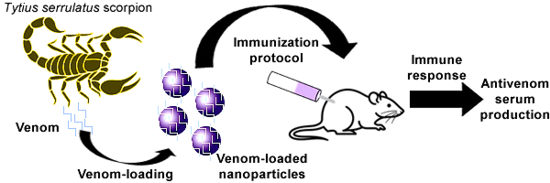
- polyethylenimine for loading peptides and proteins of T. serrulatus venom, and their use as a potential immunoadjuvant was evaluated. The protein loading efficiency of about 100% and the polyacrylamide gel electrophoresis assay confirmed the success of venom loading. Dynamic light scattering and zeta potential
- controlled by diffusion mechanism was also measured. Finally, in vivo immunization in BALB/c mice showed superior efficacy of the T. serrulatus venom protein-loaded nanoparticles compared to the traditional aluminum hydroxide immunoadjuvant. Thus, the formulations shown are promising nanocarriers to be used
- as a biotechnological approach to immunotherapy against scorpion envenomation. Keywords: cationic nanoparticles; immunoadjuvant; polyethylenimine; poly(lactic acid); Tityus serrulatus; Introduction Accidents caused by scorpion envenoming are recognized as an important public health problem in


Other Beilstein-Institut Open Science Activities



