


Search results
Search for "intense femtosecond laser" in Full Text gives 2 result(s) in Beilstein Journal of Nanotechnology.
Wavelength-dependent correlation of LIPSS periodicity and laser penetration depth in stainless steel
Beilstein J. Nanotechnol. 2025, 16, 1302–1315, doi:10.3762/bjnano.16.95
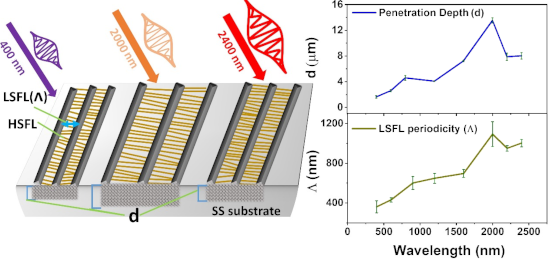
- determined at room temperature, which might not be appropriate for metals heated with intense femtosecond laser pulses. The LIPSS period becomes smaller when the stainless steel surface is rougher as the roughness increases the real part of the refractive index at the metal–air interface [61]. Variation of
- depth of LIPSS for the broadband in the existing literature. As we know, energy penetration depth under intense femtosecond laser irradiation can be described by the following equation: where d is the skin depth of the material, is the intensity-dependent complex refractive index, and is the
- ablation at all wavelengths. This slight variation in elements between the laser-treated and untreated samples can be attributed to the highly intense femtosecond laser and its interaction with matter and the fact that these low-atomic-weight species could have escaped from the system. Conclusion For the





Enhancement of X-ray emission from nanocolloidal gold suspensions under double-pulse excitation
Beilstein J. Nanotechnol. 2018, 9, 2609–2617, doi:10.3762/bjnano.9.242
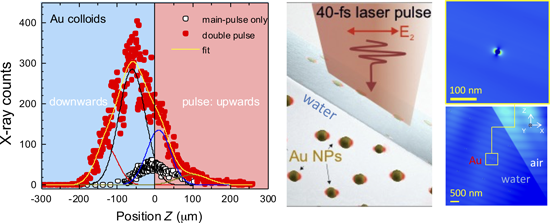
- was revealed that the volume around gold nanoparticles where the permittivity is near zero, ε ≈ 0, accounts for the strongest absorption, which leads to the effective enhancements of X-ray emission. Keywords: double pulse; gold nanoparticles; intense femtosecond laser; plasma; water; X-ray
- selectivity based on surface plasmon resonance [15]. An increase of the laser-absorption efficiency can be expected in plasmonic nanoparticles, which results in the efficient generation of highly ionized charge states [13][14]. It is expected that this characteristic interaction between intense femtosecond
- laser and plasmonic nanoparticles will contribute to a broad field of applications ranging from pulsed X-ray generation to energetic particle sources [14] or terahertz wave emission from aqueous solutions [16]. In recent experimental studies, intense fs-laser excitation of plasmonic gold nanoparticles


Other Beilstein-Institut Open Science Activities



