


Search results
Search for "laser-induced modification" in Full Text gives 2 result(s) in Beilstein Journal of Nanotechnology.
Laser ablation in liquids for shape-tailored synthesis of nanomaterials: status and challenges
Beilstein J. Nanotechnol. 2025, 16, 1963–1997, doi:10.3762/bjnano.16.137
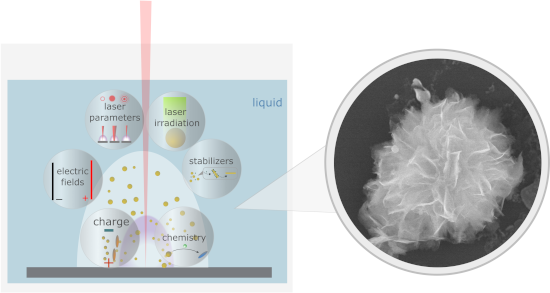
- by unfocused laser irradiation as a second step. This strategy has developed into several methods usually categorized as laser-induced fragmentation, laser-induced melting, or laser-induced modification. Such multistep processes open up ways for precise manipulation and fine tuning of NP parameters
- acetone. In the latter, no nanowires were observed in contrast to the alcohol solutions. In principle, further shape control strategies in laser-induced modification can be similar to that of laser ablation of a bulk solid target in liquid. For example, to add controllability to the laser modification
- process, additional stabilizers can be added to the solution during laser-induced modification of NPs. Such an approach allowed Sebastian et al. [87] to transform silver nanospheres to nanowires by nanosecond laser irradiation in a polyvinyl pyrrolidone (PVP) solution in ethanol. The authors underline the




Influence of laser beam profile on morphology and optical properties of silicon nanoparticles formed by laser ablation in liquid
Beilstein J. Nanotechnol. 2025, 16, 1533–1544, doi:10.3762/bjnano.16.108
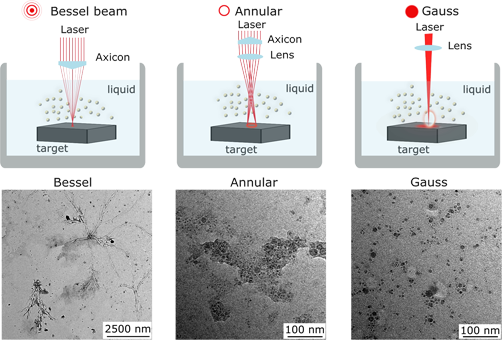
- morphology. The synthesized colloidal Si NPs are suggested for applications as a component of electrode materials in supercapacitors and batteries. Keywords: laser ablation; laser beams with Bessel, annular, Gaussian profiles; laser-induced modification; silicon nanoparticles; Introduction Silicon, due to


Other Beilstein-Institut Open Science Activities



