


Search results
Search for "liquid–liquid interface" in Full Text gives 7 result(s) in Beilstein Journal of Nanotechnology.
Interface-engineered Caco-2 cell culture on a collagen-coated liquid–liquid interface in a microfluidic device
Beilstein J. Nanotechnol. 2026, 17, 760–768, doi:10.3762/bjnano.17.53
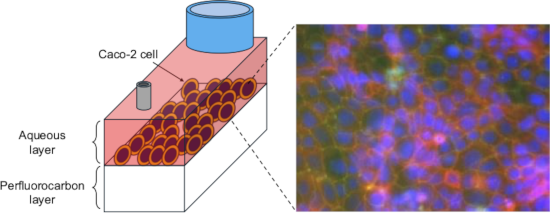
- substrates, which limit the physicochemical flexibility of the cellular microenvironment. Here, we introduce a microfluidic platform in which a collagen-coated liquid–liquid interface formed between perfluorocarbon (FC-43) and culture medium serves as a substrate for epithelial cell adhesion. By culturing
- enables the formation of stable liquid–liquid interfaces that serve as viable and flexible substrates for epithelial cell culture, offering new opportunities for multiphase microfluidic models of epithelial barriers. Keywords: Caco-2; collagen; FC-43; gut-on-a-chip; liquid–liquid interface; Introduction
- rigidity and pore-related constraints inherent to synthetic solid membranes [8][9][10]. Importantly, culturing cells at a liquid–liquid interface provides a unique opportunity to decouple biochemical signaling from substrate-imposed mechanical constraints, thereby enabling more physiologically relevant


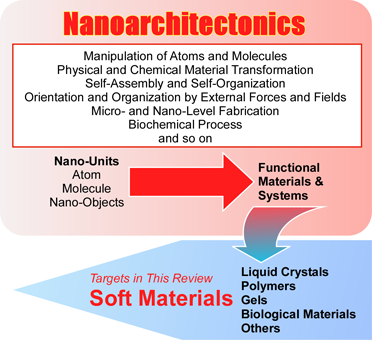
Soft materials nanoarchitectonics: liquid crystals, polymers, gels, biomaterials, and others
Beilstein J. Nanotechnol. 2025, 16, 1025–1067, doi:10.3762/bjnano.16.77






A biomimetic approach towards a universal slippery liquid infused surface coating
Beilstein J. Nanotechnol. 2024, 15, 1376–1389, doi:10.3762/bjnano.15.111
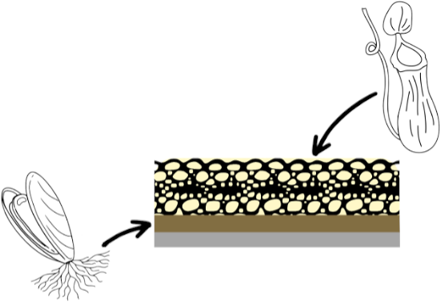
- pitcher-like feature, where they are digested by the plant. Like the pitcher plant surfaces, SLIPS can repel adhesion through the formation of a liquid–liquid interface, unlike more standard surface passivation techniques that consist of a solid–liquid interface [16]. Within a SLIPS coating, a lubricant




Interfacial nanoarchitectonics for ZIF-8 membranes with enhanced gas separation
Beilstein J. Nanotechnol. 2022, 13, 313–324, doi:10.3762/bjnano.13.26
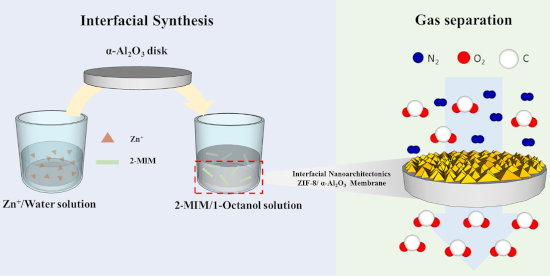
- -octanol solution was added dropwise to the zinc nitrate solution. The mixture was kept at 80 °C in an oil bath for 12 h to form a ZIF-8 free-standing thin film on the liquid–liquid interface. After the reaction, fragments of the ZIF-8 thin film were dispersed in methanol to remove solvents and unreacted
- decreased to 2 μm when the reaction temperature increased to 120 °C (Figure 3f). The thinner membrane thickness can also be attributed to the disturbed liquid–liquid interface during synthesis. The growth of ZIF-8 crystals was also investigated regarding different reaction times. The SEM images showed that
- reaction temperature led to higher crystallinity. A further increase of the reaction temperature to 120 °C caused a decrease of the separation factor to 1.77, which was due to the unstable liquid–liquid interface under boiling. In addition, the elevated temperature increased water/1-octanol solubility and


A review on slip boundary conditions at the nanoscale: recent development and applications
Beilstein J. Nanotechnol. 2021, 12, 1237–1251, doi:10.3762/bjnano.12.91
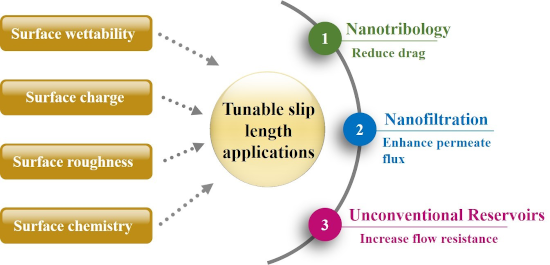
- at the liquid–liquid interface with a thin immobile liquid layer in the vicinity of the solid surface. In practice, however, the actual flow system is complex owing to the heterogeneous and rough surfaces, or to the existence of gas bubbles. Therefore, the slip length may be nonuniformly distributed


Materials nanoarchitectonics at two-dimensional liquid interfaces
Beilstein J. Nanotechnol. 2019, 10, 1559–1587, doi:10.3762/bjnano.10.153
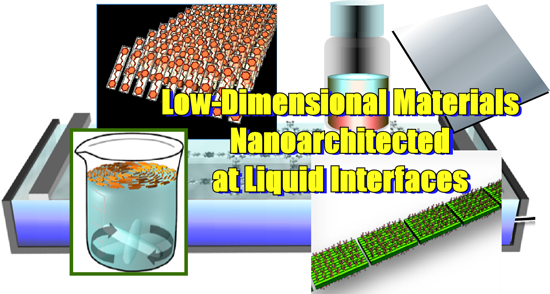
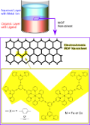
- -workers [226] were one of the first representative examples for interfacially polymerized MOF films at the liquid–liquid interface. Two immiscible phases of water and dichloromethane spatially segregate nickel acetate, a metal node precursor, from benzenehexathiol (BHT, a coordinating linker) and confine
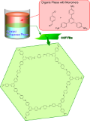
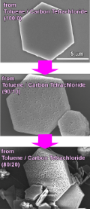
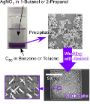
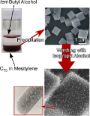
- at the liquid–liquid interface. For example, C60 rods or needles can be obtained at the interface between a saturated solution of C60 in toluene and isopropyl alcohol as poor solvent. 4.2 One-dimensional fullerene assembly materials Shrestha and co-workers have extended the research on dimensionally
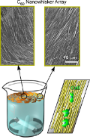
- conversion of one-dimensional fullerene crystalline assemblies at extremely high temperatures resulted in highly graphitic one-dimensional carbon materials as demonstrated by Shrestha and co-workers [242]. One-dimensional C60 nanorods and nanotubes precipitated at liquid–liquid interface were fully













Controlled graphene oxide assembly on silver nanocube monolayers for SERS detection: dependence on nanocube packing procedure
Beilstein J. Nanotechnol. 2016, 7, 9–21, doi:10.3762/bjnano.7.2
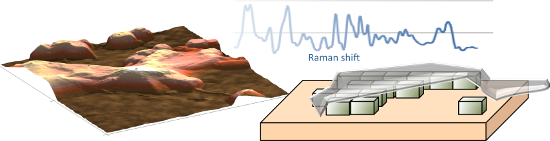
- , electrostatic layer-by-layer adsorption and formation of nanoparticle films at the liquid−liquid interface [23][24][25][26]. In the latter case, assembly of uncapped nanoparticles generally leads to the formation of loosely packed aggregates and linking functionalities must be employed to decrease the
- is suppressed. Although the weak absorbance does not allow for an unequivocal conclusion, similar results were recently obtained also by Park et al. [49] for NC horizontal transfer on silicon oxide substrates from the liquid–liquid interface. In the absence of a suitable linking functionality the
- derivatives and nanoparticles including metal evaporation, electrochemical deposition and layer-by-layer self-assembly techniques [51]. Zarbin's group [20] directly synthesized and assembled silver nanoparticle/graphene oxide nanocomposites at a water/toluene liquid–liquid interface whereas Wang et al. [52


Other Beilstein-Institut Open Science Activities



