


Search results
Search for "materials modelling" in Full Text gives 2 result(s) in Beilstein Journal of Nanotechnology.
Instance maps as an organising concept for complex experimental workflows as demonstrated for (nano)material safety research
Beilstein J. Nanotechnol. 2025, 16, 57–77, doi:10.3762/bjnano.16.7

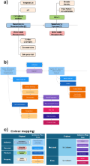
- materials characterisation experts, to facilitate collaboration with industry end users, and to optimise the interoperability of data and, thus, enable better data reuse by modelling experts. Likewise, efforts are ongoing to harmonise the (ii) materials MOdelling DAta terminology, resulting in templates for
- physics-based model description, termed MODA [44], driven by the activities of the European Materials Modelling Council (EMMC), resulting in a workshop agreement of the European Committee for Standardization (CEN). Instance maps can support this effort by graphically resolving reporting documents as they


Integrating high-performance computing, machine learning, data management workflows, and infrastructures for multiscale simulations and nanomaterials technologies
Beilstein J. Nanotechnol. 2024, 15, 1498–1521, doi:10.3762/bjnano.15.119
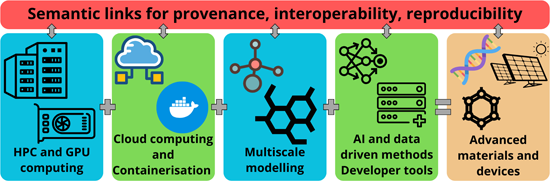
- digital methodologies in advanced research. Keywords: artificial intelligence; high-performance computing; HPC; machine learning; materials modelling; multiscale modelling; nanomaterials; semantic data management; Introduction Digital technologies have ushered in a new era of materials science, enabling
- technologies and advanced algorithms, researchers can automate different aspects of the materials modelling process, from data generation to model selection and parameter optimization [7][40][41]. Furthermore, automation enables the integration of experimental data with computational models, facilitating the
- computational workflows and minimizes manual effort. This automation not only improves efficiency but also enhances reproducibility and reduces the potential for human error. User-friendliness of software platforms and frameworks used for materials modelling tasks has also significantly improved in recent years


Other Beilstein-Institut Open Science Activities



