


Search results
Search for "mechanical property measurements" in Full Text gives 4 result(s) in Beilstein Journal of Nanotechnology.
Mechanical property measurements enabled by short-term Fourier-transform of atomic force microscopy thermal deflection analysis
Beilstein J. Nanotechnol. 2025, 16, 1952–1962, doi:10.3762/bjnano.16.136
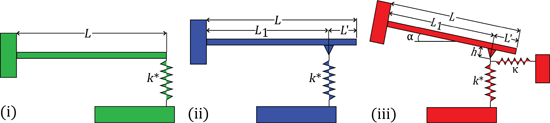
- ); mechanical property measurements; surface science; Introduction Atomic force microscopy (AFM) has become an indispensable tool for imaging the surface topography on a variety of surfaces [1]. Since the invention of the AFM [2], several other modes of AFM have been developed, including friction force


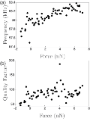


Enhanced feedback performance in off-resonance AFM modes through pulse train sampling
Beilstein J. Nanotechnol. 2024, 15, 134–143, doi:10.3762/bjnano.15.13
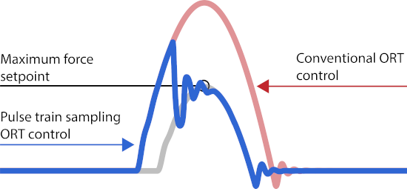
- contrast mapping of the sample in real time. However, the topography feedback error should be minimized to reduce the effect of sample topography on the mechanical property measurements. For example, the dissipated energy on the sample, simply the integral of the area between the approach and the retract


Nanoscale spatial mapping of mechanical properties through dynamic atomic force microscopy
Beilstein J. Nanotechnol. 2019, 10, 1332–1347, doi:10.3762/bjnano.10.132
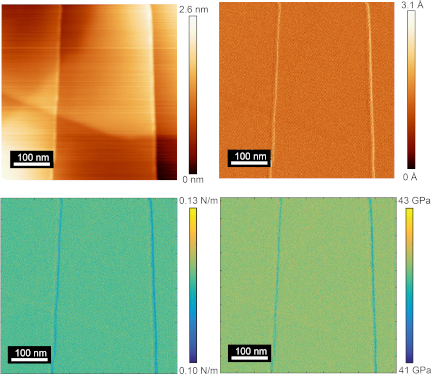
- (FMM) and contact resonance (CR) AFM, will allow for the overarching goal of nanoscale mechanical property measurements to be realized. In FMM, the tip is pressed into contact with the surface and oscillated at a frequency off resonance. The obtained variations in the measured amplitude of the
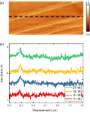
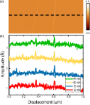
- the acquired phase images in CR-AFM or FMM-AFM results, suggesting no additional viscoelastic energy losses from modulating the applied load during scanning at the step edge. Thus, the presence of the Schwoebel barrier did not significantly impact the mechanical property measurements. We further




Relationships between chemical structure, mechanical properties and materials processing in nanopatterned organosilicate fins
Beilstein J. Nanotechnol. 2017, 8, 863–871, doi:10.3762/bjnano.8.88
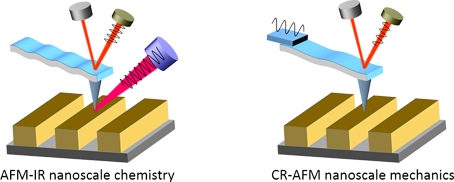
- with contact resonance AFM (CR-AFM) [29] mechanical property measurements in the investigation of 20–500 nm wide fin structures fabricated in a nanoporous organosilicate thin film. Nanoporous organosilicates are of significant importance to the electronics industry for reducing various parasitic
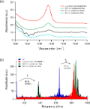
- removal and reinsertion of terminal organic (CH3) groups in the matrix. Further examination of this effect as a function of fin width and additional recently demonstrated depth-profiling CR-AFM mechanical property measurements [34] indicate that the loss of CH3 groups and the increase of mechanical



Other Beilstein-Institut Open Science Activities



