


Search results
Search for "membrane rigidity" in Full Text gives 4 result(s) in Beilstein Journal of Nanotechnology.
Ferroptosis induction by engineered liposomes for enhanced tumor therapy
Beilstein J. Nanotechnol. 2025, 16, 1325–1349, doi:10.3762/bjnano.16.97
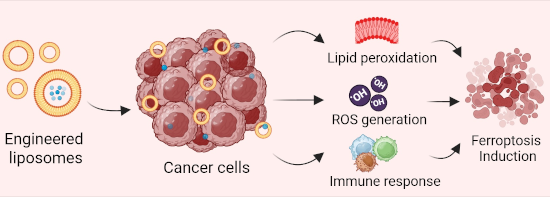
- helps organize lipid chains and regulates membrane rigidity and flexibility, which affects several functions, including liposome lifespan and controlled cargo release [108]. Liposomes are highly biocompatible, making them ideal for the targeted delivery of drugs to tumor sites. By encapsulating both


Mechanical stability of individual bacterial cells under different osmotic pressure conditions: a nanoindentation study of Pseudomonas aeruginosa
Beilstein J. Nanotechnol. 2025, 16, 1171–1183, doi:10.3762/bjnano.16.86
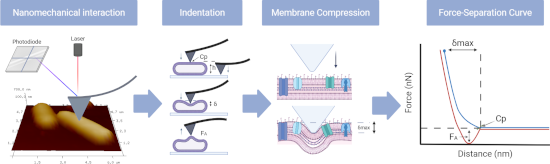
- provided Young’s moduli in the range of 0.7–1.1 kPa. Implications of the presented results with previously reported data in the literature are discussed. Keywords: AFM; force spectroscopy; membrane rigidity; nanomechanical mapping; osmotic shock; Introduction Pseudomonas aeruginosa (PA) is a Gram
- concentration and before the previous deposition of 5 μL on the PLL-coated substrate. A liquid cell was assembled to measure changes in bacterial membrane rigidity response when transitioning between different solutions. Once inside the fluid cell chamber, bacteria were imaged and tested in PBS solution and
- obtain the mechanical response from the membrane rigidity within a reversible regime. The advantage of mapping bacteria at low loading forces is that surface interactions between the tip and cell membrane can be analyzed, and information related to its adhesion or surface charge could be revealed with


Mechanistic insights into endosomal escape by sodium oleate-modified liposomes
Beilstein J. Nanotechnol. 2024, 15, 1667–1685, doi:10.3762/bjnano.15.131
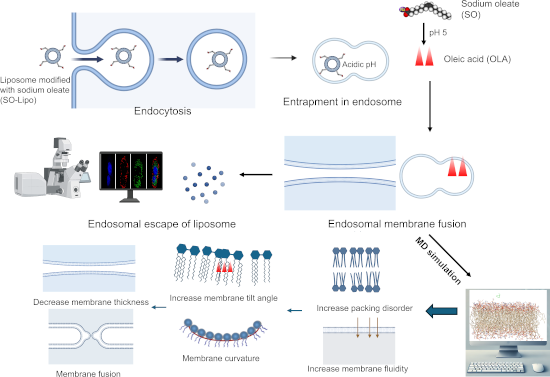
- in maintaining membrane integrity by interacting mainly with the headgroup region. In addition to the previous membrane analysis, the deuterium order parameter (SCD) in Figure 9 offers a detailed analysis of lipid alkyl chain alignment within the membrane, reflecting changes in membrane rigidity and




Microfluidic manufacturing of different niosomes nanoparticles for curcumin encapsulation: Physical characteristics, encapsulation efficacy, and drug release
Beilstein J. Nanotechnol. 2019, 10, 1826–1832, doi:10.3762/bjnano.10.177
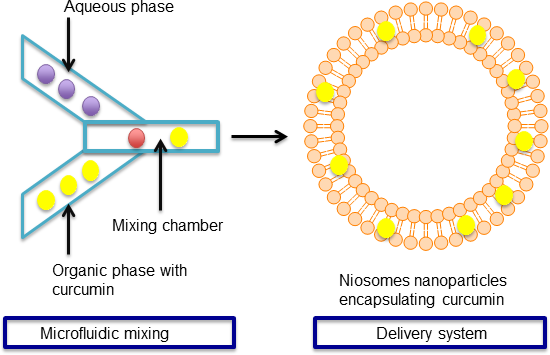
- concentration of chol and the non-ionic surfactant in the final niosome formulations. The presence of chol is a key factor that controls membrane rigidity. Higher chol concentrations results in a less permeable and more rigid bilayer membrane. Moreover, the encapsulation of hydrophobic molecules is highly


Other Beilstein-Institut Open Science Activities



