


Search results
Search for "meso-tetrakis(p-hydroxyphenyl)porphyrin" in Full Text gives 1 result(s) in Beilstein Journal of Nanotechnology.
A redox-responsive viologen–cavitand nanocarrier for dual-function photodynamic therapy
Beilstein J. Nanotechnol. 2026, 17, 1142–1158, doi:10.3762/bjnano.17.78
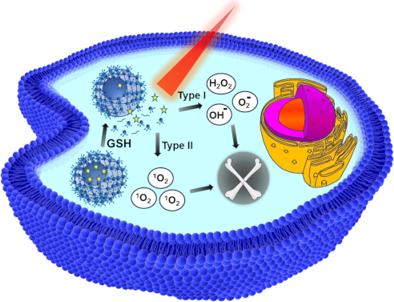
- this, we developed a redox-responsive polymeric nanocarrier through free-radical polymerization of a pre-assembled micellar ensemble. This ensemble formed spontaneously in aqueous solution by encapsulating the hydrophobic photosensitizer meso-tetrakis(p-hydroxyphenyl)porphyrin within a core composed of
- cell death mechanisms were confirmed by flow cytometry and fluorescence microscopy, establishing the developed redox-responsive system as an effective candidate for targeted photodynamic therapy. Keywords: glutathione-triggered release; meso-tetrakis(p-hydroxyphenyl)porphyrin; photodynamic therapy
- -Tetrakis(p-hydroxyphenyl)porphyrin (THPP) has been extensively studied as an isomer of temoporfin, marketed under the trade name Foscan®. However, unlike its meta-isomer, THPP was halted at the preclinical testing stage in favor of Foscan® development [19][20]. Due to the presence of p-hydroxyphenyl groups


Other Beilstein-Institut Open Science Activities



