


Search results
Search for "nanobiosensor" in Full Text gives 5 result(s) in Beilstein Journal of Nanotechnology.
Optical bio/chemical sensors for vitamin B12 analysis in food and pharmaceuticals: state of the art, challenges, and future outlooks
Beilstein J. Nanotechnol. 2025, 16, 2207–2244, doi:10.3762/bjnano.16.153
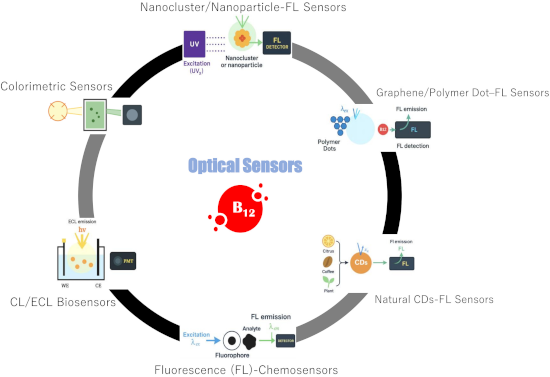
- ; molecularly imprinted polymers (MIPs); nanobiosensor; Introduction Micronutrients including vitamins and minerals play key roles in modulating body growth, preventing a wide range of diseases and disorders, and maintaining general health and wellness [1][2]. Apart from vitamin D, which the body can


Nanomaterials in targeting amyloid-β oligomers: current advances and future directions for Alzheimer's disease diagnosis and therapy
Beilstein J. Nanotechnol. 2025, 16, 561–580, doi:10.3762/bjnano.16.44
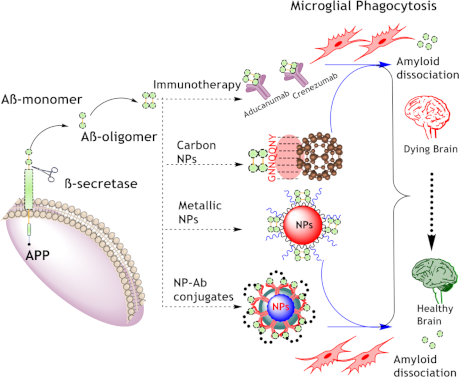
- improved associated neurotoxicity [52]. Shifting from imaging to electrochemical approaches, researchers have developed biosensors comprising immobilized thiolated PrPC peptides on a graphene oxide/gold nanoparticle hydrogel electrode. This nanobiosensor displayed high specificity and sensitivity for
- electrochemical detection of AβOs via a nanobiosensor consisting of gold nanoparticles (AuNPs) embedded in a conductive polymeric matrix. For this, the surface of the AuNPs was further modified with PrPc, which acted as the biorecognition element for the specific detection of AβOs in ex vivo real samples, viz


New application of bimetallic Ag/Pt nanoplates in a colorimetric biosensor for specific detection of E. coli in water
Beilstein J. Nanotechnol. 2024, 15, 95–103, doi:10.3762/bjnano.15.9
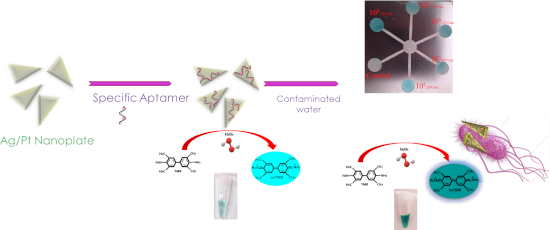
- . This nanobiosensor has the ability to specifically bind to E. coli, increasing the peroxidase activity of the apt-Ag/Pt NPL. Finally, the blue color of the solution in the contaminated water samples was increased in the presence of 3,3′,5,5′-tetramethylbenzidine (TMB) as a substrate and H2O2. The assay
- nanobiosensor as well as a paper-based analytical equipment for detecting E. coli. The E. coli could be trapped by the aptamer-NPL to create bacteria–aptamers–Ag/Pt NPL complexes in which the aptamers effectively change on the surface of Ag/Pt NPL. Surprisingly, in the conventional TMB and H2O2 color reaction


Rapid and sensitive detection of box turtles using an electrochemical DNA biosensor based on a gold/graphene nanocomposite
Beilstein J. Nanotechnol. 2022, 13, 1458–1472, doi:10.3762/bjnano.13.120
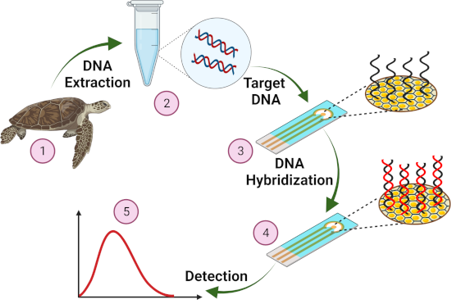
- with AuNPs. Finally, a biosensor was developed, integrating that probe sequence into a nanocomposite-modified SPCE to detect C. amboinensis. In addition, the developed in silico probe-based electrochemical nanobiosensor was validated in a wet-lab experiment. It was then tested to see if it could

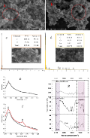


A novel electrochemical nanobiosensor for the ultrasensitive and specific detection of femtomolar-level gastric cancer biomarker miRNA-106a
Beilstein J. Nanotechnol. 2016, 7, 2023–2036, doi:10.3762/bjnano.7.193
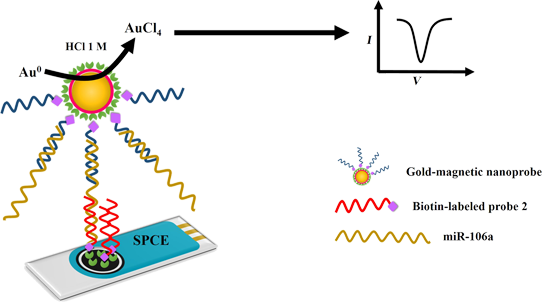
- malignancies, especially in GC. In this study, an ultrasensitive electrochemical nanobiosensor was developed for the detection of miR-106a using a double-specific probe methodology and a gold–magnetic nanocomposite as tracing tag. The successful modification of the electrode and hybridization with the target
- relationship with the concentration of the target miRNA ranging from 1 × 10⁻³ pM to 1 × 10³ pM, and the detection limit was 3 × 10⁻⁴ pM. The proposed miRNA-nanobiosensor showed remarkable selectivity, high specificity, agreeable storage stability, and great performance in real sample investigation with no
- pretreatment or amplification. Consequently, our biosensing strategy offers such a promising application to be used for clinical early detection of GC and additionally the screen of any miRNA sequence. Keywords: electrochemical nanobiosensor; gastric cancer; gold–magnetic nanoparticle; miR-106a; Introduction


Other Beilstein-Institut Open Science Activities



