


Search results
Search for "nanoglass" in Full Text gives 5 result(s) in Beilstein Journal of Nanotechnology.
Nanoglasses: a trail towards uncharted regions of vitreous materials and their properties?
Beilstein J. Nanotechnol. 2026, 17, 1047–1062, doi:10.3762/bjnano.17.72

- , and stability are identified, emphasizing opportunities for integrating nanoglasses into advanced functional thin-film systems. Keywords: columnar thin-film nanoglasses; glass–glass interfaces; mechanical and functional properties; nanoglass; stability; Introduction The advancement of civilization
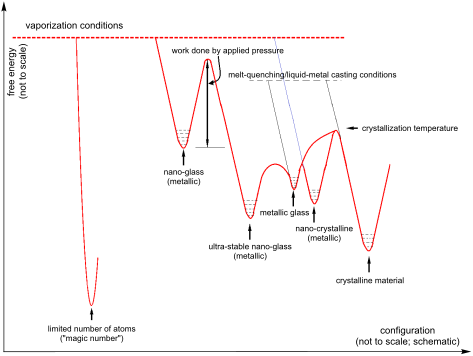
- –glass interfaces might allow, in principle, for even more structural variability. Thus, an energy landscape of a nanoglass might bear similarity with the schematic indicated in the lower part of Figure 1. As indicated therein and in the corresponding figure caption, new relaxation states exist for the
- nanoglass, and particularly the material residing in glass–glass interfaces, is not confined to the configuration space accessible to glasses made by cooling a liquid through its glass transition, there is no general rule that confines its excess entropy to the same range as for melt-quenched glasses


Au55, a stable glassy cluster: results of ab initio calculations
Beilstein J. Nanotechnol. 2017, 8, 2221–2229, doi:10.3762/bjnano.8.222
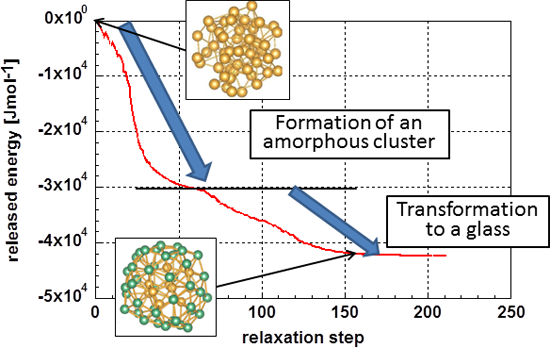
- initio calculations performed within this study confirm the experimental results: (i) The most stable configuration of the Au55 cluster is not crystalline. This cluster is composed of two shells surrounding a central atom. With high probability this cluster is glassy, a “nanoglass” according to Gleiter


Influence of grain size and composition, topology and excess free volume on the deformation behavior of Cu–Zr nanoglasses
Beilstein J. Nanotechnol. 2015, 6, 537–545, doi:10.3762/bjnano.6.56
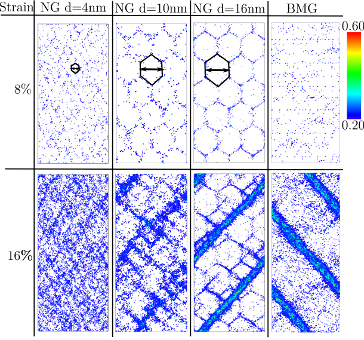
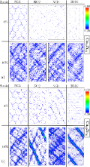
- interfaces are very different from the bulk phase. After thermal treatment the redistribution of free volume leads to a more homogenous deformation behavior. The deformation behavior of the softer Zr-rich nanoglass, in contrast, is only weakly affected by the presence of glass–glass interfaces, since the
- ; Introduction A nanoglass (NG) is a nanostructured material produced via cold compaction of glassy nanoparticles [1]. It consists of glassy grains separated by glass–glass interfaces. Indirect experimental evidence for the existence of interfaces in NGs have been provided by Gleiter et al. [2][3][4][5][6][7
- ]. The recent work of Chen et al. [8], supports Gleiter’s results on the structural model of a NG. The microstructure of a metallic nanoglass consisting of glassy grains and glass–glass interfaces has been experimentally revealed by electron microscopy, small-angle X-ray scattering and positron



On the structure of grain/interphase boundaries and interfaces
Beilstein J. Nanotechnol. 2014, 5, 1603–1615, doi:10.3762/bjnano.5.172



Nanoglasses: a new kind of noncrystalline materials
Beilstein J. Nanotechnol. 2013, 4, 517–533, doi:10.3762/bjnano.4.61
- by (1) controlling the size of the glassy regions (i.e., the volume fraction of the interfacial regions) and/or (2) by varying their chemical composition. Nanoglasses exhibit new properties, e.g., a Fe90Sc10 nanoglass is (at 300 K) a strong ferromagnet whereas the corresponding melt-quenched glass is
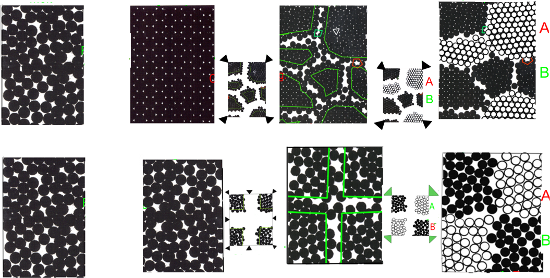
- materials (Figure 3c and Figure 3g), the glass shown in Figure 3g is called a nanoglass. Again, if we consolidate nanometer-sized glassy clusters of different chemical compositions (Figure 3h), we obtain a multiphase nanoglass that is microstructurally analogous to the multiphase nanocrystalline material
- shown in Figure 3d. Hence, this kind of glass is called a multiphase nanoglass. Production of nanoglasses So far, nanoglasses have been produced in the following three ways: Inert-gas condensation One way to produce nanoglasses is by means of inert-gas condensation (Figure 4). This production process






Other Beilstein-Institut Open Science Activities



