


Search results
Search for "nanospiral" in Full Text gives 1 result(s) in Beilstein Journal of Nanotechnology.
He+ FIBID-fabricated 3D AFM tip architectures: an exploratory study of hollow pillars, helices, and spirals
Beilstein J. Nanotechnol. 2026, 17, 863–871, doi:10.3762/bjnano.17.62
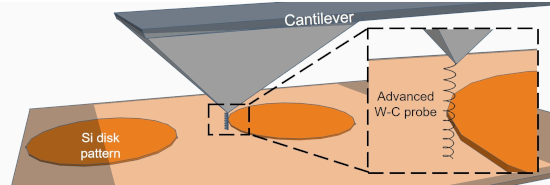
- required. Keywords: 3D-printed tips; AFM tips; beam induced nanomanufacturing; focused ion beam induced deposition (FIBID); helium ion microscope; nanohelix; nanopillar; nanospiral; scanning tip microscopy; surface topography; tungsten carbide; Introduction The atomic force microscope (AFM) is a
- μm and an approximate tip radius of 23 nm. Nanopillar structures span a broader height range, from 0.22 to 3.19 μm, with a similar tip radius of about 23 nm. Nanospiral tips are shorter, with heights between 0.05 and 0.22 μm, and exhibit a smaller approximate tip radius of 15 nm. Because of the
- exhibited distinct degradation behaviours. Hollow nanopillars showed a higher tendency to fracture during the initial approach, consistent with the larger bending moments expected for slender vertical structures. Nanospiral tips were more susceptible to progressive geometric deformation. Nanohelices showed


Other Beilstein-Institut Open Science Activities



