


Search results
Search for "organic nanoparticles" in Full Text gives 9 result(s) in Beilstein Journal of Nanotechnology.
Molecular engineering of individual dye-based nanoparticle photostability for ultrabright two-photon fluorescence
Beilstein J. Nanotechnol. 2026, 17, 688–696, doi:10.3762/bjnano.17.48
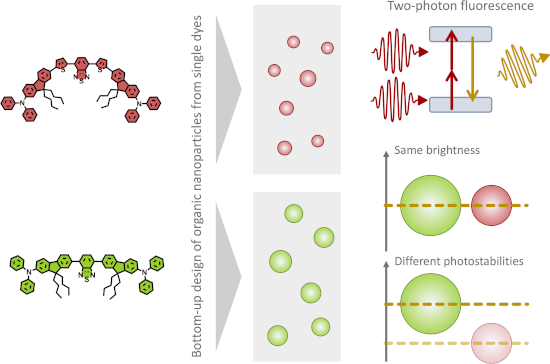
- , CentraleSupélec, LuMIn, 91190 Gif-sur-Yvette, France 10.3762/bjnano.17.48 Abstract Dye-based fluorescent organic nanoparticles (dFONs) represent a promising class of bioimaging probes combining high brightness with molecular tunability. While their fluorescence performance is well established for one-photon
- significantly faster, confirming the trade-off between absorption efficiency and photostability. These results demonstrate that the photophysical behavior of dFONs can be rationally engineered at the molecular level and provide design principles for the development of optimized organic nanoparticles for
- nonlinear fluorescence microscopy and bioimaging applications. Keywords: bottom-up design; organic nanoparticles; two-photon fluorescence; two-photon microscopy; Introduction Dye-based fluorescent organic nanoparticles (dFONs) are a class of self-stabilized bioimaging probes composed solely of aggregated


Enhancing the therapeutical potential of metalloantibiotics using nano-based delivery systems
Beilstein J. Nanotechnol. 2025, 16, 1350–1366, doi:10.3762/bjnano.16.98
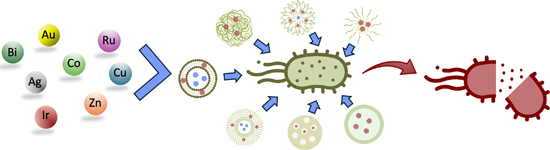
- targeted therapeutic effect, and the desired release rate. The most common encapsulation nanosystems are represented in Figure 2. Organic nanoparticles Lipid-based nanoparticles. Liposomes: Liposomes are versatile lipid-based nanoparticles that have gained prominence in drug delivery systems due to their


Biomimetic nanocarriers: integrating natural functions for advanced therapeutic applications
Beilstein J. Nanotechnol. 2024, 15, 1619–1626, doi:10.3762/bjnano.15.127

- (B), characteristics of cell membranes (C), and biomimetic nanocarriers (D). Created in BioRender. Sodré, B. (2024) https://BioRender.com/n85g617. This content is not subject to CC BY 4.0. Action of biomimetic nanocarriers. Inorganic and organic nanoparticles with transport function (A); target with


Fluorescent bioinspired albumin/polydopamine nanoparticles and their interactions with Escherichia coli cells
Beilstein J. Nanotechnol. 2023, 14, 1208–1224, doi:10.3762/bjnano.14.100
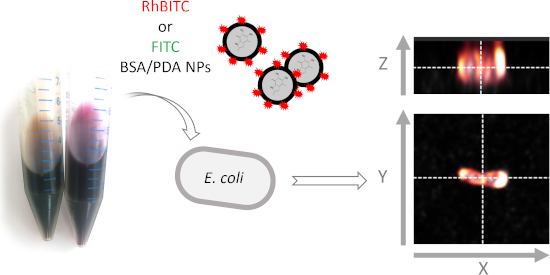
- labelled BSA/PDA NPs to track bacteria and carry drugs in the core of bacterial cells. Keywords: accumulation; albumin; antibacterial; Escherichia coli; fluorescence; nanoparticles; penetration; polydopamine; Introduction Organic nanoparticles (ONPs) are used to target and deliver drugs to tissue and
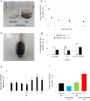
- (inspired from [14]). (e) Possible locations of organic nanoparticles in bacterial cells. Figure 1c was adapted with permission from [13]. Copyright 2018 American Chemical Society. This content is not subject to CC BY 4.0. (a) Photographic image of a dopamine solution. Main reactions leading to an auto



Self-assembly of amino acids toward functional biomaterials
Beilstein J. Nanotechnol. 2021, 12, 1140–1150, doi:10.3762/bjnano.12.85
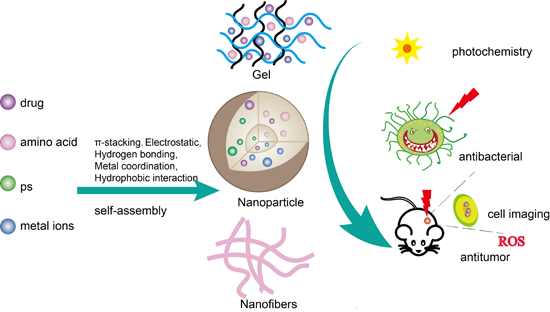
- , indicating that hMSCs had a high viability in the supramolecular hydrogel formed by NI-Phe. Sarkar et al. synthesized amphiphilic molecules containing NI and histidine which formed fluorescent organic nanoparticles with J-aggregation in water/DMSO, exhibiting high emissivity upon aggregation. These particles

Non-agglomerated silicon–organic nanoparticles and their nanocomplexes with oligonucleotides: synthesis and properties
Beilstein J. Nanotechnol. 2018, 9, 2516–2525, doi:10.3762/bjnano.9.234
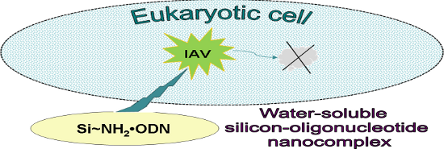
- ; non-agglomerated silicon–organic nanoparticles; penetration; Si–NH2·ODN nanocomplexes; Introduction The development of efficient and convenient systems for the delivery of nucleic-acid-based drugs into cells is an urgent task. The solution to this problem would allow for the use of these drugs in
- . The adsorption was held for one minute at room temperature; the remaining fluid was blown by air. The results are shown in Figure 4. Preparation of silicon–organic nanoparticles and Si–NH2·ODN nanocomplexes APTES (8 mL, 34.16 mmol) was added dropwise to 100 mL of hot (70 °C) water. The mixture was


Self-assembly of chiral fluorescent nanoparticles based on water-soluble L-tryptophan derivatives of p-tert-butylthiacalix[4]arene
Beilstein J. Nanotechnol. 2017, 8, 1825–1835, doi:10.3762/bjnano.8.184
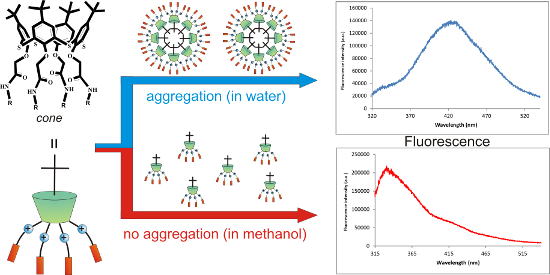
- creating fluorescent organic nanoparticles. Special attention is focused on the use of building blocks for the preparation of the nanoparticles from the macrocyclic compounds such as cyclodextrins, cucurbit[n]uriles, calix[n]arenes, pillar[n]arenes and others [13][14][15][16][17][18][19][20][21][22][23][24



Sonochemical co-deposition of antibacterial nanoparticles and dyes on textiles
Beilstein J. Nanotechnol. 2016, 7, 1–8, doi:10.3762/bjnano.7.1
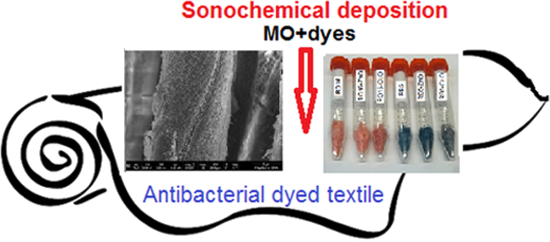
- is presented in Figure 4a. Under ultrasound irradiation the dye molecules form NPs which are deposited onto the surface of the textile. The creation of organic nanoparticles from their solution by sonochemical method was previously described by our group [25][26]. The HRSEM images of the fabric




Overview about the localization of nanoparticles in tissue and cellular context by different imaging techniques
Beilstein J. Nanotechnol. 2015, 6, 263–280, doi:10.3762/bjnano.6.25
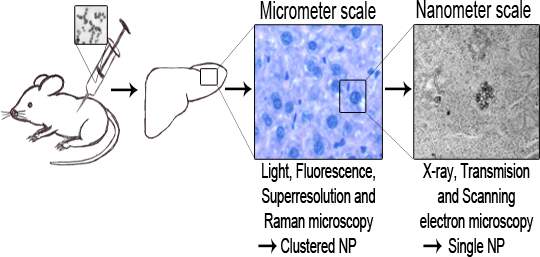
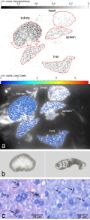
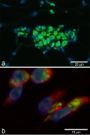
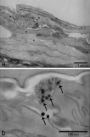
- their sites of interaction with living structures is essential to complete the picture. In this review we will describe and compare different imaging techniques for localizing inorganic as well as organic nanoparticles in tissues, cells and subcellular compartments. The visualization techniques include



Other Beilstein-Institut Open Science Activities



