


Search results
Search for "oxidative dehydrogenation" in Full Text gives 3 result(s) in Beilstein Journal of Nanotechnology.
Gold nanoparticle-decorated reduced graphene oxide as a highly effective catalyst for the selective α,β-dehydrogenation of N-alkyl-4-piperidones
Beilstein J. Nanotechnol. 2026, 17, 218–238, doi:10.3762/bjnano.17.15
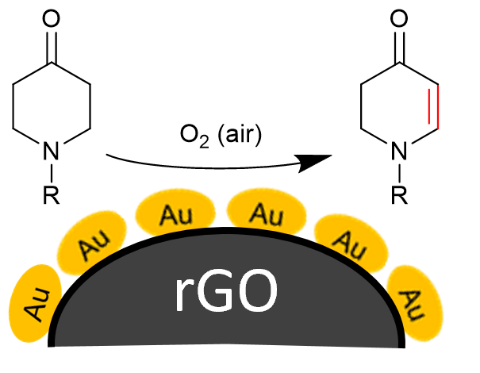
- reduced graphene oxide (AuNPs/rGO) were demonstrated to be a highly reactive catalyst for the selective α,β-oxidative dehydrogenation (ODH) of N-alkyl-4-piperidones, using N-methyl-, N-ethyl- and N-benzyl-4-piperidone. The substrate N-methyl-4-piperidone represents a pharmaceutically relevant system as
- the dehydrogenation of β-N-substituted saturated ketones and other fine chemical applications. Keywords: oxidative dehydrogenation; reduced graphene oxide; supported gold nanoparticles; β-N-substituted ketones; Introduction The properties related to the high surface area of matter at the nanometric
- POMs, the latter trivacant species exhibits the highest Au-POM reactivity in the oxidative dehydrogenation of piperidone derivatives to the corresponding enaminones [13]. Through the oxygen atoms at its three vacant sites, SiW9 coordinates to gold metal atoms, forming strong interactions. Despite being


Thermal control of the defunctionalization of supported Au25(glutathione)18 catalysts for benzyl alcohol oxidation
Beilstein J. Nanotechnol. 2019, 10, 228–237, doi:10.3762/bjnano.10.21
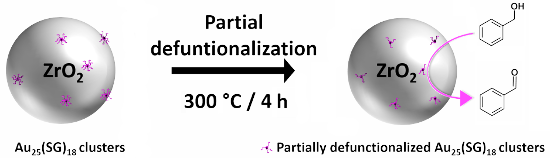
- below, with a narrow size distribution, upon calcination at temperatures up to 400 °C with 0.7 wt % Au loading. Catalytic performance The catalytic activity of Au25(SG)18@ZrO2, calcined at different temperatures, was studied for the oxidative dehydrogenation of benzyl alcohol to benzaldehyde in the
- value in the oxidative dehydrogenation of benzyl alcohol, was tested by adding a new portion of benzyl alcohol to the reaction mixture after each cycle. It was observed that after each run, the catalytic stability decreased, giving full conversion in the first cycle (A300)1, 86.6% conversion in the
- supported Au25(SG)18 clusters on ZrO2 nanoparticles was used as a catalyst, after activation, in the oxidative dehydrogenation of benzyl alcohol to benzaldehyde. The effect of the calcination temperature was studied by subsequent calcination steps under different conditions. For partial defunctionalization




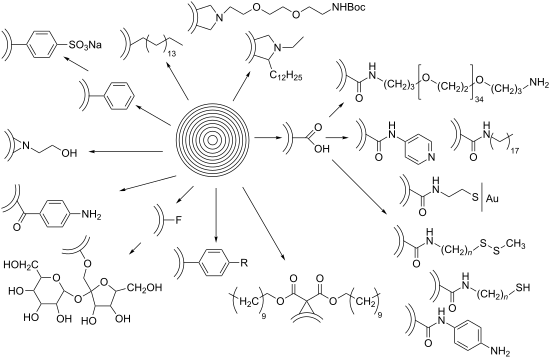
Carbon nano-onions (multi-layer fullerenes): chemistry and applications
Beilstein J. Nanotechnol. 2014, 5, 1980–1998, doi:10.3762/bjnano.5.207
- important catalytical reactions in industry is the oxidative dehydrogenation (ODH) of ethylbenzene to styrene. In 2002, Keller et al. published a study showing the potential of CNOs as catalyst for this reaction with conversion levels of up to 92% after an activation period of 2 h and stable styrene yields


Other Beilstein-Institut Open Science Activities



