


Search results
Search for "phase segregation" in Full Text gives 16 result(s) in Beilstein Journal of Nanotechnology.
Synthesis and characterization of RF-sputtered ZnTe/Cu2−xTe thin films for solar cell applications
Beilstein J. Nanotechnol. 2026, 17, 1016–1027, doi:10.3762/bjnano.17.69
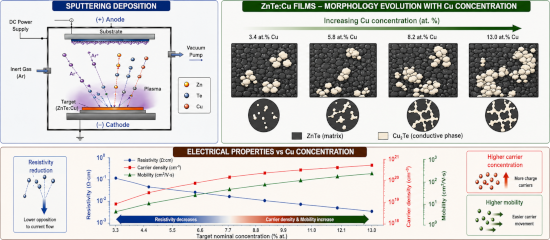
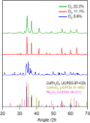
- : back contact materials; Cu2−xTe phases; phase segregation; RF magnetron sputtering; ZnTe thin films; Introduction CdTe solar cells remain one of the leading thin-film photovoltaic technologies due to the near-optimal direct bandgap of CdTe (≈1.45 eV) and its high absorption coefficient (>104 cm−1
- target, including the combined effects of composition and substrate temperature on phase evolution, microstructure, and functional properties, remains limited. In particular, the relationship between Cu-induced phase segregation, structural evolution, and the resulting electrical transition has not been
- evolution, microstructural changes, and the resulting optical and electrical properties, as well as to determine whether simultaneous Cu and O incorporation leads to the formation of a homogeneous quaternary phase or to phase segregation phenomena. This strategy provides insight into the mechanisms



Oxidative atmosphere-driven formation of single-phase spinel CuRh2O4 nanofibers for alkaline water oxidation
Beilstein J. Nanotechnol. 2026, 17, 737–743, doi:10.3762/bjnano.17.50
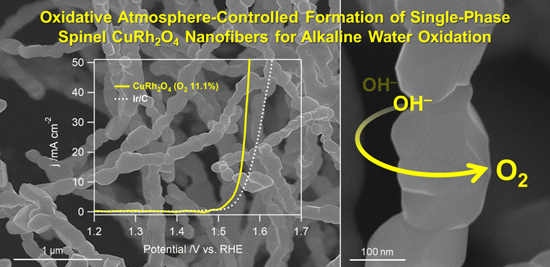
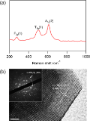
- oxygen-atmosphere engineering during annealing is critical for suppressing undesired phase segregation and achieving phase-pure CuRh2O4 nanofibers. Angle-resolved X-ray photoelectron spectroscopy (AR-XPS) was performed to clarify the surface chemical states of Cu and Rh in Cu–Rh bimetallic oxides




Recent progress in enhancing built-in electric fields of perovskite solar cells via junction engineering
Beilstein J. Nanotechnol. 2026, 17, 602–621, doi:10.3762/bjnano.17.42
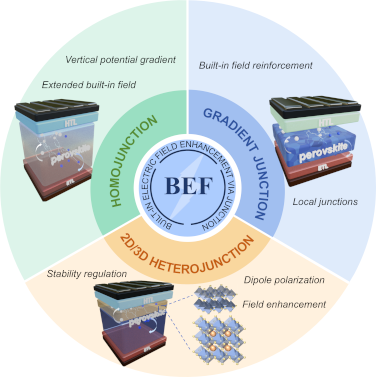
- the intentionally engineered depth-dependent potential profile. Ionic migration smooths the designed band tilt, while phase segregation introduces local band discontinuities, disrupting both the magnitude and the spatial coherence of the BEF-failure modes fundamentally more gradient-sensitive than
- decay over time due to ionic migration and phase segregation. The Dion–Jacobson (DJ)-derived 2D layer and PAPC-controlled n = 2 phase stabilize the heterojunction, preserving the BEF under operational stress; the device retained 92.9% of its initial efficiency after 1000 h in nitrogen, and 86.2% under




Synthesis and magnetic transitions of rare-earth-free Fe–Mn–Ni–Si-based compositionally complex alloys at bulk and nanoscale
Beilstein J. Nanotechnol. 2025, 16, 823–836, doi:10.3762/bjnano.16.62
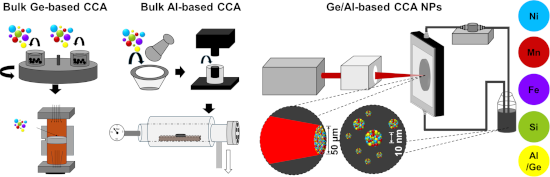
- successful in producing CCA NPs, they come with certain drawbacks. For instance, carbothermal synthesis requires an electrically conductive substrate, making it unsuitable for large-scale production [37]. Pyrolysis requires purification steps to eliminate polymer impurities and also result in phase
- segregation due to differences in precursor reduction temperatures [38]. Other techniques such as laser scanning ablation [39] and Joule heating [40] have also been employed to generate CCAs, but they often involve costly precursors and lengthy solvent screening processes. Among the various techniques


The impact of tris(pentafluorophenyl)borane hole transport layer doping on interfacial charge extraction and recombination
Beilstein J. Nanotechnol. 2025, 16, 678–689, doi:10.3762/bjnano.16.52
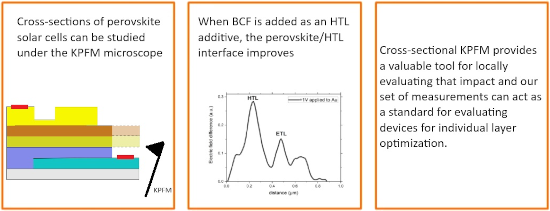
- ]. For PTAA, under illumination, a similar mechanism is proposed, whereby the oxidation of PTAA raises the conductivity of the polymer [33]. For both HTLs, the inclusion of tBP promotes a better distribution of the HTL on the perovskite, preventing organic semiconductor/LiTFSI phase segregation [34


Polyurethane/silk fibroin-based electrospun membranes for wound healing and skin substitute applications
Beilstein J. Nanotechnol. 2025, 16, 591–612, doi:10.3762/bjnano.16.46
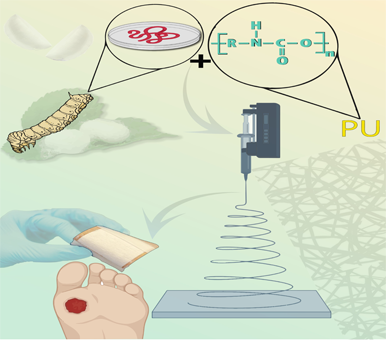
- of clarity never before possible [6][7]. In nanotechnology, different nanofiber production techniques are used such as template synthesis, electrospinning, solution blowing, drawing, thermally induced phase segregation, and self-assembly [8][9]. Among these techniques, electrospinning is the most



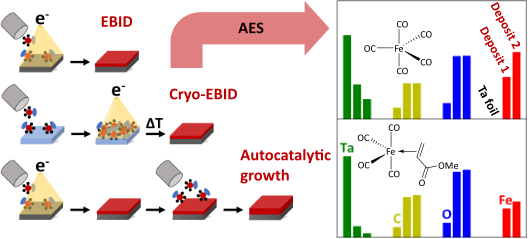
Electron-induced deposition using Fe(CO)4MA and Fe(CO)5 – effect of MA ligand and process conditions
Beilstein J. Nanotechnol. 2024, 15, 500–516, doi:10.3762/bjnano.15.45
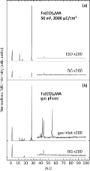
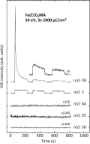
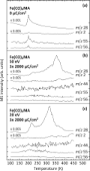
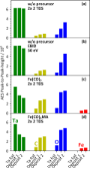
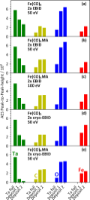
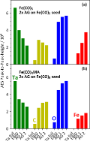
- with more than 90 atom % Fe were obtained [19], presumably related to electron beam heating effects. However, attempts to purify deposits with initial Fe contents of only 40 atom % by annealing up to 700 °C led to phase segregation into a highly pure and crystalline Fe phase and a carbonaceous material



Nanostructured lipid carriers containing benznidazole: physicochemical, biopharmaceutical and cellular in vitro studies
Beilstein J. Nanotechnol. 2023, 14, 804–818, doi:10.3762/bjnano.14.66
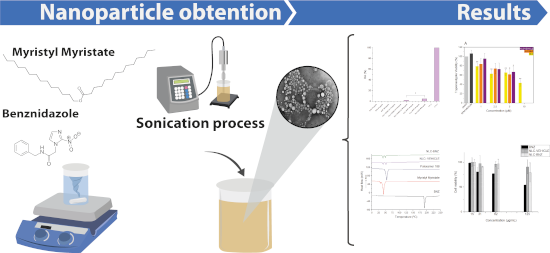
- carriers showed contributions from both the isolated myristyl myristate and additional Bragg peaks at 19.1° and 23.3° corresponding to the copolymer. This indicates that there was phase segregation, most likely a core–shell structure with the lipidic phase inside and the hydrophilic part of the copolymer


Electrocatalytic oxygen reduction activity of AgCoCu oxides on reduced graphene oxide in alkaline media
Beilstein J. Nanotechnol. 2022, 13, 1020–1029, doi:10.3762/bjnano.13.89
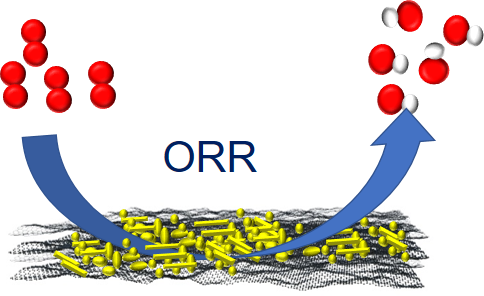
- of Co atoms in the Ag lattice [28][29], while reflections of Cu mask the Ag reflections. We see a systematic variation of the particle sizes for the bi- and trimetallic NPs (Table S1, Supporting Information File 1), which could be connected to the intermixing and phase segregation of mainly Co3O4 in


Band tail state related photoluminescence and photoresponse of ZnMgO solid solution nanostructured films
Beilstein J. Nanotechnol. 2020, 11, 899–910, doi:10.3762/bjnano.11.75
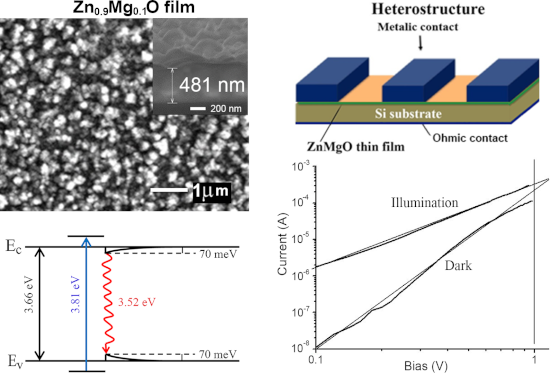
- unavoidable in the structure transformation process, in a certain interval of Mg concentrations. The phase segregation process was investigated in detail by means of X-ray diffraction, element-specific near-edge X-ray absorption fine structure (NEXAFS), electron dispersive spectroscopy (EDS), atomic force
- microscopy (AFM), UV–vis spectroscopy, photoluminescence (PL) and resistivity measurements in Zn1−xMgxO thin films deposited by the sol–gel spin-coating route in the composition range x = 0.00–0.40 [23]. It was found that the phase segregation manifests itself starting at a Mg content of x = 0.25. However
- , the results showed that films are deposited with wurtzite structure as the dominant phase even after phase segregation in the investigated Mg concentration interval. The issue of phase segregation was also investigated via selective resonant Raman scattering in a wider composition range of x = 0.00

Multicomponent bionanocomposites based on clay nanoarchitectures for electrochemical devices
Beilstein J. Nanotechnol. 2019, 10, 1303–1315, doi:10.3762/bjnano.10.129
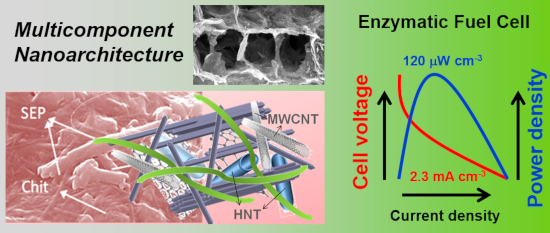
- promotes the homogeneous dispersion of diverse nanoparticulated components. It can be inferred that the disaggregated fibres of sepiolite form an interpenetrated network representing, in the present case, a steric hindrance for GNPs, MWCNTs, and HNTs to aggregate. This avoids phase segregation and particle



Zn/F-doped tin oxide nanoparticles synthesized by laser pyrolysis: structural and optical properties
Beilstein J. Nanotechnol. 2019, 10, 9–21, doi:10.3762/bjnano.10.2
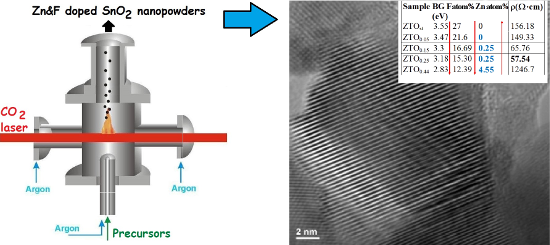
- nanoparticles measured from TEM images. The tendency of the reduction in the mean crystallite size with increasing Zn concentration (without ZnO phase segregation) was also observed for the case of Zn-doped SnO2 nanocrystals prepared by a solid-state reaction from stannous chloride and zinc acetate, yet in this



Ternary nanocomposites of reduced graphene oxide, polyaniline and hexaniobate: hierarchical architecture and high polaron formation
Beilstein J. Nanotechnol. 2018, 9, 2936–2946, doi:10.3762/bjnano.9.272
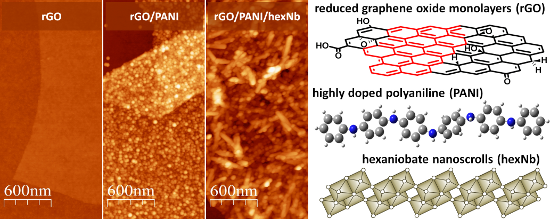
- (typically above 90 °C) results in the aggregation of the material due to restacking of the hydrophobic rGO layers [34][35]. This is a drawback in the preparation of rGO nanocomposites because phase segregation and/or composition heterogeneity will occur in the final materials. Although it is well known that


Magnetism and magnetoresistance of single Ni–Cu alloy nanowires
Beilstein J. Nanotechnol. 2018, 9, 2345–2355, doi:10.3762/bjnano.9.219
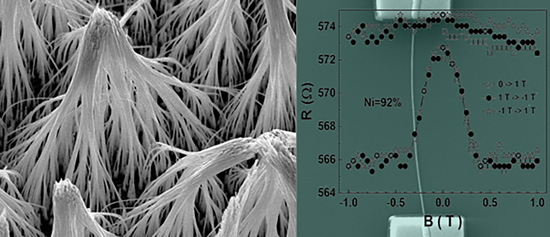
- -resistance data in corresponding magnetic hysteresis loops can be applied, opening the way for an easier experimental investigation of magnetization reversal in ferromagnetic single nanowires. Information about magnetic parameters and phase segregation in single nanowires has been obtained by exploiting the


Electronic interaction in composites of a conjugated polymer and carbon nanotubes: first-principles calculation and photophysical approaches
Beilstein J. Nanotechnol. 2015, 6, 1138–1144, doi:10.3762/bjnano.6.115
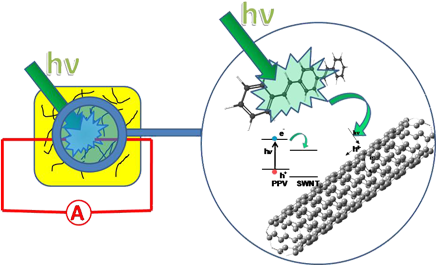
- substantial effect than the salient conjugation changes in the variation of peak-1 intensity with x. We note that the persistence of PL for high x-values suggests phase segregation between PPV and the SWNT network, likely due to an increase of the SWNT bundle sizes. To better understand how the morphology


An insight into the mechanism of charge-transfer of hybrid polymer:ternary/quaternary chalcopyrite colloidal nanocrystals
Beilstein J. Nanotechnol. 2014, 5, 1235–1244, doi:10.3762/bjnano.5.137
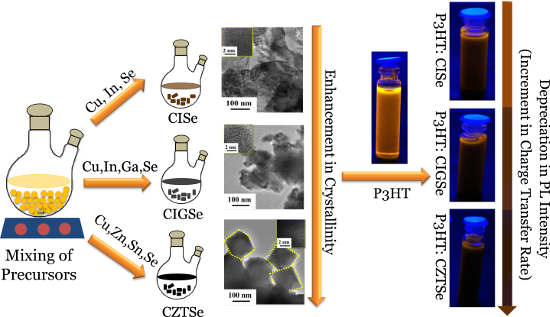
- mainly attributed to the inability of the nanocrystals to uniformly cling to the polymer matrix so that each of the nanocrystals contributes to a reduction in the PL intensity of the polymer. Additionally, a slight phase segregation may occur in the polymer-nanocomposite of P3HT-chalcogenides, which





