


Search results
Search for "photoelectrocatalysis" in Full Text gives 1 result(s) in Beilstein Journal of Nanotechnology.
Light-driven ammonia electrooxidation via carbon nitride–ruthenium molecular interfaces
Beilstein J. Nanotechnol. 2026, 17, 854–862, doi:10.3762/bjnano.17.61
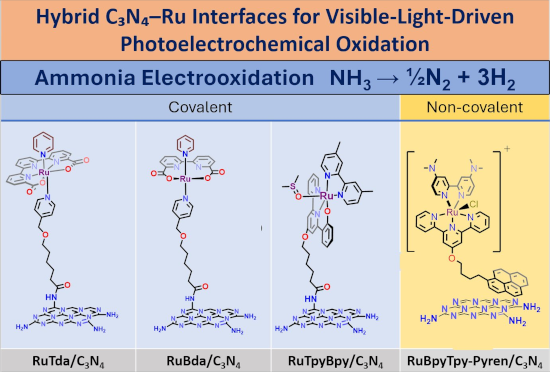
- optimizing charge carrier dynamics at the hybrid interface. Finally, photoelectrocatalysis is the enabling configuration: Simultaneous illumination and electrochemical bias reduce the thermodynamic penalty, suppress charge recombination, and provide independent control over product selectivity. Despite
- ; hybrid semiconductor–molecular interfaces; molecular ruthenium catalysts; photoelectrocatalysis; Perspective A) The energy challenge and the catalysis gap The global transition away from fossil fuels demands new paradigms for how chemical energy is stored and released. At the heart of this challenge
- and charge-conducting scaffold, functionally analogous to a photosensitizer, while the Ru complex serves as the molecular catalytic centre and light absorber too. Transferring this synergistic photoactive interface concept into photoelectrocatalysis for ammonia oxidation, a sustainable hydrogen


Other Beilstein-Institut Open Science Activities



