


Search results
Search for "polyynes" in Full Text gives 4 result(s) in Beilstein Journal of Nanotechnology.
Further insights into the thermodynamics of linear carbon chains for temperatures ranging from 13 to 300 K
Beilstein J. Nanotechnol. 2025, 16, 1818–1825, doi:10.3762/bjnano.16.125
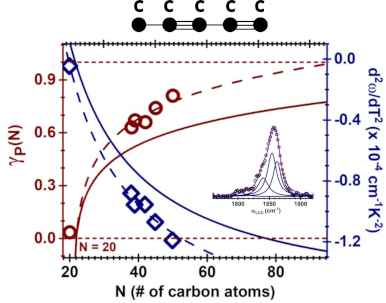
- parameter, and thermal expansion coefficient [29][30]. This is the case with linear atomic chains constituted of carbon atoms [29][30]. Linear carbon chains (LCC) are 1D systems that are classified into two categories: polyynes (displaying alternating triple and single bonds between constituent carbon atoms
- ) and cumulenes (displaying only double bonds between constituent carbon atoms) [31][34][35][36][37][38][39][40]. Cumulenes are metallic systems that, due to Peierls transition, are more unstable than polyynes, which present insulating properties with bandgaps whose sizes are dependent on the number of
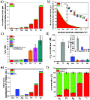
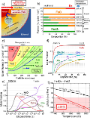
- temperature, ωLCC is dependent on the chain length (i.e., N-dependent) as well (see Figure 3b). This is an expected behavior since the size of the chain affects the bond length alternation (BLA) strength of the polyynes. Figure 2a shows the evolution of ωLCC with T, and again, it is noteworthy that no matter


![[Graphic 23]](/bjnano/content/inline/2190-4286-16-125-i25.svg?max-width=637&scale=1.18182)
Preferential enrichment and extraction of laser-synthesized nanoparticles in organic phases
Beilstein J. Nanotechnol. 2025, 16, 254–263, doi:10.3762/bjnano.16.20
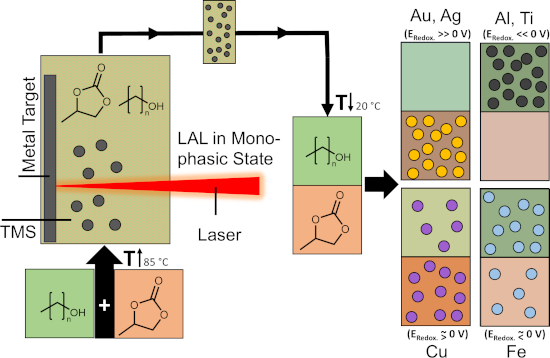
- liquid hydrocarbons such as pyrolysis products [15][16][17][18], polyynes [19][20][21], and dimers [13][22][23]. Furthermore, depending on the solvent and ablated material pairing, carbon may be “harvested” from the solvent forming crystalline carbides [24][25][26][27], amorphous carbon dopant [28][29




Laser synthesis of nanoparticles in organic solvents – products, reactions, and perspectives
Beilstein J. Nanotechnol. 2024, 15, 638–663, doi:10.3762/bjnano.15.54
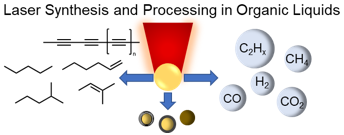
- example, polyynes or alkanes, or permanent gases forming persistent gas microbubbles. There have been various reviews regarding nanoparticle synthesis (mainly addressing findings reported for aqueous media) [7][54][55][56], fundamental physical processes during LSPC [57][58][59], and the potential use of
- , ethylene [116][117], and polyynes [117][118] were observed from ablation of benzene and toluene. Overall, a large quantity of different products was found for the irradiation of solvents with pulsed lasers. Although the reaction products resulting from the photolysis of solvents have been characterized
- of sp2- or sp3-hybridized short-chain hydrocarbons observed but also the formation of sp-hybridized polyynes, which are linear hydrocarbons consisting of alternating single and triple bonds. They are often synthesized by laser ablation of carbon-based materials in water [127][128][129][130][131] or





Raman spectroscopy as a tool to investigate the structure and electronic properties of carbon-atom wires
Beilstein J. Nanotechnol. 2015, 6, 480–491, doi:10.3762/bjnano.6.49
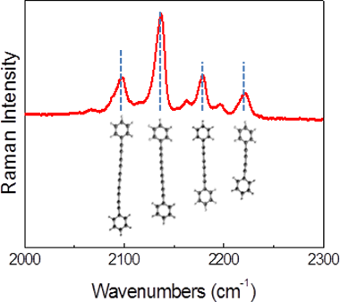
- single–triple bonds (polyynes), expected to show semiconducting properties. The electronic and optical properties of CAWs can be finely tuned by controlling the wire length (i.e., the number of carbon atoms) and the type of termination (e.g., atom, molecular group or nanostructure). Although linear, sp
- electronic structure from alternating to equalized bonds. Keywords: carbon nanostructures; cumulenes; polyynes; Raman spectroscopy; sp-hybridized carbon systems; Review Introduction Over the last decades carbon nanostructures have been widely investigated for their unique properties and for their potential
- semiconducting behavior of polyynes, which corresponds to a lower energy of the ideal sp-carbon chain. Along this metal-to-semiconductor transition the vibrational properties are strongly modified. One of the major effects is the appearance of an optical phonon branch, which is otherwise absent in an equalized


Other Beilstein-Institut Open Science Activities



