


Search results
Search for "silver(I) carboxylate" in Full Text gives 2 result(s) in Beilstein Journal of Nanotechnology.
Evaluating metal-organic precursors for focused ion beam-induced deposition through solid-layer decomposition analysis
Beilstein J. Nanotechnol. 2025, 16, 1942–1951, doi:10.3762/bjnano.16.135
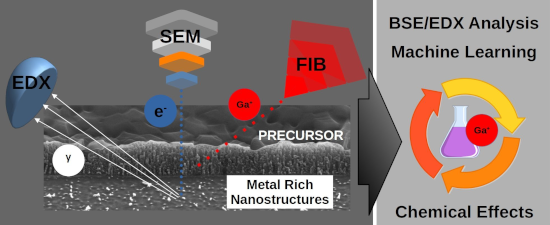
- before deciding which compound is the most promising one. Therefore, we used in our studies copper(II) and silver(I) carboxylate complexes such as non-fluorinated pivalate [Cu2(μ-O2Ct-Bu)4]n [28][29], perfluorinated pentafluoropropionates [Cu2(µ-O2CC2F5)4] [30], [Ag2(μ-O2C2F5)2] [31] and the heteroligand


Synthesis of [{AgO2CCH2OMe(PPh3)}n] and theoretical study of its use in focused electron beam induced deposition
Beilstein J. Nanotechnol. 2017, 8, 2615–2624, doi:10.3762/bjnano.8.262
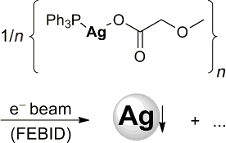
- O2CCH2OMe− is generated, further following the first fragmentation route. However, at 1.3 eV the initial step is decarboxylation giving [AgCH2OMe(PPh3)], followed by Ag–P and Ag–C bond cleavages. Keywords: DFT; DSC; FEBID; silver(I) carboxylate; solid-state structure; TGA; Introduction Focused electron
- silver(I) carboxylate [{AgO2CCH2OMe}n] (1), which gives [{AgO2CCH2OMe(PPh3)}n] (2), when treated with equimolar amounts of PPh3 (Scheme 1). Coordination polymers 1 and 2 are colorless solids, which are stable towards air and moisture and hence can be safely handled under aerobe conditions. Silver


Other Beilstein-Institut Open Science Activities



