


Search results
Search for "soil remediation" in Full Text gives 2 result(s) in Beilstein Journal of Nanotechnology.
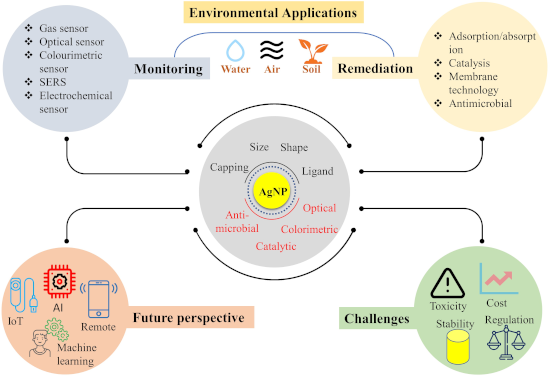
Environmental applications of silver nanoparticles: state-of-the-art review and emerging trends
Beilstein J. Nanotechnol. 2026, 17, 697–736, doi:10.3762/bjnano.17.49


The role of biochar in combating microplastic pollution: a bibliometric analysis in environmental contexts
Beilstein J. Nanotechnol. 2025, 16, 1401–1416, doi:10.3762/bjnano.16.102
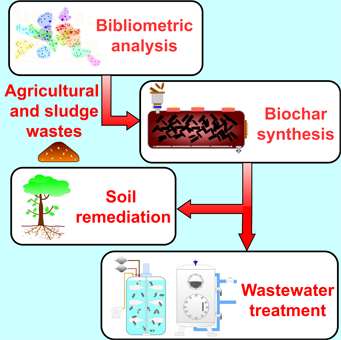
- , positioning it as a promising solution for nanoplastic remediation. Keywords: aquatic pollution; bibliometric analysis; biochar; microplastics (MPs); soil remediation; Introduction Plastics are widely utilized in various industries and daily life due to their low production cost. The average global per
- as “adsorbent”, “adsorbent mechanism”, “waste”, and “walnut shell”, highlight the development of biochar from agricultural residues and adsorption mechanism evaluations. Similarly, terms like “aggregate”, ”soil remediation”, “identification”, “mechanism”, and “kinetics” indicate a research trajectory
- groups, affecting biochar stability [43]. The goal of modified biochar synthesis is to enhance its wastewater treatment and soil remediation capabilities by improving electrostatic and chemical bonding interactions with MPs, beyond the limitations of physical adsorption governed by specific surface area



Other Beilstein-Institut Open Science Activities



