


Search results
Search for "split-ring resonator" in Full Text gives 3 result(s) in Beilstein Journal of Nanotechnology.
Electromagnetic study of a split-ring resonator metamaterial with cold-electron bolometers
Beilstein J. Nanotechnol. 2025, 16, 2199–2206, doi:10.3762/bjnano.16.152
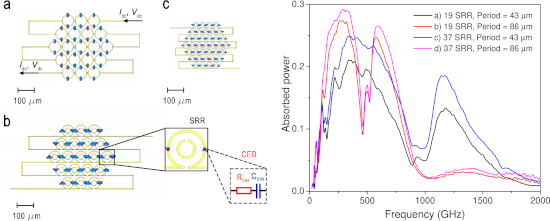
- ; metamaterial; split-ring resonator; Introduction Highly sensitive receivers with broadband antennas are of significant interest for advanced spectroscopic applications and various radioastronomy tasks [1][2][3][4][5]. In particular, broadband receiving systems are required for use with a Fourier-transform
- transition from a single-ring antenna to a double split-ring resonator design, while keeping the number of elements constant, resulted in a significant improvement in performance. The addition of the inner ring, which increases the total capacitance of the resonant element, leads to a slight reduction of the


Plasmonic nanosensor based on multiple independently tunable Fano resonances
Beilstein J. Nanotechnol. 2019, 10, 2527–2537, doi:10.3762/bjnano.10.243
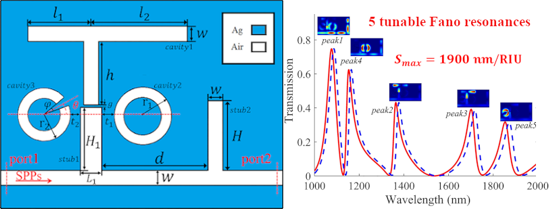
- modes, the ring resonator can produce a sharper transmission peak, and the split-ring resonator has the minimum size with more adjustable parameters under the premise of guaranteeing high performance. Hence, our compound structure combines the advantages of the various resonators, such as the asymmetric
- and a split-ring resonator), which are gap-coupled to a bus waveguide with two stubs. For convenience, we named the T-shaped, ring, split-ring, left stub and right stub modules as cavity1, cavity2, cavity3, stub1 and stub2, respectively. The width of the bus waveguide, the three cavities and stub2 are
- can significantly improve the detection accuracy of the nanosensor. Finally, a split-ring resonator (cavity3) is inserted into the left side of stub1. The relevant parameters of cavity3 are r2 = 130 nm, φ = 20°, θ = 25° and t2 = 9 nm. The corresponding transmission spectrum is shown in Figure 3a by




Linear and nonlinear optical properties of hybrid metallic–dielectric plasmonic nanoantennas
Beilstein J. Nanotechnol. 2016, 7, 111–120, doi:10.3762/bjnano.7.13
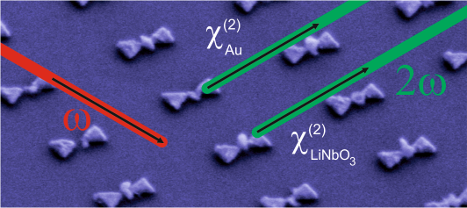
- crystalline gallium arsenide substrate and have demonstrated enhanced second harmonic emission caused by the interplay of the local near-field of the split-ring resonator and the substrate. Recently, Alu and Belkin have reported similar results in the mid-infrared spectral region [70]. As a last example


Other Beilstein-Institut Open Science Activities



