


Search results
Search for "strengthening effect" in Full Text gives 4 result(s) in Beilstein Journal of Nanotechnology.
Probing tribological evolution in atomically thin MoS2 at different scales
Beilstein J. Nanotechnol. 2026, 17, 586–597, doi:10.3762/bjnano.17.40
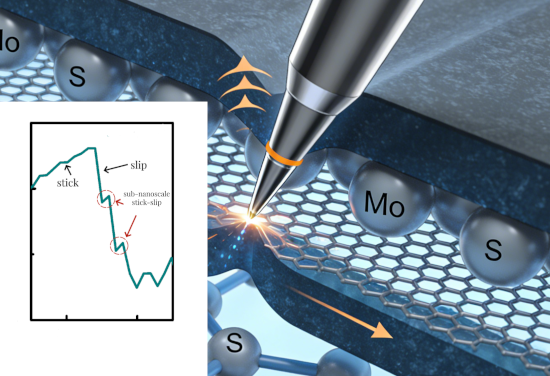
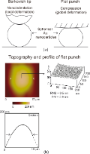
- Xingzhong Zeng Miao Zhang School of Intelligent Manufacturing, Hunan First Normal University, Changsha 410205, China Changsha Denghua Off-Campus Custodial Service Co., Ltd., Changsha, China 10.3762/bjnano.17.40 Abstract Atomic-scale stick–slip motion and the nanoscale strengthening effect are
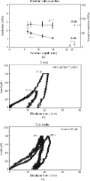
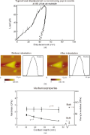
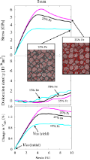
- (MoS2) under controlled loads using a calibrated atomic force microscope (AFM), with a focus on quantifying the strengthening effect and sub-nanoscale stick–slip motion. Our results reveal that the nanoscale strengthening effect intensifies with increasing applied load but weakens as the number of MoS2
- load-dependent transition, remaining nearly constant under low loads before increasing with higher loads, and ultimately decreasing at ultrahigh loads. This transition arises from two competing mechanisms: under low loads, the evolution of interfacial contact quality dominates the strengthening effect


Review: Electrostatically actuated nanobeam-based nanoelectromechanical switches – materials solutions and operational conditions
Beilstein J. Nanotechnol. 2018, 9, 271–300, doi:10.3762/bjnano.9.29
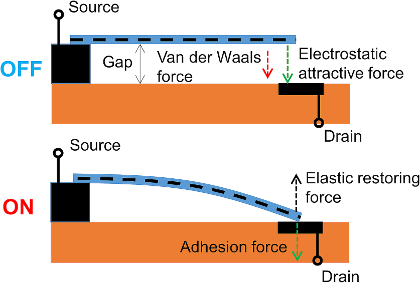
- result in a smoothening of the contacting surfaces because of local Joule heating and welding. The contact strengthening effect in Figure 9b was explained by smoothing and thinning of the native Ge oxide layer which results in an increase of contact area and adhesion force [54]. At higher current


Scale effects of nanomechanical properties and deformation behavior of Au nanoparticle and thin film using depth sensing nanoindentation
Beilstein J. Nanotechnol. 2014, 5, 822–836, doi:10.3762/bjnano.5.94
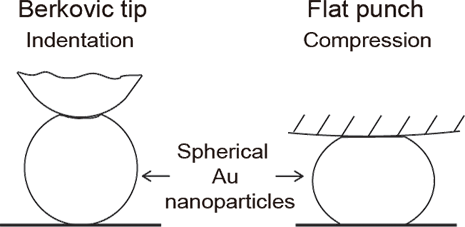
- gradients, known as statistically stored dislocations (SSD), hinder the formation and movement of new dislocations. As indentation depths decreases larger strain gradients lead to an increase in the density of dislocations. This results in a strengthening effect [28][29][30] and accounts for the observed
- mechanism and are described in subsequent sections. In both mechanisms as the grain size is reduced, the yield stress increases resulting in higher hardness in the case of indentation as stated previously [31][32][33][34]. It should be noted that the strengthening effect can also be the result of a






Plasticity of nanocrystalline alloys with chemical order: on the strength and ductility of nanocrystalline Ni–Fe
Beilstein J. Nanotechnol. 2013, 4, 542–553, doi:10.3762/bjnano.4.63
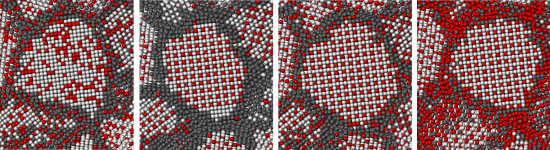
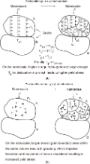
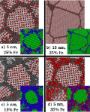
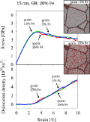
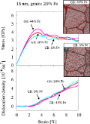
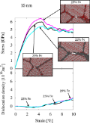
- elemental distribution and not due to a differing stable configuration for the case of a nanometer grain size as observed for other systems [29]. Random alloy: fixed GB composition, varying grain composition (15 nm) For coarse grained material, the strengthening effect of substitutional solutes (i.e., solid
- has an effect on the macroscopic mechanical properties. Here, an excess in Fe strengthens the structure, while a depletion in Fe decreases the strength. This is consistent with findings for miscible systems, where a maximum in the strengthening effect of solutes was observed for intermediate



Other Beilstein-Institut Open Science Activities



