


Search results
Search for "tracheid" in Full Text gives 2 result(s) in Beilstein Journal of Nanotechnology.
Comparative study on 3D morphologies of delignified, single tracheids and fibers of five wood species
Beilstein J. Nanotechnol. 2026, 17, 239–250, doi:10.3762/bjnano.17.16
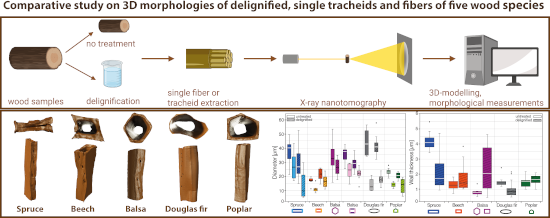
- wood to withstand high stress. This structural resilience makes wood a versatile material for applications ranging from construction to advanced composites. However, a detailed understanding of how delignification affects softwood tracheid and hardwood fiber morphology is crucial for predicting
- resulted in facilitated separation of fibers and tracheids and frayed wall appearance. We observed similar tracheid/fiber diameters and wall thicknesses for all five wood species. These findings enhance our understanding of the wood fiber and tracheid structures across species and the effects of
- biomechanics and water management. Keywords: 3D models; delignification; tracheid; wood; X-ray nanotomography; Introduction Wood fibers in hardwood and tracheids in softwood play a crucial role in the structure and function of vascular plants, particularly in water conduction and mechanical support [1][2


Humidity-dependent wound sealing in succulent leaves of Delosperma cooperi – An adaptation to seasonal drought stress
Beilstein J. Nanotechnol. 2018, 9, 175–186, doi:10.3762/bjnano.9.20
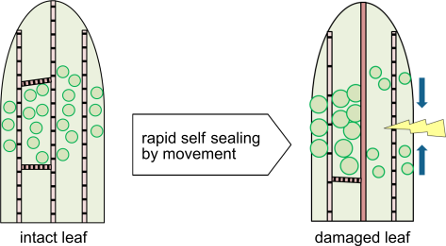
- 2c). Moreover, the net of vascular tissue consists in part of wide-band tracheids, a specialized type of tracheid that prevents cell collapse under (high) drought stress. Wide-band tracheids are short, wide and spindle-shaped and possess pronounced annular or helical cell wall thickenings. They
- consist of an unlignified primary cell wall and a band-like secondary cell wall that project deeply into the cell lumen [8][9][10][11][12][13][14]. Up to 70% of the cross-section of a tracheid can be filled by these thickenings. Biomechanics Table 2 summarizes the mechanical properties and other
- patterns evolved independently within the families Aizoaceae, Cactaceae and Portulacaceae [8][12]. Wide-band tracheids are often found in seedlings and young plants. They are typically replaced by tracheid types with scalariform and reticulate thickenings, which are more rigid in bending, compression and


Other Beilstein-Institut Open Science Activities



