


Search results
Search for "viologen cavitand" in Full Text gives 1 result(s) in Beilstein Journal of Nanotechnology.
A redox-responsive viologen–cavitand nanocarrier for dual-function photodynamic therapy
Beilstein J. Nanotechnol. 2026, 17, 1142–1158, doi:10.3762/bjnano.17.78
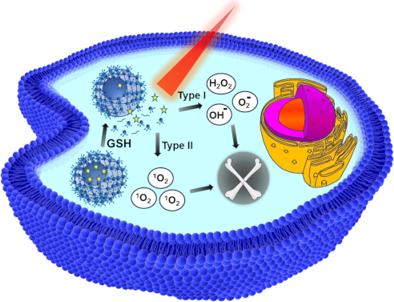
- ; redox-responsive nanocarrier; viologen cavitand; Introduction Photodynamic therapy (PDT) is a minimally invasive, clinically approved approach widely utilized for cancer treatment, as well as various non-malignant conditions. It relies on three key components, namely, light, molecular oxygen, and a
- THPP@p(MVCA-BAC) nanoplatform assembled via the copolymerization of a viologen-cavitand and a disulfide crosslinker. This system stabilizes hydrophobic THPP in its monomeric, non-aggregated state, maintains colloidal stability for at least three months, and enables GSH-triggered payload release. In


Other Beilstein-Institut Open Science Activities



