


Search results
Search for "water quality monitoring" in Full Text gives 2 result(s) in Beilstein Journal of Nanotechnology.
Materials challenges in solid-state sensors for continuous monitoring of ions in water
Beilstein J. Nanotechnol. 2026, 17, 935–973, doi:10.3762/bjnano.17.66
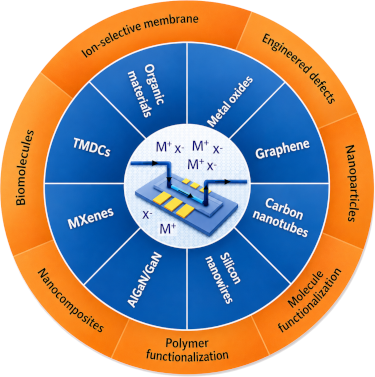
- active and sensing materials for designing electrochemical and electrical devices capable of reliable, real-time ion monitoring in water. Keywords: aqueous ion sensors; biosensors; chemical sensors; nanomaterials; water quality monitoring; Introduction Access to clean water is critical for public
- health and ecosystem integrity. Traditionally, water quality monitoring has relied on periodic grab sampling and laboratory analyses. While useful, these methods only offer brief snapshots and may miss sudden changes or localized chemical shifts. For example, ion levels in natural, treated, or
- especially ISEs, FETs, and chemiresistive devices, are central to next-generation online water quality monitoring. They offer sensitivity and selectivity aligned with regulatory thresholds, fast response to capture transient events, and the potential for dense spatial networks. Given these advantages, there


Nanogenerator-based self-powered sensors for data collection
Beilstein J. Nanotechnol. 2021, 12, 680–693, doi:10.3762/bjnano.12.54
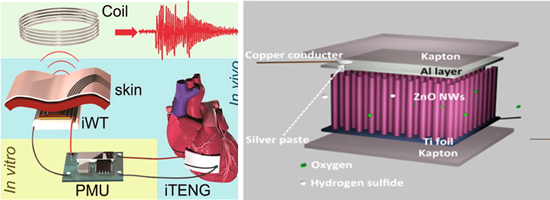
- , portable, easy-to-deploy, and low-cost TENGs are novel devices for water quality monitoring. Zhou et al. proposed the use of waste materials to make an arc-shaped TENG (AS-TENG) [15]. The AS-TENG can provide energy for a pH sensor in water. The system can trigger an alarm when the pH value is lower than 5



Other Beilstein-Institut Open Science Activities



