Cite the Following Article
Carbohydrate inhibitors of cholera toxin
Vajinder Kumar and W. Bruce Turnbull
Beilstein J. Org. Chem. 2018, 14, 484–498.
https://doi.org/10.3762/bjoc.14.34
How to Cite
Kumar, V.; Turnbull, W. B. Beilstein J. Org. Chem. 2018, 14, 484–498. doi:10.3762/bjoc.14.34
Download Citation
Citation data can be downloaded as file using the "Download" button or used for copy/paste from the text window
below.
Citation data in RIS format can be imported by all major citation management software, including EndNote,
ProCite, RefWorks, and Zotero.
Presentation Graphic
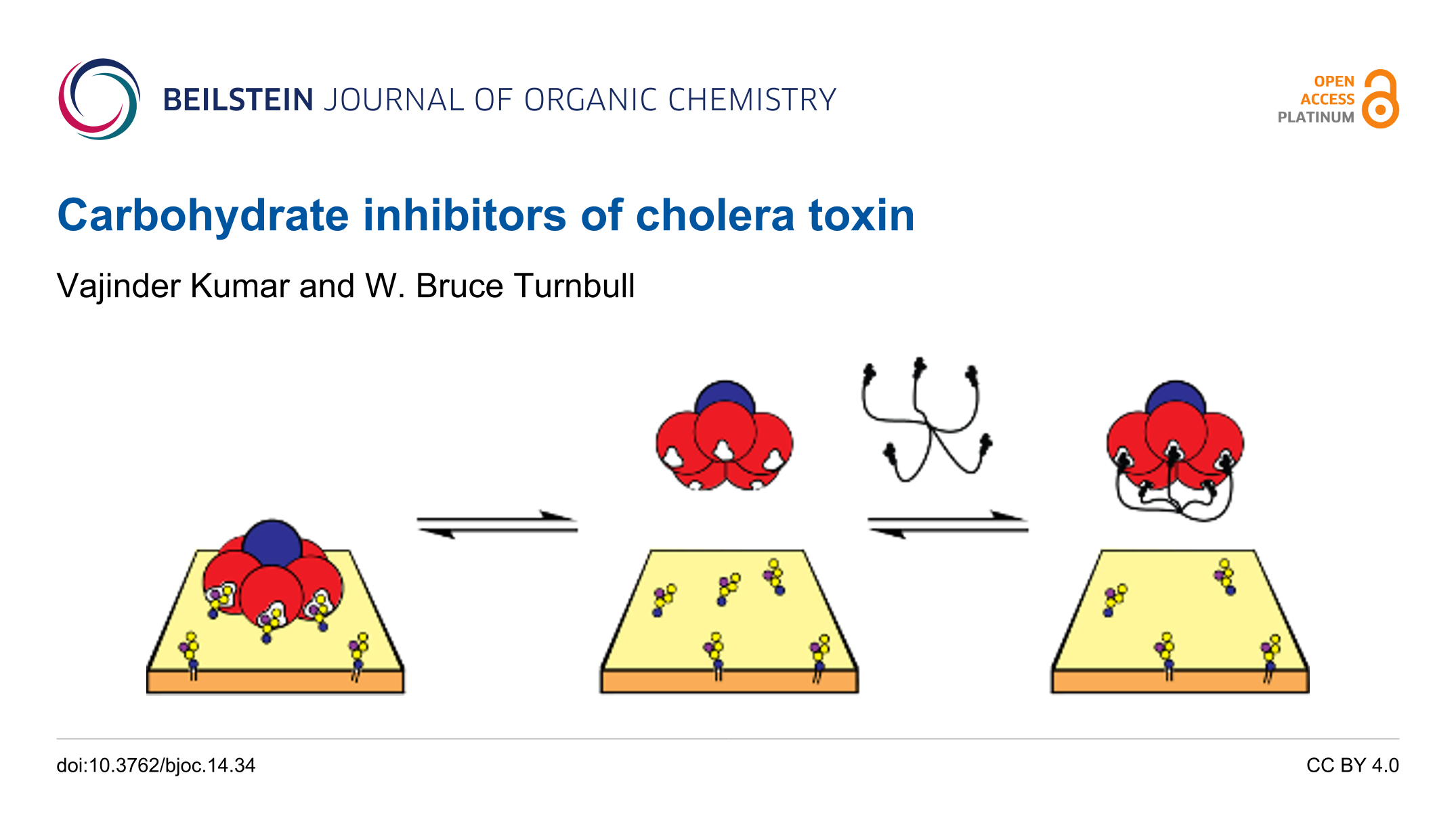
| Picture with graphical abstract, title and authors for social media postings and presentations. | ||
| Format: PNG | Size: 329.3 KB | Download |
Citations to This Article
Up to 20 of the most recent references are displayed here.
Scholarly Works
- Basheer, H.; Azad, C. S.; Samim, M.; Khan, I. A. Tunable triazole-based cholera toxin inhibitors: A QSAR-guided design and evaluation approach. Bioorganic chemistry 2026, 171, 109563. doi:10.1016/j.bioorg.2026.109563
- Mlinac-Jerkovic, K.; Heffer, M.; Schnaar, R. L. Gangliosides in molecular interactions and cell regulation. The Journal of biological chemistry 2026, 302, 111184. doi:10.1016/j.jbc.2026.111184
- Saltor Núñez, L.; Kumar, V.; Ross, J. F.; Dolan, J. P.; Srimasorn, S.; Zhang, X.; Richter, R. P.; Turnbull, W. B. Molecularly Defined Glycocalyx Models Reveal AB5 Toxins Recognize Their Target Glycans Superselectively. JACS Au 2025, 5, 2699–2712. doi:10.1021/jacsau.5c00305
- Kundu, S.; Das, S.; Maitra, P.; Halder, P.; Koley, H.; Mukhopadhyay, A. K.; Miyoshi, S.-I.; Dutta, S.; Chatterjee, N. S.; Bhattacharya, S. Sodium butyrate inhibits the expression of virulence factors in Vibrio cholerae by targeting ToxT protein. mSphere 2025, 10, e0082424. doi:10.1128/msphere.00824-24
- Khan, I. A.; Basheer, H.; Azad, C. S.; Samim, M. Qsar-Driven Computational Design and Synthesis of Tunable Cholera Toxin Inhibitors: Unveiling the Role of Triazoles. Elsevier BV 2025. doi:10.2139/ssrn.5154033
- Kundu, S.; Das, S.; Maitra, P.; Halder, P.; Koley, H.; Mukhopadhyay, A. K.; Miyoshi, S.-i.; Dutta, S.; Chatterjee, N. S.; Bhattacharya, S. Potential use of Sodium Butyrate (SB) as an anti-virulence agent against Vibrio cholerae targeting ToxT virulence protein. openRxiv 2023. doi:10.1101/2023.10.05.561138
- Li, Y.; Yang, K.-d.; Kong, D.-C.; Ye, J.-F. Advances in phage display based nano immunosensors for cholera toxin. Frontiers in immunology 2023, 14, 1224397. doi:10.3389/fimmu.2023.1224397
- Porkolab, V.; Lepšík, M.; Ordanini, S.; St John, A.; Le Roy, A.; Thépaut, M.; Paci, E.; Ebel, C.; Bernardi, A.; Fieschi, F. Powerful Avidity with a Limited Valency for Virus-Attachment Blockers on DC-SIGN: Combining Chelation and Statistical Rebinding with Structural Plasticity of the Receptor. ACS central science 2023, 9, 709–718. doi:10.1021/acscentsci.2c01136
- White, C.; Bader, C.; Teter, K. The manipulation of cell signaling and host cell biology by cholera toxin. Cellular signalling 2022, 100, 110489. doi:10.1016/j.cellsig.2022.110489
- McBerney, R.; Dolan, J. P.; Cawood, E. E.; Webb, M. E.; Turnbull, W. B. Bioorthogonal, Bifunctional Linker for Engineering Synthetic Glycoproteins. JACS Au 2022, 2, 2038–2047. doi:10.1021/jacsau.2c00312
- Tomek, M. B.; Janesch, B.; Braun, M. L.; Taschner, M.; Figl, R.; Grünwald-Gruber, C.; Coyne, M. J.; Blaukopf, M.; Altmann, F.; Kosma, P.; Kählig, H.; Comstock, L. E.; Schäffer, C. A Combination of Structural, Genetic, Phenotypic and Enzymatic Analyses Reveals the Importance of a Predicted Fucosyltransferase to Protein O-Glycosylation in the Bacteroidetes. Biomolecules 2021, 11, 1795. doi:10.3390/biom11121795
- Bremner, J. Future Possibilities. Multiple Action-Based Design Approaches to Antibacterials; Springer Singapore, 2021; pp 159–187. doi:10.1007/978-981-16-0999-2_5
- Damalanka, V. C.; Maddirala, A. R.; Janetka, J. W. Novel approaches to glycomimetic design: development of small molecular weight lectin antagonists. Expert opinion on drug discovery 2021, 16, 513–536. doi:10.1080/17460441.2021.1857721
- Niedzwiecka, A.; Achebe, N.; Ling, C.-C. Comprehensive Glycoscience - Glycoclusters and Glycodendrimers. Comprehensive Glycoscience; Elsevier, 2021; pp 263–345. doi:10.1016/b978-0-12-819475-1.00039-0
- Toutounian, K.; Heinig, M. L.; Götz, P.; Ulsemer, P. Exploring the pathogen binding potential within the human gut microbiome. Human Microbiome Journal 2020, 18, 100075. doi:10.1016/j.humic.2020.100075
- Youn, G.; Cervin, J.; Yu, X.; Bhatia, S. R.; Yrlid, U.; Sampson, N. S. Targeting Multiple Binding Sites on Cholera Toxin B with Glycomimetic Polymers Promotes the Formation of Protein-Polymer Aggregates. Biomacromolecules 2020, 21, 4878–4887. doi:10.1021/acs.biomac.0c01122
- Laezza, A.; Georgiou, P. G.; Richards, S.-J.; Baker, A. N.; Walker, M.; Gibson, M. I. Protecting Group Free Synthesis of Glyconanoparticles Using Amino-Oxy-Terminated Polymer Ligands. Bioconjugate chemistry 2020, 31, 2392–2403. doi:10.1021/acs.bioconjchem.0c00465
- Cervin, J.; Boucher, A.; Youn, G.; Björklund, P.; Wallenius, V.; Mottram, L.; Sampson, N. S.; Yrlid, U. Fucose-Galactose Polymers Inhibit Cholera Toxin Binding to Fucosylated Structures and Galactose-Dependent Intoxication of Human Enteroids. ACS infectious diseases 2020, 6, 1192–1203. doi:10.1021/acsinfecdis.0c00009
- Ghosh, S. Sialic acid and biology of life: An introduction. Sialic Acids and Sialoglycoconjugates in the Biology of Life, Health and Disease; Elsevier, 2020; pp 1–61. doi:10.1016/b978-0-12-816126-5.00001-9
- Haksar, D.; van Ufford, L. Q.; Pieters, R. J. A hybrid polymer to target blood group dependence of cholera toxin. Organic & biomolecular chemistry 2019, 18, 52–55. doi:10.1039/c9ob02369k