Abstract
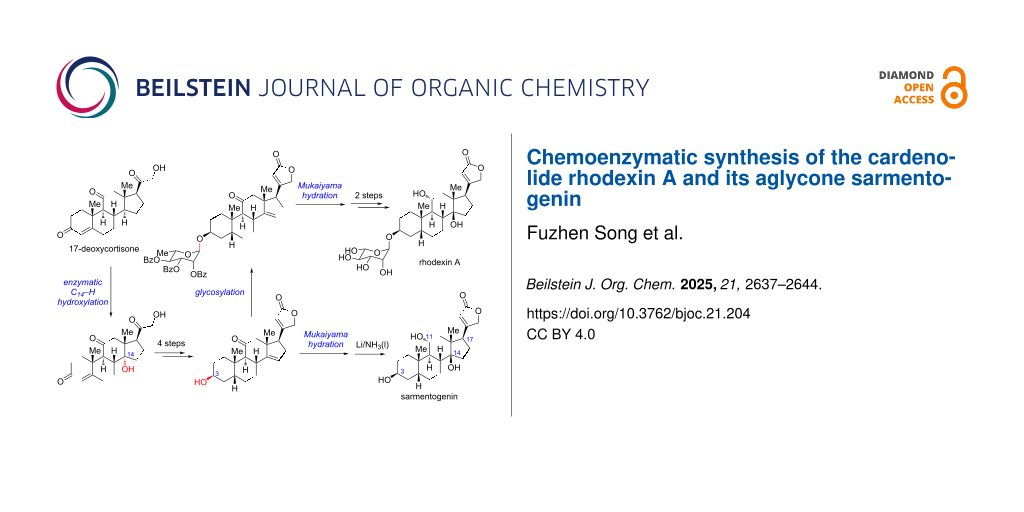
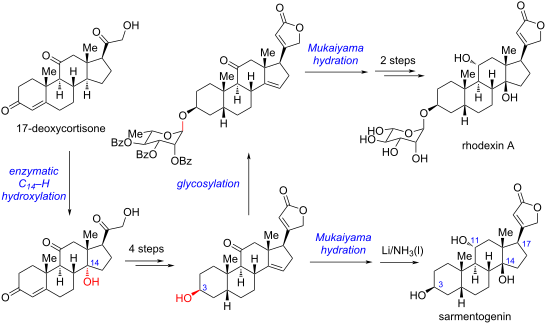
Herein, we report a concise chemoenzymatic synthesis of the cardenolide rhodexin A in 9 steps and the first protecting-group-free synthesis of its aglycone sarmentogenin in 7 steps from 17-deoxycortisone. The synthesis features a scalable enzymatic C14–H α-hydroxylation, a Bestmann ylide-enabled one-step construction of the butenolide motif, a late stage Mukaiyama hydration, and a stereoselective C11 carbonyl reduction.
Graphical Abstract
Introduction
Cardiac glycosides (CGs) are widely distributed natural products, generated by plants and amphibians [1]. Structurally, they are composed of an aglycone-steroidal moiety, an unsaturated lactone ring attached to the C17 position, and a glycosyl moiety in general. It is believed that CGs can increase cardiac contractility by inhibiting the sodium–potassium adenosine triphosphatase (Na+/K+ ATPase) of the plasma membrane [2]. The well-known CGs, such as digoxin, digitoxin, ouabain, and oleandrin have been used in clinical treatment for heart failure for a long time (Figure 1) [3-5]. The bioactivity of CGs is primarily determined by the lactone ring, with the sugar residue critically influencing their toxicological profile [6]. This is evident as the free aglycone facilitates absorption and metabolism, and specific moieties like rhamnose can enhance CG potency markedly by more than 25 times [1,7]. In addition, the -OH groups on the steroids’ structure also play an important role on their activity. However, these compounds are mainly isolated from plants or animals, which not only causes damage to the environment, but also greatly restricts further research for their pharmaceutical applications. Therefore, substantial synthetic efforts have been devoted towards the preparation of these valuable targets recently [8-17].
![[1860-5397-21-204-1]](/bjoc/content/figures/1860-5397-21-204-1.svg?scale=2.0&max-width=1024&background=FFFFFF)
Figure 1: Representative CGs with promising biological activities.
Figure 1: Representative CGs with promising biological activities.
Rhodexin A was firstly isolated from the leaves and roots of the Japanese evergreen plant Rohdea japonica in 1951, and was also discovered in several other plants later [18]. Rhodexin A is the only natural CG that exhibits both cardiotonic activity and strong inhibitory activity on human leukemia K562 cells with an IC50 = 19 nM [19]. In addition, rhodexin A exhibits a strong antiproliferation activity due to the ability to inhibit the synthesis of hypoxia inducible factor 1 (HIF-1α) [20]. Thus, rhodexin A shows high value in medicinal research. Structurally, rhodexin A consists of two parts, the cardenolide aglycon – sarmentogenin and ʟ-rhamnose connected by the C3–O bond. In the steroidal skeleton, both the A/B and C/D rings are cis fused, which is different from common steroids. Besides, the steroidal skeleton is moderately oxidized at the C3, C11, and C14 positions. The introduction of the hydroxy groups and the glycoside in a stereocontrolled manner makes the synthesis of rhodexin A a challenging task. Currently, there are only a few reports about the synthesis of rhodexin A [20-22]. In 2011, the Jung group finished the first total synthesis of rhodexin A in 26 steps [20]. In this work, an elegant inverse-electron demand Diels–Alder (IEDDA) reaction was utilized to successfully construct the BCD tricyclic structure with the correct configuration of the four contiguous stereocenters in just one step. However, the requirement of a series of protecting group manipulations undermined the step-economy and overall synthetic efficiency of this route. Therefore, the development of more efficient syntheses of rhodexin A is of great significance.
Recently, chemoenzymatic syntheses of steroids have made excellent progress, which can enormously shorten the synthetic routes and increase the overall efficiency [23-27]. Considering the common steroidal skeleton, we envisioned a chemoenzymatic strategy for the concise synthesis of rhodexin A and the retrosynthetic analysis is shown in Scheme 1. We envisaged rhodexin A (1) could be assembled from two fragments, sarmentogenin (2) and the ʟ-rhamnose donor, through a late-stage glycosylation. The aglycon 2 can be derived from the Δ14 olefin intermediate 3 via Mukaiyama hydration and several functional group transformations. In turn, 3 would be generated from the key C14α-hydroxylated intermediate 4 via an elimination process. For the synthesis of 4, an enzymatic C14–H α-hydroxylation of 17-deoxycortisone (5) could be adopted, as described in our recent work [27]. Notably, 5 can be readily obtained from the inexpensive commercial steroid cortisone via a two-step process [27].
![[1860-5397-21-204-i1]](/bjoc/content/inline/1860-5397-21-204-i1.svg?scale=2.0&max-width=1024&background=FFFFFF)
Scheme 1: Retrosynthetic analysis of rhodexin A and sarmentogenin.
Scheme 1: Retrosynthetic analysis of rhodexin A and sarmentogenin.
Results and Discussion
Following the retrosynthetic analysis, we started the first step to prepare the C14α-hydroxylated steroidal intermediate 4 from 17-deoxycortisone (5). Delightfully, based on our previous study on enzymatic α-hydroxylation of C14–H of common steroids [27], compound 4 could be successfully obtained in 69% yield by using the biocatalyst CYP14A mutant. However, the maximum substrate loading was only 0.1 g/L, which was not sufficient for the enrichment of 4. Thus, we changed our focus to another microorganism Thamnostylum piriforme NBRC 6117, which could act as whole cell biocatalyst to oxidize progesterone at the C14 position [28]. Fortunately, 17-deoxycortisone 5 could also be transformed into 4 in 65% yield after incubation in the Thamnostylum piriforme NBRC 6117 liquid medium (Table 1, entry 1). Notably, a major C9 α-hydroxylated side product 4' was also generated in 30% yield, which could be readily separated by column chromatography.
Table 1: Optimization of the fermentation conditions of the biocatalytic C14–H α-hydroxylation.
![[Graphic 1]](/bjoc/content/inline/1860-5397-21-204-i4.svg?max-width=637&scale=1.0)
|
|||||
| Entry |
Substrate loading
(g/L) |
Additive | Time (d) |
Yield of 4
(%)a |
Yield of 4'
(%)a |
| 1 | 0.1 | – | 1 | 65 | 30 |
| 2 | 0.25 | – | 2 | 64 | 32 |
| 3 | 0.5 | – | 4 | 30 | 18 |
| 4 | 0.5 | HP-β-CD | 3 | 60 | 34 |
| 5 | 1.0 | HP-β-CD | 4 | 52 | 26 |
| 6 | 1.0 |
HP-β-CD
tween 80 |
4 | 64 | 30 |
| 7 | 2.0 |
HP-β-CD
tween 80 |
6 | 28 | 15 |
aIsolated yields were reported.
Based on the above preliminary results, we subsequently performed extensive optimization of fermentation conditions for a scalable synthesis of 4. As shown in Table 1, when the substrate loading was increased to 0.25 g/L, a much longer reaction time (2 days) was required to allow complete conversion, affording 4 in 64% yield (Table 1, entry 2). However, at a higher concentration (0.5 g/L), a significant amount of starting compound 5 remained unconverted even after 4 days, and only 30% of 4 was isolated (Table 1, entry 3). To our delight, upon adding 2-hydroxypropyl-β-cyclodextrin (HP-β-CD) [29] as the solubilizer to the fermentation broth, a complete conversion of 5 was achieved within 3 days to afford 4 in 60% yield (Table 1, entry 4). When the substrate loading was further increased to 1.0 g/L in the presence of HP-β-CD, there was a small amount of starting material remained after 4 days of fermentation (Table 1, entry 5). Delightfully, after adding 1% Tween 80 to the above fermentation broth, a complete conversion was observed in 4 days, and compound 4 was obtained in 64% yield (Table 1, entry 6). However, further increasing the substrate concentration to 2.0 g/L resulted in a much lower conversion rate owing to inhibited microbial growth (Table 1, entry 7). Therefore, the conditions from Table 1, entry 6 were identified as the optimized fermentation conditions that secured the gram-scale synthesis of 4 effortlessly.
With compound 4 in sufficient quantities at hands, we next focused on transforming it into the pivotal C14 β-hydroxylated steroidal intermediate. As shown in Scheme 2, a BF3·Et2O-promoted elimination afforded the 14-olefinated intermediate 3 in a moderate yield. However, the following Mukaiyama hydration to introduce the C14 β-hydroxy group was unsuccessful. Owing to the reactive C17 side chain including an α-hydroxycarbonyl group, a set of side reactions (e.g., reduction of the C20 carbonyl, hydrogenation of Δ4 and Δ14 double bonds, etc.) occurred under the Mukaiyama hydration conditions [30,31]. Therefore, it was necessary to alter the side chain before installing the C14 β-OH group.
![[1860-5397-21-204-i2]](/bjoc/content/inline/1860-5397-21-204-i2.svg?scale=2.0&max-width=1024&background=FFFFFF)
Scheme 2: Chemoenzymatic synthesis of sarmentogenin (2).
Scheme 2: Chemoenzymatic synthesis of sarmentogenin (2).
The revised synthetic route is described in Scheme 2. At first, 4 was subjected to a Pd/C-catalyzed hydrogenation to afford the desired A/B-cis fused intermediate 7 along with its C5 epimer as a 2:1 separable mixture in a quantitative yield. By treating 7 with the Bestmann ylide reagent [20], the key intermediate 8 bearing a butenolide motif was obtained in 76% yield. Next, with the aid of the strong Lewis acid Bi(OTf)3, the regioselective elimination of 8 was achieved to produce the Δ14 olefin intermediate 9 in 86% yield. Afterwards, we evaluated the reactivity of 9 towards typical Mukaiyama hydration conditions [30-32] to install the C14 β-hydroxy group. However, only a trace amount of the undesired C14α-hydroxylated product 10 was obtained. Additional optimizations regarding the transition-metal catalyst, hydrogen source and solvent all failed to improve the results. Therefore, we decided to perform the Mukaiyama hydration on advanced intermediates. Next, a K-selectride-promoted chemo- and stereoselective reduction of the C3 carbonyl of 9 was realized to solely deliver 11 in 85% yield [33]. Then, 11 was subjected to Mukaiyama hydration conditions. Under the Fe(acac)3-catalyzed anaerobic conditions [30], 11 was transformed into the C14 hydroxylated intermediate 12 as epimeric mixture in 42% yield and dr = 1:5, among which the undesired 14α-hydroxy epimer was the major component. Interestingly, the use of Co(acac)2 or Mn(acac)2 as the catalyst [31,32] instead of Fe(acac)3 could reverse the diastereomeric ratio of the C14-hydroxylated products to dr = 1.5–1.7:1 and increased the yield to 48–58% as well. Nevertheless, the unsatisfactory diastereoselectivity urged us to explore a late-stage Mukaiyama hydration. To this end, we next performed the thermodynamic C11-carbonyl reduction by dissolved lithium metal in liquid NH3 solution, and the C11 α-hydroxylated intermediate 13 was obtained as a single diastereoisomer in 54% yield. Lastly, as expected, a Co(acac)2-catalyzed Mukaiyama hydration of 13 afforded the desired natural product sarmentogenin (2) in 69% yield with high diastereoselectivity (dr = 14β/14α = 6.7:1), and the minor component 14-epi-sarmentogenin could be readily separated. Notably, our work represents the first protecting-group-free synthesis [34,35] of sarmentogenin in just 7 steps from 17-deoxycortisone.
With the aglycone sarmentogenin (2) in hand, we first tried the synthesis of rhodexin A through direct glycosylation of 2 by the ʟ-rhamnose donor 2,3,4-tri-O-benzoyl-α-ʟ-rhamnopyranosyl trichloroacetimidate (14). However, the selective glycosylation at the C3-hydroxy group of 2 was a formidable challenge since competitive glycosylations of the other hydroxy groups of 2 could not be avoided, resulting in a complex mixture including mono-, di-, and triglycosylated products (Scheme 3A). Thus, both C11–OH and C14–OH needed to be masked before glycosylation. Based on this thought, we selected intermediate 11 as a suitable substrate for glycosylation. To our delight, as shown in Scheme 3B, with TMSOTf as the promoter, the glycosylation between 11 and 14 proceeded smoothly in a stereospecific manner, delivering the key intermediate 15 in 98% yield. Subsequently, treating 15 under Mn(acac)2-catalyzed Mukaiyama hydration conditions yielded the key C14 β-hydroxylated intermediate 16 in 53% yield, accompanied by the separable C14 α-OH epimer in 27% yield. Later on, we assumed to achieve the deprotection of the sugar motif and the reduction of the C11 carbonyl of 16 simultaneously under Li–NH3(l) conditions, which would directly afford the final natural product rhodexin A in one step. Just as expected, when directly subjecting 16 to the abovementioned conditions, rhodexin A was indeed afforded albeit in only 10% yield. The required longer reaction time and elevated temperature to achieve deprotection of the sugar motif resulted in an over-reduction of the butenolide motif. The low efficiency of this reaction prompted us to pursue an alternative two-step approach. First, we performed the deprotection to remove all the Bz groups of 16 by NH3/MeOH, furnishing the saccharide 17 in 95% yield. Eventually, the quick stereospecific C11 carbonyl reduction by Li–NH3(l) was accomplished in just 3 minutes to afford rhodexin A in 60% isolated yield. The synthetic sample exhibited identical NMR spectroscopic data to the literature precedent [20], which confirmed the completion of the chemoenzymatic synthesis of rhodexin A in 9 steps from 17-deoxycortisone.
![[1860-5397-21-204-i3]](/bjoc/content/inline/1860-5397-21-204-i3.svg?scale=2.0&max-width=1024&background=FFFFFF)
Conclusion
In summary, we have completed a concise chemoenzymatic synthesis of cardenolide rhodexin A in 9 steps and the first protecting-group-free synthesis of its aglycone sarmentogenin (2) in 7 steps from 17-deoxycortisone. The key steps include a scalable enzymatic C14–H α-hydroxylation, a Bestmann ylide-enabled one-step construction of the butenolide motif, a late-stage Mukaiyama hydration, and a stereoselective C11 carbonyl reduction. We believe this chemoenzymatic synthetic strategy will inspire future endeavors towards the practical synthesis of complex steroids and other bioactive natural products.
Supporting Information
| Supporting Information File 1: Experimental details and spectral data for all new compounds. | ||
| Format: PDF | Size: 3.9 MB | Download |
Data Availability Statement
All data that supports the findings of this study is available in the published article and/or the supporting information of this article.
References
-
Botelho, A. F. M.; Pierezan, F.; Soto-Blanco, B.; Melo, M. M. Toxicon 2019, 158, 63–68. doi:10.1016/j.toxicon.2018.11.429
Return to citation in text: [1] [2] -
Langford, S. D.; Boor, P. J. Toxicology 1996, 109, 1–13. doi:10.1016/0300-483x(95)03296-r
Return to citation in text: [1] -
El-Seedi, H. R.; Khalifa, S. A. M.; Taher, E. A.; Farag, M. A.; Saeed, A.; Gamal, M.; Hegazy, M.-E. F.; Youssef, D.; Musharraf, S. G.; Alajlani, M. M.; Xiao, J.; Efferth, T. Pharmacol. Res. 2019, 141, 123–175. doi:10.1016/j.phrs.2018.12.015
Return to citation in text: [1] -
Gao, H.; Popescu, R.; Kopp, B.; Wang, Z. Nat. Prod. Rep. 2011, 28, 953–969. doi:10.1039/c0np00032a
Return to citation in text: [1] -
Zhong, Y.; Zhao, C.; Wu, W.-Y.; Fan, T.-Y.; Li, N.-G.; Chen, M.; Duan, J.-A.; Shi, Z.-H. Eur. J. Med. Chem. 2020, 189, 112038. doi:10.1016/j.ejmech.2020.112038
Return to citation in text: [1] -
Brown, L.; Thomas, R.; Watson, T. Naunyn-Schmiedeberg's Arch. Pharmacol. 1986, 332, 98–102. doi:10.1007/bf00633205
Return to citation in text: [1] -
Cornelius, F.; Kanai, R.; Toyoshima, C. J. Biol. Chem. 2013, 288, 6602–6616. doi:10.1074/jbc.m112.442137
Return to citation in text: [1] -
Heasley, B. Chem. – Eur. J. 2012, 18, 3092–3120. doi:10.1002/chem.201103733
Return to citation in text: [1] -
Michalak, M.; Michalak, K.; Wicha, J. Nat. Prod. Rep. 2017, 34, 361–410. doi:10.1039/c6np00107f
Return to citation in text: [1] -
Khatri, H. R.; Carney, N.; Rutkoski, R.; Bhattarai, B.; Nagorny, P. Eur. J. Org. Chem. 2020, 755–776. doi:10.1002/ejoc.201901466
Return to citation in text: [1] -
Fu, S.; Liu, B. Org. Chem. Front. 2020, 7, 1903–1947. doi:10.1039/d0qo00203h
Return to citation in text: [1] -
Sun, J.; Chen, Y.; Ragab, S. S.; Gu, W.; Tang, Z.; Tang, Y.; Tang, W. Angew. Chem., Int. Ed. 2023, 62, e202303639. doi:10.1002/anie.202303639
Return to citation in text: [1] -
Renata, H.; Zhou, Q.; Baran, P. S. Science 2013, 339, 59–63. doi:10.1126/science.1230631
Return to citation in text: [1] -
Urabe, D.; Asaba, T.; Inoue, M. Chem. Rev. 2015, 115, 9207–9231. doi:10.1021/cr500716f
Return to citation in text: [1] -
Mukai, K.; Urabe, D.; Kasuya, S.; Aoki, N.; Inoue, M. Angew. Chem., Int. Ed. 2013, 52, 5300–5304. doi:10.1002/anie.201302067
Return to citation in text: [1] -
Mukai, K.; Kasuya, S.; Nakagawa, Y.; Urabe, D.; Inoue, M. Chem. Sci. 2015, 6, 3383–3387. doi:10.1039/c5sc00212e
Return to citation in text: [1] -
Bai, H.; Gu, W.; Zhao, D.; Xu, G.; Tang, W. Green Synth. Catal. 2025, 6, 267–274. doi:10.1016/j.gresc.2023.12.001
Return to citation in text: [1] -
Nawa, H. Proc. Jpn. Acad. 1951, 27, 436–440. doi:10.2183/pjab1945.27.436
Return to citation in text: [1] -
Masuda, T.; Oyama, Y.; Yamamoto, N.; Umebayashi, C.; Nakao, H.; Toi, Y.; Takeda, Y.; Nakamoto, K.; Kuninaga, H.; Nishizato, Y.; Nonaka, A. Biosci., Biotechnol., Biochem. 2003, 67, 1401–1404. doi:10.1271/bbb.67.1401
Return to citation in text: [1] -
Jung, M. E.; Yoo, D. Org. Lett. 2011, 13, 2698–2701. doi:10.1021/ol200796r
Return to citation in text: [1] [2] [3] [4] [5] -
Jung, M. E.; Chu, H. V. Tetrahedron Lett. 2011, 52, 4512–4514. doi:10.1016/j.tetlet.2011.06.114
Return to citation in text: [1] -
Jung, M. E.; Guzaev, M. J. Org. Chem. 2013, 78, 7518–7526. doi:10.1021/jo400909t
Return to citation in text: [1] -
Zheng, M.; Lin, Z.; Lin, S.; Qu, X. Eur. J. Org. Chem. 2024, 27, e202301066. doi:10.1002/ejoc.202301066
Return to citation in text: [1] -
Zhao, Y.; Zhang, B.; Sun, Z. Q.; Zhang, H.; Wang, W.; Wang, Z. R.; Guo, Z. K.; Yu, S.; Tan, R. X.; Ge, H. M. ACS Catal. 2022, 12, 9839–9845. doi:10.1021/acscatal.2c02185
Return to citation in text: [1] -
Wang, J.; Zhang, Y.; Liu, H.; Shang, Y.; Zhou, L.; Wei, P.; Yin, W.-B.; Deng, Z.; Qu, X.; Zhou, Q. Nat. Commun. 2019, 10, 3378. doi:10.1038/s41467-019-11344-0
Return to citation in text: [1] -
Peng, Y.; Gao, C.; Zhang, Z.; Wu, S.; Zhao, J.; Li, A. ACS Catal. 2022, 12, 2907–2914. doi:10.1021/acscatal.1c05776
Return to citation in text: [1] -
Song, F.; Zheng, M.; Wang, J.; Liu, H.; Lin, Z.; Liu, B.; Deng, Z.; Cong, H.; Zhou, Q.; Qu, X. Nat. Synth. 2023, 2, 729–739. doi:10.1038/s44160-023-00280-z
Return to citation in text: [1] [2] [3] [4] -
Hu, S.-h.; Genain, G.; Azerad, R. Steroids 1995, 60, 337–352. doi:10.1016/0039-128x(95)00006-c
Return to citation in text: [1] -
Malanga, M.; Szemán, J.; Fenyvesi, É.; Puskás, I.; Csabai, K.; Gyémánt, G.; Fenyvesi, F.; Szente, L. J. Pharm. Sci. 2016, 105, 2921–2931. doi:10.1016/j.xphs.2016.04.034
Return to citation in text: [1] -
Bhunia, A.; Bergander, K.; Daniliuc, C. G.; Studer, A. Angew. Chem., Int. Ed. 2021, 60, 8313–8320. doi:10.1002/anie.202015740
Return to citation in text: [1] [2] [3] -
Cheng, M.-J.; Zhong, L.-P.; Gu, C.-C.; Zhu, X.-J.; Chen, B.; Liu, J.-S.; Wang, L.; Ye, W.-C.; Li, C.-C. J. Am. Chem. Soc. 2020, 142, 12602–12607. doi:10.1021/jacs.0c05479
Return to citation in text: [1] [2] [3] -
Mukaiyama, T.; Yamada, T. Bull. Chem. Soc. Jpn. 1995, 68, 17–35. doi:10.1246/bcsj.68.17
Return to citation in text: [1] [2] -
Kaplan, W.; Khatri, H. R.; Nagorny, P. J. Am. Chem. Soc. 2016, 138, 7194–7198. doi:10.1021/jacs.6b04029
Return to citation in text: [1] -
Zhou, Q.; Chen, X.; Ma, D. Angew. Chem., Int. Ed. 2010, 49, 3513–3516. doi:10.1002/anie.201000888
Return to citation in text: [1] -
Hui, C.; Chen, F.; Pu, F.; Xu, J. Nat. Rev. Chem. 2019, 3, 85–107. doi:10.1038/s41570-018-0071-1
Return to citation in text: [1]
| 1. | Botelho, A. F. M.; Pierezan, F.; Soto-Blanco, B.; Melo, M. M. Toxicon 2019, 158, 63–68. doi:10.1016/j.toxicon.2018.11.429 |
| 1. | Botelho, A. F. M.; Pierezan, F.; Soto-Blanco, B.; Melo, M. M. Toxicon 2019, 158, 63–68. doi:10.1016/j.toxicon.2018.11.429 |
| 7. | Cornelius, F.; Kanai, R.; Toyoshima, C. J. Biol. Chem. 2013, 288, 6602–6616. doi:10.1074/jbc.m112.442137 |
| 27. | Song, F.; Zheng, M.; Wang, J.; Liu, H.; Lin, Z.; Liu, B.; Deng, Z.; Cong, H.; Zhou, Q.; Qu, X. Nat. Synth. 2023, 2, 729–739. doi:10.1038/s44160-023-00280-z |
| 6. | Brown, L.; Thomas, R.; Watson, T. Naunyn-Schmiedeberg's Arch. Pharmacol. 1986, 332, 98–102. doi:10.1007/bf00633205 |
| 28. | Hu, S.-h.; Genain, G.; Azerad, R. Steroids 1995, 60, 337–352. doi:10.1016/0039-128x(95)00006-c |
| 3. | El-Seedi, H. R.; Khalifa, S. A. M.; Taher, E. A.; Farag, M. A.; Saeed, A.; Gamal, M.; Hegazy, M.-E. F.; Youssef, D.; Musharraf, S. G.; Alajlani, M. M.; Xiao, J.; Efferth, T. Pharmacol. Res. 2019, 141, 123–175. doi:10.1016/j.phrs.2018.12.015 |
| 4. | Gao, H.; Popescu, R.; Kopp, B.; Wang, Z. Nat. Prod. Rep. 2011, 28, 953–969. doi:10.1039/c0np00032a |
| 5. | Zhong, Y.; Zhao, C.; Wu, W.-Y.; Fan, T.-Y.; Li, N.-G.; Chen, M.; Duan, J.-A.; Shi, Z.-H. Eur. J. Med. Chem. 2020, 189, 112038. doi:10.1016/j.ejmech.2020.112038 |
| 27. | Song, F.; Zheng, M.; Wang, J.; Liu, H.; Lin, Z.; Liu, B.; Deng, Z.; Cong, H.; Zhou, Q.; Qu, X. Nat. Synth. 2023, 2, 729–739. doi:10.1038/s44160-023-00280-z |
| 2. | Langford, S. D.; Boor, P. J. Toxicology 1996, 109, 1–13. doi:10.1016/0300-483x(95)03296-r |
| 27. | Song, F.; Zheng, M.; Wang, J.; Liu, H.; Lin, Z.; Liu, B.; Deng, Z.; Cong, H.; Zhou, Q.; Qu, X. Nat. Synth. 2023, 2, 729–739. doi:10.1038/s44160-023-00280-z |
| 19. | Masuda, T.; Oyama, Y.; Yamamoto, N.; Umebayashi, C.; Nakao, H.; Toi, Y.; Takeda, Y.; Nakamoto, K.; Kuninaga, H.; Nishizato, Y.; Nonaka, A. Biosci., Biotechnol., Biochem. 2003, 67, 1401–1404. doi:10.1271/bbb.67.1401 |
| 23. | Zheng, M.; Lin, Z.; Lin, S.; Qu, X. Eur. J. Org. Chem. 2024, 27, e202301066. doi:10.1002/ejoc.202301066 |
| 24. | Zhao, Y.; Zhang, B.; Sun, Z. Q.; Zhang, H.; Wang, W.; Wang, Z. R.; Guo, Z. K.; Yu, S.; Tan, R. X.; Ge, H. M. ACS Catal. 2022, 12, 9839–9845. doi:10.1021/acscatal.2c02185 |
| 25. | Wang, J.; Zhang, Y.; Liu, H.; Shang, Y.; Zhou, L.; Wei, P.; Yin, W.-B.; Deng, Z.; Qu, X.; Zhou, Q. Nat. Commun. 2019, 10, 3378. doi:10.1038/s41467-019-11344-0 |
| 26. | Peng, Y.; Gao, C.; Zhang, Z.; Wu, S.; Zhao, J.; Li, A. ACS Catal. 2022, 12, 2907–2914. doi:10.1021/acscatal.1c05776 |
| 27. | Song, F.; Zheng, M.; Wang, J.; Liu, H.; Lin, Z.; Liu, B.; Deng, Z.; Cong, H.; Zhou, Q.; Qu, X. Nat. Synth. 2023, 2, 729–739. doi:10.1038/s44160-023-00280-z |
| 8. | Heasley, B. Chem. – Eur. J. 2012, 18, 3092–3120. doi:10.1002/chem.201103733 |
| 9. | Michalak, M.; Michalak, K.; Wicha, J. Nat. Prod. Rep. 2017, 34, 361–410. doi:10.1039/c6np00107f |
| 10. | Khatri, H. R.; Carney, N.; Rutkoski, R.; Bhattarai, B.; Nagorny, P. Eur. J. Org. Chem. 2020, 755–776. doi:10.1002/ejoc.201901466 |
| 11. | Fu, S.; Liu, B. Org. Chem. Front. 2020, 7, 1903–1947. doi:10.1039/d0qo00203h |
| 12. | Sun, J.; Chen, Y.; Ragab, S. S.; Gu, W.; Tang, Z.; Tang, Y.; Tang, W. Angew. Chem., Int. Ed. 2023, 62, e202303639. doi:10.1002/anie.202303639 |
| 13. | Renata, H.; Zhou, Q.; Baran, P. S. Science 2013, 339, 59–63. doi:10.1126/science.1230631 |
| 14. | Urabe, D.; Asaba, T.; Inoue, M. Chem. Rev. 2015, 115, 9207–9231. doi:10.1021/cr500716f |
| 15. | Mukai, K.; Urabe, D.; Kasuya, S.; Aoki, N.; Inoue, M. Angew. Chem., Int. Ed. 2013, 52, 5300–5304. doi:10.1002/anie.201302067 |
| 16. | Mukai, K.; Kasuya, S.; Nakagawa, Y.; Urabe, D.; Inoue, M. Chem. Sci. 2015, 6, 3383–3387. doi:10.1039/c5sc00212e |
| 17. | Bai, H.; Gu, W.; Zhao, D.; Xu, G.; Tang, W. Green Synth. Catal. 2025, 6, 267–274. doi:10.1016/j.gresc.2023.12.001 |
| 20. | Jung, M. E.; Yoo, D. Org. Lett. 2011, 13, 2698–2701. doi:10.1021/ol200796r |
| 21. | Jung, M. E.; Chu, H. V. Tetrahedron Lett. 2011, 52, 4512–4514. doi:10.1016/j.tetlet.2011.06.114 |
| 22. | Jung, M. E.; Guzaev, M. J. Org. Chem. 2013, 78, 7518–7526. doi:10.1021/jo400909t |
| 29. | Malanga, M.; Szemán, J.; Fenyvesi, É.; Puskás, I.; Csabai, K.; Gyémánt, G.; Fenyvesi, F.; Szente, L. J. Pharm. Sci. 2016, 105, 2921–2931. doi:10.1016/j.xphs.2016.04.034 |
| 30. | Bhunia, A.; Bergander, K.; Daniliuc, C. G.; Studer, A. Angew. Chem., Int. Ed. 2021, 60, 8313–8320. doi:10.1002/anie.202015740 |
| 31. | Cheng, M.-J.; Zhong, L.-P.; Gu, C.-C.; Zhu, X.-J.; Chen, B.; Liu, J.-S.; Wang, L.; Ye, W.-C.; Li, C.-C. J. Am. Chem. Soc. 2020, 142, 12602–12607. doi:10.1021/jacs.0c05479 |
| 34. | Zhou, Q.; Chen, X.; Ma, D. Angew. Chem., Int. Ed. 2010, 49, 3513–3516. doi:10.1002/anie.201000888 |
| 35. | Hui, C.; Chen, F.; Pu, F.; Xu, J. Nat. Rev. Chem. 2019, 3, 85–107. doi:10.1038/s41570-018-0071-1 |
| 30. | Bhunia, A.; Bergander, K.; Daniliuc, C. G.; Studer, A. Angew. Chem., Int. Ed. 2021, 60, 8313–8320. doi:10.1002/anie.202015740 |
| 31. | Cheng, M.-J.; Zhong, L.-P.; Gu, C.-C.; Zhu, X.-J.; Chen, B.; Liu, J.-S.; Wang, L.; Ye, W.-C.; Li, C.-C. J. Am. Chem. Soc. 2020, 142, 12602–12607. doi:10.1021/jacs.0c05479 |
| 32. | Mukaiyama, T.; Yamada, T. Bull. Chem. Soc. Jpn. 1995, 68, 17–35. doi:10.1246/bcsj.68.17 |
| 30. | Bhunia, A.; Bergander, K.; Daniliuc, C. G.; Studer, A. Angew. Chem., Int. Ed. 2021, 60, 8313–8320. doi:10.1002/anie.202015740 |
| 31. | Cheng, M.-J.; Zhong, L.-P.; Gu, C.-C.; Zhu, X.-J.; Chen, B.; Liu, J.-S.; Wang, L.; Ye, W.-C.; Li, C.-C. J. Am. Chem. Soc. 2020, 142, 12602–12607. doi:10.1021/jacs.0c05479 |
| 32. | Mukaiyama, T.; Yamada, T. Bull. Chem. Soc. Jpn. 1995, 68, 17–35. doi:10.1246/bcsj.68.17 |
| 33. | Kaplan, W.; Khatri, H. R.; Nagorny, P. J. Am. Chem. Soc. 2016, 138, 7194–7198. doi:10.1021/jacs.6b04029 |
© 2025 Song et al.; licensee Beilstein-Institut.
This is an open access article licensed under the terms of the Beilstein-Institut Open Access License Agreement (https://www.beilstein-journals.org/bjoc/terms), which is identical to the Creative Commons Attribution 4.0 International License (https://creativecommons.org/licenses/by/4.0). The reuse of material under this license requires that the author(s), source and license are credited. Third-party material in this article could be subject to other licenses (typically indicated in the credit line), and in this case, users are required to obtain permission from the license holder to reuse the material.