Abstract
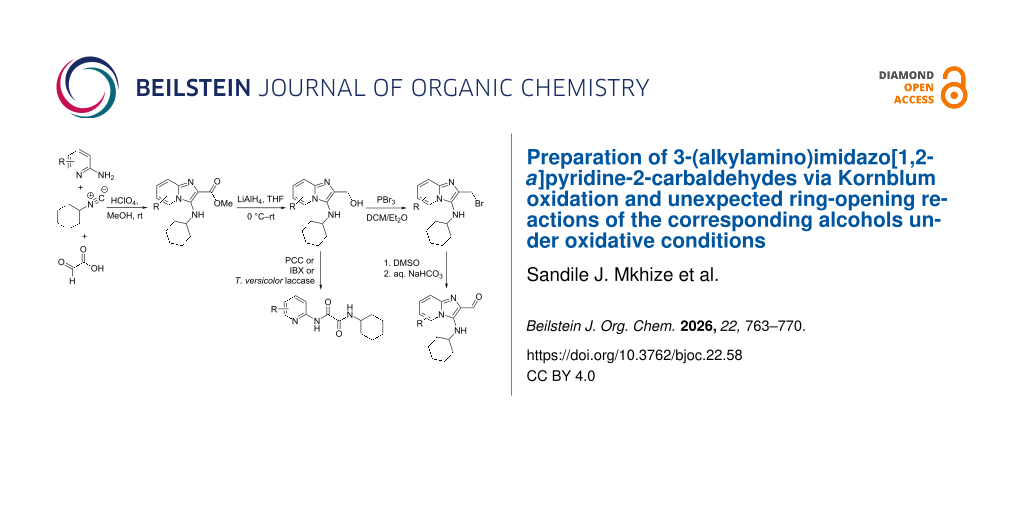
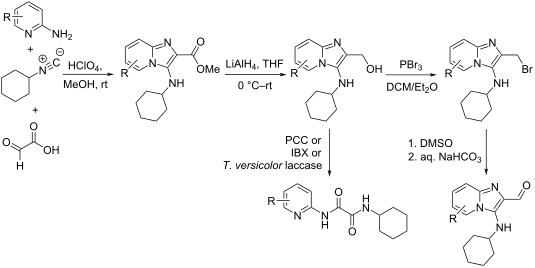
The first synthesis of 3-(alkylamino)imidazo[1,2-a]pyridine-2-carbaldehydes is reported. A Groebke–Blackburn–Bienaymé reaction between 2-aminopyridine derivatives, cyclohexyl isocyanide and glyoxylic acid in the presence of methanol and an acid catalyst gave the 2-ester derivatives that were reduced to give the corresponding alcohols. Mild Kornblum oxidation conditions, reaction in the presence of DMSO and NaHCO3 under conventional or microwave heating to ≈100 °C, were applied to the bromides derived from these alcohols by treatment with PBr3, resulting in the desired aldehydes which successfully underwent reductive amination reactions with 2-chloroaniline. Alternative oxidation conditions such as PCC, IBX or T. versicolor laccase applied to the alcohols led only to oxidative ring-opening to give oxalamide derivatives, with no aldehyde being isolated.
Graphical Abstract
Introduction
Imidazo[1,2-a]pyridines display a wide range of different biological activities, and this scaffold has come to be regarded as being biologically privileged [1]. Compounds containing the imidazo[1,2-a]pyridine core have been found to act on targets in the central nervous system. For example, zolpidem (1) is used for the treatment of sleeping disorders, while alpidem (2), now discontinued due to safety concerns, was used for the treatment of anxiety (Figure 1). Other derivatives are currently under investigation for their CNS-active properties, showing promise for the treatment of conditions such as Parkinson’s disease [2]. Compounds containing the imidazo[1,2-a]pyridine core have also shown potential as anti-infective agents, with some compounds showing activity against Streptococcus pneumoniae (3) [3], tuberculosis (4) [4], and HIV (5), [5] to name a few (Figure 1). The imidazo[1,2-a]pyridine drug zolimidine (6) is used for the treatment of gastroesophageal reflux disease [6] while other compounds have exhibited anticancer [7,8] and anti-inflammatory [9,10] activity. More recently, imidazo[1,2-a]pyridine derivatives have been found to be of interest in the development of organic materials with interesting properties [11,12].
![[1860-5397-22-58-1]](/bjoc/content/figures/1860-5397-22-58-1.svg?scale=2.0&max-width=1024&background=FFFFFF)
Figure 1: Examples of biologically active imidazo[1,2-a]pyridines.
Figure 1: Examples of biologically active imidazo[1,2-a]pyridines.
The importance of imidazo[1,2-a]pyridines is evidenced by the plethora of recent review articles covering methods for their preparation [13-16] and functionalisation reactions [17-19].
Our own interest in the chemistry of imidazo[1,2-a]pyridines arose from the discovery that compounds such as 5 exhibit significant activity against wild-type HIV-1, acting as non-nucleoside reverse transcriptase inhibitors (NNRTIs) [5]. Subsequent investigations revealed that these compounds displayed reduced activity against mutant viral strains, possibly because of a lack of torsional flexibility which could potentially be increased by introduction of a heteroatom between the two aromatic moieties. Thus, we embarked upon this current study to prepare derivatives possessing increased torsional flexibility which might maintain activity against the viral mutants. The plan was to increase compound flexibility through introduction of a bridging nitrogen atom between the imidazopyridine ring and the benzene ring of the original compounds such as 5. Initially, it was envisaged that chemotype 7 could be accessed from the corresponding 2-bromo derivative as shown in Figure 2 (top). Halogen substituents or a cyano group were planned at positions 5 and 6 of the imidazo[1,2-a]pyridine ring and the ortho-chloroaniline moiety was envisaged to be appended directly to position 2 because our earlier studies had shown that anti-HIV activity was highly dependent on the presence of these groups [5]. However, during the course of this work, we discovered a superior strategy to the 2-aminomethyl derivatives 8, as shown in Figure 2 (bottom), which could be easily accessed from the corresponding ester. In this paper, we describe the synthesis of a library of derivatives of 8, whose imidazo[1,2-a]pyridine core could be accessed via the Groebke–Blackburn–Bienayme (GBB) multicomponent coupling reaction [20-23].
![[1860-5397-22-58-2]](/bjoc/content/figures/1860-5397-22-58-2.svg?scale=2.0&max-width=1024&background=FFFFFF)
Figure 2: Compounds envisaged for synthesis.
Figure 2: Compounds envisaged for synthesis.
Results and Discussion
In order to access our initial target compounds 7, the GBB reaction was performed using a suitably substituted 2-aminopyridine 9a–e, cyclohexyl isocyanide (10) and glyoxylic acid monohydrate (11) in the presence of 0.1 equiv HClO4 (relative to aminopyridine) to afford the imidazo[1,2-a]pyridin-3-amine product 12 unsubstituted at position 2 (Scheme 1), using conditions described by Gladysz et al. [24]. Reaction with glyoxylic acid as the aldehyde component has previously been reported to yield the 2-unsubstituted product as a result of in situ decarboxylation [25]. Unexpectedly, on product isolation we discovered that compounds 13a–d, the methyl esters, had been obtained from 2-aminopyridines 9a–d while no reaction was observed for 2-aminopyridine 9e (Scheme 1). We reasoned that at the relatively small scale of the reaction (≈350 mg aminopyridine) and because a period of 30 min stirring of all reactants had been allowed prior to addition of the isocyanide, the glyoxylic acid had undergone in situ esterification in the presence of methanol and the acid catalyst.
![[1860-5397-22-58-i1]](/bjoc/content/inline/1860-5397-22-58-i1.svg?scale=2.0&max-width=1024&background=FFFFFF)
Scheme 1: Preparation of methyl esters 13 versus unsubstituted derivatives 12 under various conditions. Method A: 0.1 equiv HClO4, MeOH, rt (≈350 mg aminopyridine); method B: 1. glyoxylic acid monohydrate, 0.2 equiv HClO4, MeOH, reflux, 2 h; 2. aminopyridine 9, cyclohexyl isocyanide 10, rt, 20–24 h.
Scheme 1: Preparation of methyl esters 13 versus unsubstituted derivatives 12 under various conditions. Metho...
On scaling the reaction (≈2 g aminopyridine), the originally anticipated unsubstituted products 12a–d were prepared as the sole products in yields ranging from 31% to 57%. Once again, only starting material was recovered from reaction of compound 9e. In order to prevent possible mixtures of the two products being formed with slight variation in reaction conditions, the reaction to prepare ester 13 was properly optimised to ensure that full in situ esterification of the glyoxylic acid had taken place before addition of the other reagents. Increasing the amount of acid catalyst to 0.2 equiv significantly increased the yield of the ester products 13, although the yields were still modest (Table 1). A further increase to 0.3 equiv of acid catalyst did not lead to further yield improvement. Compound 9f was also successfully converted into 13f under the conditions shown in Table 1. Nenajdenko et al. reported a few examples of the preparation of imidazo[1,2-a]pyridin-3-amine ethyl esters starting from ethyl glyoxylate in toluene and using ammonium chloride as a catalyst in yields of 30–35% [26].
Table 1: Yield optimisation using varying amounts of acid catalyst.a
| Compound | HClO4 | ||
| 0.1 equiv | 0.2 equiv | 0.3 equiv | |
| 13a | 26% | 41% | 43% |
| 13b | 28% | 58% | 56% |
| 13c | 42% | 51% | 48% |
| 13d | 44% | 55% | 56% |
| 13f | – | 51% | – |
aReaction conditions: aminopyridine (1 equiv), cyclohexyl isocyanide (1.1 equiv), glyoxylic acid monohydrate (1.5 equiv), perchloric acid as specified above.
With the relatively facile preparation of esters 13a–d and 13f now demonstrated, we shifted our focus to investigate possible routes to compounds such as 8, that have not been reported previously. There were three immediate possibilities to consider: i) reaction of the ester directly with 2-chloroaniline, followed by reduction; ii) reaction of the corresponding carboxylic acid with 2-chloroaniline under peptide-coupling conditions followed by reduction; and iii) reduction of the ester to the aldehyde, followed by reductive amination to give compounds 8. Initial attempts at direct conversion of ester 13b into the corresponding amide using AlCl3 were not promising and therefore the hydrolysis of this ester to corresponding carboxylic acid 14 was tested. Using KOH in MeOH at 35–40 °C for the ester hydrolysis reaction resulted in decarboxylated compound 12b being isolated as the sole product in 60% yield (Scheme 2).
![[1860-5397-22-58-i2]](/bjoc/content/inline/1860-5397-22-58-i2.svg?scale=2.0&max-width=1024&background=FFFFFF)
Scheme 2: Ester hydrolysis and in situ decarboxylation.
Scheme 2: Ester hydrolysis and in situ decarboxylation.
Interestingly, there appears to be only one report, in the patent literature [27], of a compound (15) containing both 2-carboxylic acid and 3-alkylamino substituents (Figure 3). The unsubstituted 3-aminoimidazo[1,2-a]pyridine-2-carboxylic acid (16) has also been reported [28]. The very small number of compounds of this type reported is suggestive of their inherent instability and their tendency to readily decarboxylate.
![[1860-5397-22-58-3]](/bjoc/content/figures/1860-5397-22-58-3.svg?scale=2.0&max-width=1024&background=FFFFFF)
Figure 3: Previously reported 3-amino-2-carboxylic acid derivatives.
Figure 3: Previously reported 3-amino-2-carboxylic acid derivatives.
Having ruled out using a peptide-coupling approach we moved to investigate the preparation of the 2-substituted aldehyde derivative, with subsequent reductive amination in mind. Imidazo[1,2-a]pyridin-3-amines bearing an aldehyde substituent at the 2-position have not been previously reported and we were uncertain as to their stability. Attempted reduction of the ester (13b) to the corresponding aldehyde using DIBAL-H met with failure, with unreacted ester being recovered. Thus, for the preparation of the aldehydes we opted for reduction of the esters 13a–d and 13f to their corresponding alcohol derivatives (17) followed by oxidation to the aldehyde. Esters 13a–c were readily converted into the corresponding alcohols 17a–c in excellent yields of 92–99% using LiAlH4 reduction (Scheme 3). Unexpectedly, reduction of 13d and 13f led to the same compound, the dehalogenated derivative 17d in 96% and 51% yield, respectively, presumably through nucleophilic aromatic substitution [29].
![[1860-5397-22-58-i3]](/bjoc/content/inline/1860-5397-22-58-i3.svg?scale=2.0&max-width=1024&background=FFFFFF)
Scheme 3: Ester reduction to the corresponding alcohols. Reaction yields are provided in parentheses.
Scheme 3: Ester reduction to the corresponding alcohols. Reaction yields are provided in parentheses.
Oxidation of alcohols 17a–d using pyridinium chlorochromate (PCC) did not lead to the anticipated aldehyde derivatives. Although a cursory inspection of the 1H NMR spectrum seemed to indicate that an aldehyde had been formed, with a single proton signal appearing at 9.8 ppm (Figure S24, in Supporting Information File 1), on closer inspection it became clear that there was an additional proton observed in the aromatic region and one missing from the aliphatic region.
Crystals were grown for the unexpected oxidation product formed from 17a and X-ray crystallography revealed that oxidative ring-opening had occurred to give product 18a (Figure 4).
![[1860-5397-22-58-4]](/bjoc/content/figures/1860-5397-22-58-4.png?scale=2.0&max-width=1024&background=FFFFFF)
Figure 4: Single crystal X-ray structure of 18a. ORTEP diagram drawn at 50% probability level.
Figure 4: Single crystal X-ray structure of 18a. ORTEP diagram drawn at 50% probability level.
Carrying out similar reactions on alcohols 17b–d led to the corresponding ring-opened products 18b–d (Scheme 4). The ring-opened products were isolated in yields of 26–36%, with loss of one carbon atom occurring (-CH2OH).
![[1860-5397-22-58-i4]](/bjoc/content/inline/1860-5397-22-58-i4.svg?scale=2.0&max-width=1024&background=FFFFFF)
Scheme 4: Oxidative ring-opening with loss of one carbon atom. Yields are provided in parentheses.
Scheme 4: Oxidative ring-opening with loss of one carbon atom. Yields are provided in parentheses.
To test whether C-2 decarboxylation could have immediately preceded ring-opening, decarboxylated compound 12b was subjected to the same oxidative conditions applied to 17 and the reaction mixture was monitored for any sign of compound 18b (Scheme 5). Only starting material was isolated from the reaction, indicating that it is unlikely that decarboxylation is the first step of the ring-opening mechanism.
![[1860-5397-22-58-i5]](/bjoc/content/inline/1860-5397-22-58-i5.svg?scale=2.0&max-width=1024&background=FFFFFF)
Scheme 5: Oxidative conditions applied to decarboxylated compound 12b.
Scheme 5: Oxidative conditions applied to decarboxylated compound 12b.
Oxidative ring-opening of imidazo[1,2-a]pyridines has been reported previously, but in these cases different ring-opened products were identified. These previous results are compared to our present report in Figure 5. Wang and co-workers [30] reported ring-opening accompanied by loss of a carbon atom, giving rise to benzamides, while Wu and co-workers [31] reported ring-opening to give either benzamides or α-ketoamides. This is in contrast to our own report, where only the oxalamide derivatives 18 were isolated.
![[1860-5397-22-58-5]](/bjoc/content/figures/1860-5397-22-58-5.svg?scale=2.0&max-width=1024&background=FFFFFF)
Figure 5: Different oxidative cleavage products obtained under different conditions.
Figure 5: Different oxidative cleavage products obtained under different conditions.
Two other oxidation methods, IBX and enzymatic oxidation using T. versicolor laccase in the presence of TEMPO and O2, were tested on compounds 17 in order to obtain the corresponding aldehydes, but both of these methods also gave rise to the ring-opened products 18. A detailed investigation into the mechanism of this ring-opening reaction was not conducted. However, this failure to obtain the desired aldehydes led to a modification of the planned synthesis. A decision was made to convert alcohols 17 into the corresponding tosylate derivatives 19 (Scheme 6) and then react these with anilines to obtain the desired products 8. To our complete surprise, reaction of 17b and 17d under typical tosylation conditions gave none of the anticipated tosylate derivatives 19 but instead gave small quantities of the elusive aldehydes 20b (5%) and 20d (12%), together with unreacted starting material. This result showed that these aldehydes are indeed stable and isolable, once prepared. 3-(Alkylamino)imidazo[1,2-a]pyridine-2-carbaldehydes have not been previously reported, but there is a single report of the N-unsubstituted 2-formyl-3-aminoimidazo[1,2-a]pyridine, prepared from the corresponding nitro-derivative [32].
![[1860-5397-22-58-i6]](/bjoc/content/inline/1860-5397-22-58-i6.svg?scale=2.0&max-width=1024&background=FFFFFF)
Scheme 6: Unexpected aldehyde formation from tosylation reaction.
Scheme 6: Unexpected aldehyde formation from tosylation reaction.
The conversion of tosylates (or halides) into their corresponding aldehydes, which might have occurred here, can be achieved by means of the Kornblum oxidation [33] and thus our attention turned to the very mild oxidation conditions of this reaction and we did not explore the tosylation reaction further. Conversion of the alcohols 17a–d into bromides 21a–d was successfully achieved using PBr3 and the bromides were further reacted in situ, due to their highly hygroscopic nature, into the corresponding aldehydes 20a–d using Kornblum conditions (Scheme 7). The reaction could be carried out under conventional heating or using microwave irradiation.
![[1860-5397-22-58-i7]](/bjoc/content/inline/1860-5397-22-58-i7.svg?scale=2.0&max-width=1024&background=FFFFFF)
Scheme 7: Kornblum oxidation to give imidazo[1,2-a]pyridine-2-carbaldehydes 20. Yield over two steps from the alcohol is shown in parentheses. Compound 20d was used crude in the reductive amination reaction.
Scheme 7: Kornblum oxidation to give imidazo[1,2-a]pyridine-2-carbaldehydes 20. Yield over two steps from the...
The aldehydes 20a–d were successfully subjected to reductive amination conditions to give the desired amine products 8a–d (Scheme 8). To the best of our knowledge, this is the first reported synthesis of aldehydes 20 and products of reductive amination, such as 8.
![[1860-5397-22-58-i8]](/bjoc/content/inline/1860-5397-22-58-i8.svg?scale=2.0&max-width=1024&background=FFFFFF)
Scheme 8: Reductive amination reactions to give target molecules 8.
Scheme 8: Reductive amination reactions to give target molecules 8.
Conclusion
A method for the preparation of 3-(alkylamino)imidazo[1,2-a]pyridine-2-carbaldehydes has been developed that proceeds via the 2-methyl esters resulting from the Groebke–Blackburn–Bienaymé reaction, followed by reduction to the corresponding alcohols, bromination and then mild Kornblum oxidation. Other typical oxidation reagents such as PCC, IBX and laccase gave only a ring-opened oxalamide product, resulting from oxidative ring-opening. Aldehydes prepared were subjected to reaction with 2-chloroaniline in the presence of sodium cyanoborohydride to give the corresponding reductive amination products which will be tested for activity against HIV-1 reverse transcriptase in due course.
Supporting Information
| Supporting Information File 1: Experimental procedures, copies of NMR spectra and X-ray data of compound 18a. | ||
| Format: PDF | Size: 7.2 MB | Download |
Acknowledgements
The authors thank Matthew Bracken for the acquisition of the X-ray data. This work is based on Sandile J. Mkhize’s MSc dissertation (“Exploration of the synthesis of imidazo[1,2-a]pyridin-3-amine derivatives with heteroatom linkers as potential HIV-1 reverse transcriptase inhibitors”, University of the Witwatersrand, 2022).
Funding
The authors would like to acknowledge the following funding sources: Medical Research Council (MRC) for funding through an SIR grant (MLB), the National Research Foundation of South Africa, CSIR and Wits University. In terms of equipment funding, we thank the NRF and the University of the Witwatersrand for generous funding to enable the purchase of a dual-wavelength hybrid diamond anode X-ray diffractometer (Bruker D8 Discovery Bio equipped with Mo and Cu X-ray sources) under NEP Grant No 129920.
Data Availability Statement
All data that supports the findings of this study is available in the published article and/or the supporting information of this article. CCDC deposition number 2533649 contains the supplementary crystallographic data for this paper.
References
-
Devi, N.; Rawal, R. K.; Singh, V. Tetrahedron 2015, 71, 183–232. doi:10.1016/j.tet.2014.10.032
Return to citation in text: [1] -
Vanda, D.; Zajdel, P.; Soural, M. Eur. J. Med. Chem. 2019, 181, 111569. doi:10.1016/j.ejmech.2019.111569
Return to citation in text: [1] -
Jahan, K.; Battaje, R. R.; Pratap, V.; Ahire, G.; Pushpakaran, A.; Ashtam, A.; Bharatam, P. V.; Panda, D. Eur. J. Med. Chem. 2024, 267, 116196. doi:10.1016/j.ejmech.2024.116196
Return to citation in text: [1] -
Samanta, S.; Kumar, S.; Aratikatla, E. K.; Ghorpade, S. R.; Singh, V. RSC Med. Chem. 2023, 14, 644–657. doi:10.1039/d3md00019b
Return to citation in text: [1] -
Bode, M. L.; Gravestock, D.; Moleele, S. S.; van der Westhuyzen, C. W.; Pelly, S. C.; Steenkamp, P. A.; Hoppe, H. C.; Khan, T.; Nkabinde, L. A. Bioorg. Med. Chem. 2011, 19, 4227–4237. doi:10.1016/j.bmc.2011.05.062
Return to citation in text: [1] [2] [3] -
Prasher, P.; Sharma, M. Chem. Pap. 2024, 78, 93–109. doi:10.1007/s11696-023-03119-1
Return to citation in text: [1] -
Dam, J.; Ismail, Z.; Kurebwa, T.; Gangat, N.; Harmse, L.; Marques, H. M.; Lemmerer, A.; Bode, M. L.; de Koning, C. B. Eur. J. Med. Chem. 2017, 126, 353–368. doi:10.1016/j.ejmech.2016.10.041
Return to citation in text: [1] -
An, W.; Wang, W.; Yu, T.; Zhang, Y.; Miao, Z.; Meng, T.; Shen, J. Eur. J. Med. Chem. 2016, 112, 367–372. doi:10.1016/j.ejmech.2016.02.004
Return to citation in text: [1] -
Hieke, M.; Rödl, C. B.; Wisniewska, J. M.; la Buscató, E.; Stark, H.; Schubert-Zsilavecz, M.; Steinhilber, D.; Hofmann, B.; Proschak, E. Bioorg. Med. Chem. Lett. 2012, 22, 1969–1975. doi:10.1016/j.bmcl.2012.01.038
Return to citation in text: [1] -
Kraft, F. B.; Enns, J.; Honin, I.; Engelhardt, J.; Schöler, A.; Smith, S. T.; Meiler, J.; Schäker-Hübner, L.; Weindl, G.; Hansen, F. K. Bioorg. Chem. 2024, 143, 107072. doi:10.1016/j.bioorg.2023.107072
Return to citation in text: [1] -
Zucolotto Cocca, L. H.; Valverde, J. V. P.; le Bescont, J.; Breton-Patient, C.; Piguel, S.; Silva, D. L.; Mendonca, C. R.; De Boni, L. J. Mol. Struct. 2024, 1300, 137221. doi:10.1016/j.molstruc.2023.137221
Return to citation in text: [1] -
Bedard, N.; Coen, A. G.; Pekarske, S.; Sennett, A.; Davis, G. J.; Chavez, T.; Lichtenberger, D. L.; Hulme, C. Tetrahedron Lett. 2023, 130, 154748. doi:10.1016/j.tetlet.2023.154748
Return to citation in text: [1] -
Panda, J.; Raiguru, B. P.; Mishra, M.; Mohapatra, S.; Nayak, S. ChemistrySelect 2022, 7, e202103987. doi:10.1002/slct.202103987
Return to citation in text: [1] -
Kurteva, V. ACS Omega 2021, 6, 35173–35185. doi:10.1021/acsomega.1c03476
Return to citation in text: [1] -
Tali, J. A.; Kumar, G.; Sharma, B. K.; Rasool, Y.; Sharma, Y.; Shankar, R. Org. Biomol. Chem. 2023, 21, 7267–7289. doi:10.1039/d3ob00849e
Return to citation in text: [1] -
Bhatt, K.; Patel, D.; Rathod, M.; Patel, A.; Shah, D. Curr. Org. Chem. 2022, 26, 2016–2054. doi:10.2174/1385272827666230123124441
Return to citation in text: [1] -
Konwar, D.; Bora, U. ChemistrySelect 2021, 6, 2716–2744. doi:10.1002/slct.202100144
Return to citation in text: [1] -
Tashrifi, Z.; Mohammadi‐Khanaposhtani, M.; Larijani, B.; Mahdavi, M. Eur. J. Org. Chem. 2020, 269–284. doi:10.1002/ejoc.201901491
Return to citation in text: [1] -
Sofi, F. A.; Gogde, K.; Mukherjee, D.; Masoodi, M. H. J. Mol. Struct. 2024, 1297, 137012. doi:10.1016/j.molstruc.2023.137012
Return to citation in text: [1] -
Groebke, K.; Weber, L.; Mehlin, F. Synlett 1998, 661–663. doi:10.1055/s-1998-1721
Return to citation in text: [1] -
Blackburn, C.; Guan, B.; Fleming, P.; Shiosaki, K.; Tsai, S. Tetrahedron Lett. 1998, 39, 3635–3638. doi:10.1016/s0040-4039(98)00653-4
Return to citation in text: [1] -
Bienaymé, H.; Bouzid, K. Angew. Chem., Int. Ed. 1998, 37, 2234–2237. doi:10.1002/(sici)1521-3773(19980904)37:16<2234::aid-anie2234>3.0.co;2-r
Return to citation in text: [1] -
Martini, C.; Mardjan, M. I. D.; Basso, A. Beilstein J. Org. Chem. 2024, 20, 1839–1879. doi:10.3762/bjoc.20.162
Return to citation in text: [1] -
Gladysz, R.; Adriaenssens, Y.; De Winter, H.; Joossens, J.; Lambeir, A.-M.; Augustyns, K.; Van der Veken, P. J. Med. Chem. 2015, 58, 9238–9257. doi:10.1021/acs.jmedchem.5b01171
Return to citation in text: [1] -
Lyon, M. A.; Kercher, T. S. Org. Lett. 2004, 6, 4989–4992. doi:10.1021/ol0478234
Return to citation in text: [1] -
Nenajdenko, V. G.; Reznichenko, A. L.; Balenkova, E. S. Russ. Chem. Bull. 2007, 56, 560–562. doi:10.1007/s11172-007-0093-1
Return to citation in text: [1] -
Lee, K. C.; Sun, E. T.; Wang, H. Imidazo[1,2-a]pyridine derivatives: preparation and pharmaceutical applications. U.S. Pat. Appl. US20080085896A1, April 10, 2008.
Return to citation in text: [1] -
Márquez-Flores, Y. K.; Campos-Aldrete, M. E.; Salgado-Zamora, H.; Correa-Basurto, J.; Meléndez-Camargo, M. E. Med. Chem. Res. 2012, 21, 3491–3498. doi:10.1007/s00044-011-9870-3
Return to citation in text: [1] -
Changunda, C. R. K.; Venkatesh, B. C.; Mokone, W. K.; Rousseau, A. L.; Brady, D.; Fernandes, M. A.; Bode, M. L. RSC Adv. 2020, 10, 8104–8114. doi:10.1039/c9ra10447j
Return to citation in text: [1] -
Yan, K.; Yang, D.; Wei, W.; Li, G.; Sun, M.; Zhang, Q.; Tian, L.; Wang, H. RSC Adv. 2015, 5, 100102–100105. doi:10.1039/c5ra17740e
Return to citation in text: [1] -
Xu, F.; Wang, Y.; Xun, X.; Huang, Y.; Jin, Z.; Song, B.; Wu, J. J. Org. Chem. 2019, 84, 8411–8422. doi:10.1021/acs.joc.9b00208
Return to citation in text: [1] -
Desbois, N.; Chezal, J.-M.; Fauvelle, F.; Debouzy, J.-C.; Lartigue, C.; Gueiffier, A.; Blache, Y.; Moreau, E.; Madelmont, J.-C.; Chavignon, O.; Teulade, J.-C. Heterocycles 2005, 65, 1121–1137. doi:10.3987/com-05-10354
Return to citation in text: [1] -
Kornblum, N.; Jones, W. J.; Anderson, G. J. J. Am. Chem. Soc. 1959, 81, 4113–4114. doi:10.1021/ja01524a080
Return to citation in text: [1]
| 28. | Márquez-Flores, Y. K.; Campos-Aldrete, M. E.; Salgado-Zamora, H.; Correa-Basurto, J.; Meléndez-Camargo, M. E. Med. Chem. Res. 2012, 21, 3491–3498. doi:10.1007/s00044-011-9870-3 |
| 26. | Nenajdenko, V. G.; Reznichenko, A. L.; Balenkova, E. S. Russ. Chem. Bull. 2007, 56, 560–562. doi:10.1007/s11172-007-0093-1 |
| 27. | Lee, K. C.; Sun, E. T.; Wang, H. Imidazo[1,2-a]pyridine derivatives: preparation and pharmaceutical applications. U.S. Pat. Appl. US20080085896A1, April 10, 2008. |
| 1. | Devi, N.; Rawal, R. K.; Singh, V. Tetrahedron 2015, 71, 183–232. doi:10.1016/j.tet.2014.10.032 |
| 5. | Bode, M. L.; Gravestock, D.; Moleele, S. S.; van der Westhuyzen, C. W.; Pelly, S. C.; Steenkamp, P. A.; Hoppe, H. C.; Khan, T.; Nkabinde, L. A. Bioorg. Med. Chem. 2011, 19, 4227–4237. doi:10.1016/j.bmc.2011.05.062 |
| 24. | Gladysz, R.; Adriaenssens, Y.; De Winter, H.; Joossens, J.; Lambeir, A.-M.; Augustyns, K.; Van der Veken, P. J. Med. Chem. 2015, 58, 9238–9257. doi:10.1021/acs.jmedchem.5b01171 |
| 4. | Samanta, S.; Kumar, S.; Aratikatla, E. K.; Ghorpade, S. R.; Singh, V. RSC Med. Chem. 2023, 14, 644–657. doi:10.1039/d3md00019b |
| 25. | Lyon, M. A.; Kercher, T. S. Org. Lett. 2004, 6, 4989–4992. doi:10.1021/ol0478234 |
| 3. | Jahan, K.; Battaje, R. R.; Pratap, V.; Ahire, G.; Pushpakaran, A.; Ashtam, A.; Bharatam, P. V.; Panda, D. Eur. J. Med. Chem. 2024, 267, 116196. doi:10.1016/j.ejmech.2024.116196 |
| 5. | Bode, M. L.; Gravestock, D.; Moleele, S. S.; van der Westhuyzen, C. W.; Pelly, S. C.; Steenkamp, P. A.; Hoppe, H. C.; Khan, T.; Nkabinde, L. A. Bioorg. Med. Chem. 2011, 19, 4227–4237. doi:10.1016/j.bmc.2011.05.062 |
| 33. | Kornblum, N.; Jones, W. J.; Anderson, G. J. J. Am. Chem. Soc. 1959, 81, 4113–4114. doi:10.1021/ja01524a080 |
| 2. | Vanda, D.; Zajdel, P.; Soural, M. Eur. J. Med. Chem. 2019, 181, 111569. doi:10.1016/j.ejmech.2019.111569 |
| 20. | Groebke, K.; Weber, L.; Mehlin, F. Synlett 1998, 661–663. doi:10.1055/s-1998-1721 |
| 21. | Blackburn, C.; Guan, B.; Fleming, P.; Shiosaki, K.; Tsai, S. Tetrahedron Lett. 1998, 39, 3635–3638. doi:10.1016/s0040-4039(98)00653-4 |
| 22. | Bienaymé, H.; Bouzid, K. Angew. Chem., Int. Ed. 1998, 37, 2234–2237. doi:10.1002/(sici)1521-3773(19980904)37:16<2234::aid-anie2234>3.0.co;2-r |
| 23. | Martini, C.; Mardjan, M. I. D.; Basso, A. Beilstein J. Org. Chem. 2024, 20, 1839–1879. doi:10.3762/bjoc.20.162 |
| 11. | Zucolotto Cocca, L. H.; Valverde, J. V. P.; le Bescont, J.; Breton-Patient, C.; Piguel, S.; Silva, D. L.; Mendonca, C. R.; De Boni, L. J. Mol. Struct. 2024, 1300, 137221. doi:10.1016/j.molstruc.2023.137221 |
| 12. | Bedard, N.; Coen, A. G.; Pekarske, S.; Sennett, A.; Davis, G. J.; Chavez, T.; Lichtenberger, D. L.; Hulme, C. Tetrahedron Lett. 2023, 130, 154748. doi:10.1016/j.tetlet.2023.154748 |
| 17. | Konwar, D.; Bora, U. ChemistrySelect 2021, 6, 2716–2744. doi:10.1002/slct.202100144 |
| 18. | Tashrifi, Z.; Mohammadi‐Khanaposhtani, M.; Larijani, B.; Mahdavi, M. Eur. J. Org. Chem. 2020, 269–284. doi:10.1002/ejoc.201901491 |
| 19. | Sofi, F. A.; Gogde, K.; Mukherjee, D.; Masoodi, M. H. J. Mol. Struct. 2024, 1297, 137012. doi:10.1016/j.molstruc.2023.137012 |
| 31. | Xu, F.; Wang, Y.; Xun, X.; Huang, Y.; Jin, Z.; Song, B.; Wu, J. J. Org. Chem. 2019, 84, 8411–8422. doi:10.1021/acs.joc.9b00208 |
| 9. | Hieke, M.; Rödl, C. B.; Wisniewska, J. M.; la Buscató, E.; Stark, H.; Schubert-Zsilavecz, M.; Steinhilber, D.; Hofmann, B.; Proschak, E. Bioorg. Med. Chem. Lett. 2012, 22, 1969–1975. doi:10.1016/j.bmcl.2012.01.038 |
| 10. | Kraft, F. B.; Enns, J.; Honin, I.; Engelhardt, J.; Schöler, A.; Smith, S. T.; Meiler, J.; Schäker-Hübner, L.; Weindl, G.; Hansen, F. K. Bioorg. Chem. 2024, 143, 107072. doi:10.1016/j.bioorg.2023.107072 |
| 5. | Bode, M. L.; Gravestock, D.; Moleele, S. S.; van der Westhuyzen, C. W.; Pelly, S. C.; Steenkamp, P. A.; Hoppe, H. C.; Khan, T.; Nkabinde, L. A. Bioorg. Med. Chem. 2011, 19, 4227–4237. doi:10.1016/j.bmc.2011.05.062 |
| 32. | Desbois, N.; Chezal, J.-M.; Fauvelle, F.; Debouzy, J.-C.; Lartigue, C.; Gueiffier, A.; Blache, Y.; Moreau, E.; Madelmont, J.-C.; Chavignon, O.; Teulade, J.-C. Heterocycles 2005, 65, 1121–1137. doi:10.3987/com-05-10354 |
| 7. | Dam, J.; Ismail, Z.; Kurebwa, T.; Gangat, N.; Harmse, L.; Marques, H. M.; Lemmerer, A.; Bode, M. L.; de Koning, C. B. Eur. J. Med. Chem. 2017, 126, 353–368. doi:10.1016/j.ejmech.2016.10.041 |
| 8. | An, W.; Wang, W.; Yu, T.; Zhang, Y.; Miao, Z.; Meng, T.; Shen, J. Eur. J. Med. Chem. 2016, 112, 367–372. doi:10.1016/j.ejmech.2016.02.004 |
| 29. | Changunda, C. R. K.; Venkatesh, B. C.; Mokone, W. K.; Rousseau, A. L.; Brady, D.; Fernandes, M. A.; Bode, M. L. RSC Adv. 2020, 10, 8104–8114. doi:10.1039/c9ra10447j |
| 6. | Prasher, P.; Sharma, M. Chem. Pap. 2024, 78, 93–109. doi:10.1007/s11696-023-03119-1 |
| 13. | Panda, J.; Raiguru, B. P.; Mishra, M.; Mohapatra, S.; Nayak, S. ChemistrySelect 2022, 7, e202103987. doi:10.1002/slct.202103987 |
| 14. | Kurteva, V. ACS Omega 2021, 6, 35173–35185. doi:10.1021/acsomega.1c03476 |
| 15. | Tali, J. A.; Kumar, G.; Sharma, B. K.; Rasool, Y.; Sharma, Y.; Shankar, R. Org. Biomol. Chem. 2023, 21, 7267–7289. doi:10.1039/d3ob00849e |
| 16. | Bhatt, K.; Patel, D.; Rathod, M.; Patel, A.; Shah, D. Curr. Org. Chem. 2022, 26, 2016–2054. doi:10.2174/1385272827666230123124441 |
| 30. | Yan, K.; Yang, D.; Wei, W.; Li, G.; Sun, M.; Zhang, Q.; Tian, L.; Wang, H. RSC Adv. 2015, 5, 100102–100105. doi:10.1039/c5ra17740e |
© 2026 Mkhize et al.; licensee Beilstein-Institut.
This is an open access article licensed under the terms of the Beilstein-Institut Open Access License Agreement (https://www.beilstein-journals.org/bjoc/terms), which is identical to the Creative Commons Attribution 4.0 International License (https://creativecommons.org/licenses/by/4.0). The reuse of material under this license requires that the author(s), source and license are credited. Third-party material in this article could be subject to other licenses (typically indicated in the credit line), and in this case, users are required to obtain permission from the license holder to reuse the material.