Abstract
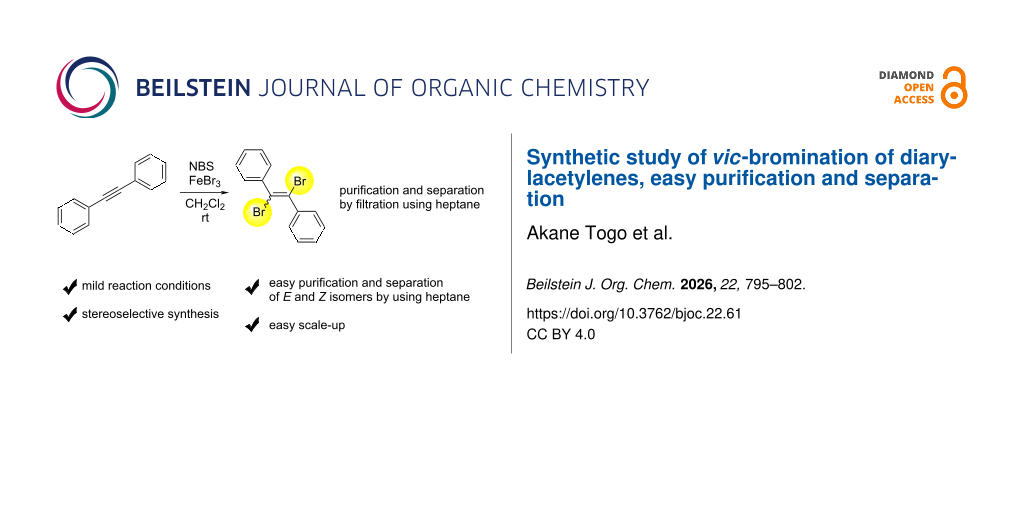
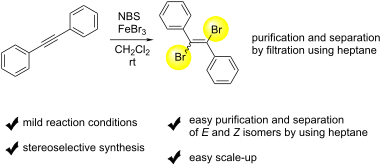
E-Selective bromination for diphenylacetylene was established by using the combination of NBS and FeBr3 in CH2Cl2. In addition, easy purification and separation from the crude product were found. When the crude product was treated with heptane, the E isomer could be recovered as a solid material by utilizing the difference in solubility. On the other hand, the Z isomer could be removed by filtration while remaining in solution.
Graphical Abstract
Introduction
The addition reaction of bromine to diphenylacetylene is one of basic reactions and is recognized as important, because resulting 1,2-dibromo-1,2-diphenylethylene can serve as a precursor for various molecular transformations in organic synthesis [1,2]. This reaction seems to be simple, but some reported studies suggest that it is surprisingly difficult to obtain the E isomer selectively (Scheme 1). For selected examples, Espenson and co-workers reported in 1999 that E-selective bromination of diphenylacetylene took place by using H2O2, NaBr, and AcOH in the presence of MTO (methyltrioxorhenium(VII)) to give (E)-1,2-dibromo-1,2-diphenylethylene, selectively (Scheme 1a) [3]. However, MTO is an expensive reagent and a more versatile synthetic method is highly needed. As a simple method, the reaction of diphenylacetylene and Br2 in CH2Cl2 was reported by Glorius in 2007 [4], but the selectivity was reported for the Z isomer (Scheme 1b). As another example in 2008, Adimurthy and co-workers proposed the combination of NaBr-NaBrO3 in AcOH in order to prepare in-situ generated Br2, which was reacted with diphenylacetylene to give no selectivity between E and Z isomers of 1,2-dibromo-1,2-diphenylethylenes (Scheme 1c) [5]. Previous studies reported the selective synthesis of (E)-1,2-dibromo-1,2-diphenylethylene and related compounds, but Br2 or expensive reagent, which was difficult to handle, was often used [6-15].
![[1860-5397-22-61-i1]](/bjoc/content/inline/1860-5397-22-61-i1.svg?scale=2.0&max-width=1024&background=FFFFFF)
Scheme 1: Selected and previous reports for bromination of diphenylacetylenes (a–c), and this work (d).
Scheme 1: Selected and previous reports for bromination of diphenylacetylenes (a–c), and this work (d).
Based on these research backgrounds, we have also been interested in the selective synthesis of the E isomer of 1,2-dibromo-1,2-diphenylethylene, together with simple purification and separation toward process chemistry, because the compound is an attractive synthetic intermediate for further transformations. During the course of our studies, we have found that the combination of NBS (N-bromosuccinimide) and FeBr3 in CH2Cl2 was good for the reaction with diphenylacetylene [16-19] to give 1,2-dibromo-1,2-diphenylethylene with high E-selectivity. The present method has some advantages. First, is mild reaction conditions, and second is stereoselective synthesis. In addition, we have found an easy purification and separation method of E and Z isomers of the crude product by using heptane. The method utilizes the difference in solubility of E and Z isomers. Because of this technique, the purification, separation, and scale-up were easy to perform. In this paper, we wish to report the details of the results.
Results and Discussion
In order to obtain the E isomer of 1,2-dibromo-1,2-diphenylethylene, we have examined the reaction regarding optimized conditions (Table 1). The typical procedure is as follows: the reaction of diphenylacetylene (1a, 0.5 mmol) with NBS (N-bromosuccinimide, X equiv), FeBr3 (1.0 equiv), n-Bu4NBr (Y equiv), and TEMPO (2,2,6,6-tetramethylpiperidine 1-oxyl free radical, Z equiv) in solvent (2 mL) at the desired temperature was conducted for 23 h or 2 h. After the reaction, the typical work-up procedure was carried out and the crude product was analyzed for the ratio of E and Z isomers and starting material 1a, by using HPLC. Purification and separation from the crude product was conducted by the filtration using heptane (Table 1). At first, we have recognized that E-2a is solid and Z-2a is liquid in heptane. After various considerations, we found that E-2a could be isolated by only filtration, utilizing the difference in solubility of E-2a and Z-2a in heptane from the crude product.
Table 1: Reaction optimization of bromination reaction of diphenylacetylene (1a).
![[Graphic 1]](/bjoc/content/inline/1860-5397-22-61-i4.svg?max-width=637&scale=1.0)
|
|||||||
| Entry |
NBS
(X equiv) |
n-Bu4NBr
(Y equiv) |
TEMPO
(Z equiv) |
Temp. (oC) | Solvent | Ratio of E-2a/Z-2a/1aa |
Yield (%)
of E-2ab |
| 1c | 2.2 | 0 | 0 | rt | CH2Cl2 | 86:14:0 | 78 |
| 2c,d | 2.2 | 0 | 0 | rt | CH2Cl2 | 87:13:0 | 78 |
| 3d | 1.2 | 0 | 0 | rt | CH2Cl2 | 88:12:0 | 79 |
| 4 | 2.2 | 0 | 1.0 | rt | CH2Cl2 | 91:8:1 | 77 |
| 5d | 2.2 | 0.5 | 1.0 | rt | CH2Cl2 | 80:2:18 | 73 |
| 6d | 2.2 | 1.0 | 1.0 | rt | CH2Cl2 | 55:0:45 | 47 |
| 7 | 2.2 | 1.0 | 0.2 | rt | CH2Cl2 | 88:12:0 | 79 |
| 8 | 2.2 | 1.0 | 0.5 | rt | CH2Cl2 | 78:2:20 | 68 |
| 9e | 2.2 | 1.0 | 0 | rt | CH2Cl2 | 82:18:0 | 72 |
| 10 | 2.2 | 1.0 | 0.5 | 40 | CH2Cl2 | 85:3:12 | 70 |
| 11 | 2.2 | 1.0 | 0.5 | 60 | C2H8Cl2 | 72:3:25 | 63 |
| 12 | 2.2 | 0 | 0 | rt | C2H8Cl2 | 58:42:0 | 54 |
aCalculated from the ratio of HPLC area for the crude product. bIsolated yield of E-2a by filtration with heptane from the crude product. The yield of E-2a was obtained from the solids recovered after the filtration. cReaction time was 2 hours. dCalculated from the ratio of GC area for the crude product. eReaction time was 5 hours. C2H8Cl2 = 1,2-dichloroethane.
In Table 1, entry 1, the combination of NBS (2.2 equiv) and FeBr3 (1.0 equiv) for 2 h gave the ratio of E-2a/Z-2a/1a such as 86:14:0 by HPLC, in which E-2a was obtained in 78% yield. Similarly, to examine the reproducibility of the chemical yield and the ratio of E-2a/Z-2a/1a by GC analysis, Table 1, entry 2 was shown. The reaction time of 2 h gave the same ratio of E-2a/Z-2a/1a by GC analysis, and E-2a was obtained in 78% yield (Table 1, entry 2). The use of a smaller amount of NBS (1.2 equiv) did not result in a decrease of yield, indicating that FeBr3 is thought to be one of the sources of bromine (Table 1, entry 3). To increase the chemical yield and ratio of E-2a/Z-2a/1a, various parameters such as NBS, n-Bu4NBr, TEMPO, temperature, and solvent were examined (Table 1, entries 3–12). Because there was a possibility that a bromine radical was involved, TEMPO was used for the purpose of the ratio-control of E and Z isomers. TEMPO was found to have a tendency to suppress the generation of Z-2a in CH2Cl2 (Table 1, entries 6 and 8) [20]. Among Table 1, entries 5–11, the addition of n-Bu4NBr did not seem to have any effect. Instead of CH2Cl2, C2H8Cl2 (1,2-dichloroethane) was used as the solvent, but the yield of E-2a was decreased (Table 1, entries 11 and 12). Generally, decomposition of the product or over reaction was not observed by GC and/or GC–MS analysis, in the case of the longer reaction time of 23 h. We have examined other Lewis acids such as ZnBr2, LiBr, and FeBr2 instead of the use of FeBr3 under similar reaction conditions. The use of ZnBr2 for reaction time of 4 h showed a ratio of E-2a/Z-2a/1a = 86:14:0 by HPLC analysis and 68% yield of E-2a. In the case of LiBr, the desired reaction progressed only slightly, even after two days, and the ratio of E-2a/Z-2a/1a = 17:3:80 was indicated by GC analysis. In addition, the use of FeBr2 for a reaction time of 3 h gave an E-2a/Z-2a/1a ratio of 67:13:20 by GC analysis and 57% yield of E-2a. Based on these investigations, we have adopted the conditions of Table 1, entry 2, because better chemical yield of E-2a as well as a higher ratio of E-2a/Z-2a/1a with short reaction time were attractive for chemical synthesis in the laboratory [21].
Next, we have investigated the scope and limitations by using various diarylacetylenes bearing the substituents on the benzene ring at para-position. The results were summarized in Table 2. Depending on the product's characteristics, either heptane or methanol was used for purification and separation. The reaction of 1,2-di-p-tolylethyne (1b) under the optimized conditions gave the corresponding product with a ratio of 68:32 of E and Z isomers. The isolated yield of E-2b was <54% yield (Table 2, entry 1). Likewise, 1,2-bis(4-(tert-butyl)phenyl)ethyne (1c) showed the similar tendency to give E-2c in 45% yield (Table 2, entry 2). Poor selectivity as shown in entries 1 and 2 might be due to the stability of the intermediate. In the cases of Table 2, entries 3–6 residues such as MeO, F, Br and CN as the substituent at para position of the benzene ring in 1d–g, the selectivity of E and Z and the isolated yield of the E isomer seemed to be good. In the case of unsymmetrical diarylacetylene, 1-(tert-butyl)-4-((4-fluorophenyl)ethynyl)benzene (1h) was tested and the corresponding E-2h was isolated and purified with MeOH. E-2h was obtained in 41% yield (Table 2, entry 7).
Table 2: Scope and limitations for bromination of various diarylacetylenes 1.
![[Graphic 2]](/bjoc/content/inline/1860-5397-22-61-i5.svg?max-width=637&scale=1.0)
|
|||
| Entry | Product | Ratio of E-2/Z-2a | Yield (%) of E-2 |
| 1b |
![[Graphic 3]](/bjoc/content/inline/1860-5397-22-61-i6.svg?max-width=637&scale=1.0)
E-2b |
68:32 | <54c |
| 2b |
![[Graphic 4]](/bjoc/content/inline/1860-5397-22-61-i7.svg?max-width=637&scale=1.0)
E-2c |
57:43 | 45 |
| 3b |
![[Graphic 5]](/bjoc/content/inline/1860-5397-22-61-i8.svg?max-width=637&scale=1.0)
E-2d |
82:18 | 75 |
| 4b |
![[Graphic 6]](/bjoc/content/inline/1860-5397-22-61-i9.svg?max-width=637&scale=1.0)
E-2e |
89:11 | 56 |
| 5d |
![[Graphic 7]](/bjoc/content/inline/1860-5397-22-61-i10.svg?max-width=637&scale=1.0)
E-2f |
89:11 | 78 |
| 6b |
![[Graphic 8]](/bjoc/content/inline/1860-5397-22-61-i11.svg?max-width=637&scale=1.0)
E-2g |
82:18e | 70 |
| 7b |
![[Graphic 9]](/bjoc/content/inline/1860-5397-22-61-i12.svg?max-width=637&scale=1.0)
E-2h |
78:22 | 41 |
aCalculated from the ratio of GC area for crude product. bIsolated yield of E-isomer by filtration with methanol. cBecause a small amount of impurity after the isolation was confirmed, the chemical yield was expressed as ’’<54% yield’’. See NMR spectra in Supporting Information File 1. dIsolated yield of E-isomer by filtration with heptane. eCalculated from the ratio of 1H NMR for crude product.
A gram-scale synthesis of E-2a and Z-2a from 1a was performed (Scheme 2a). 1a (20.0 mmol) was allowed to react under optimized conditions for 5 hours. The purification and separation by using heptane from the crude product afforded E-2a (4.1 g, 12.2 mmol, 61% yield) and Z-2a (2.5 g, 7.2 mmol, 36% yield), indicating that purification and separation by heptane make scale-up very easy. The E-selectivity was dropped in gram-scale synthesis, although the reason is unclear at present.
![[1860-5397-22-61-i2]](/bjoc/content/inline/1860-5397-22-61-i2.svg?scale=2.0&max-width=1024&background=FFFFFF)
Scheme 2: Gram-scale synthesis of (a), and control experiments of (b), (c) and (d). n.r. = no reaction.
Scheme 2: Gram-scale synthesis of (a), and control experiments of (b), (c) and (d). n.r. = no reaction.
For the understanding of the reaction mechanism, some control experiments were carried out. The reaction of 1a with NBS and n-Bu4NBr without FeBr3 gave trace amount of E-2a (Scheme 2b). In addition, the reaction of 1a with FeBr3 and n-Bu4NBr without NBS showed no reaction (Scheme 2c). Instead of NBS, Br2 (1.1 equiv) was reacted with 1a and FeBr3 (1.0 equiv) to give E-2a in 56% yield, with a ratio of E-2a/Z-2a/1a = 79:21:0. These results indicate that the combination of NBS and FeBr3 might be important and in situ Br2 might be generated and formed. FeBr3 might react with Br2 to form [FeBr4]− and "Br+", which can react with 1a.
As for the reaction mechanism, the plausible pathway might be the following (Scheme 3). The reaction of NBS and FeBr3 might generate Br2 or "Br+", which can react with 1a to form intermediate A. A reacts with Br− to give E-2a. Another possibility is the reaction of NBS and FeBr3 gives coordinated intermediate B, which can react with 1a to give A, leading to the formation of E-2a [21,22]. Both pathways may be mixed together. One reason why E and Z isomers are formed together might be due to the equilibrium between A and C, although there are many unknown points.
![[1860-5397-22-61-i3]](/bjoc/content/inline/1860-5397-22-61-i3.svg?scale=2.0&max-width=1024&background=FFFFFF)
Scheme 3: Plausible reaction mechanism of the present reaction.
Scheme 3: Plausible reaction mechanism of the present reaction.
Conclusion
In summary, we have developed a simple and selective procedure of the synthesis of (E)-1,2-dibromo-1,2-diphenylethylene from diphenylacetylene by using NBS and FeBr3 in CH2Cl2. In addition, heptane played an important and critical role for purification and separation of the crude product. Scope and limitations for bromination of various diarylacetylenes together with the gram-scale synthesis and control experiments were also investigated. These results and findings can contribute to process chemistry for the synthesis of (E)-1,2-dibromo-1,2-diphenylethylene and their derivatives. Further synthetic investigations are currently underway in our laboratory.
Experimental
The experimental procedures and characterization data (Table 1, entry 1). The glass flask was dried and heated by a heating gun. After cooled to room temperature, the flask was filled with N2. FeBr3 (154.2 mg, 0.52 mmol) and NBS (N-bromosuccinimide, 196.0 mg, 1.10 mmol) were added to the glass flask. Then, CH2Cl2 (dry, 2.0 mL) and 1,2-diphenylacetylene (1a, 89.4 mg, 0.502 mmol) were added and the mixture was stirred at room temperature for 2 hours. A 10% aqueous solution of Na2S2O3 (20 mL) was added to stop the reaction. The mixture was extracted with CH2Cl2 (20 mL × 1), and separated. The aqueous phase was extracted with CH2Cl2 (20 mL × 2). The combined organic phase was washed with H2O (20 mL) and brine (20 mL), and dried over Na2SO4. After this, filtration and concentration were performed; the organic phase was passed through a short column of silica gel using CH2Cl2 (100 mL) to remove inorganic materials and others; then it was concentrated under reduced pressure to give the crude product. This crude product was purified three times with heptane to obtain (E)-1,2-dibromo-1,2-diphenylethylene (E-2a, 132.6 mg, 0.392 mmol, 78% yield) of high-purity.
(E)-1,2-Dibromo-1,2-diphenylethylene (E-2a) [4]: White solid. 1H NMR (400 MHz, CDCl3) δ 7.34–7.46 (m, 6H), 7.50–7.57 (m, 4H) ppm; 13C NMR (100 MHz CDCl3) δ 118.0, 128.4, 128.9, 129.1, 140.7 ppm; HRMS (ESI) m/z: [M + Na]+ calcd for C14H10Br2Na, 358.9041; found, 358.9028.
(Z)-1,2-Dibromo-1,2-diphenylethylene (Z-2a) [7]: Yellow solid. 1H NMR (300 MHz, CDCl3) δ 7.10–7.22 (m, 10H) ppm; 13C NMR (75 MHz, CDCl3) δ 125.7, 128.0, 128.3, 129.8, 139.4 ppm; HRMS (ESI) m/z: [M + Na]+ calcd for C14H11Br2, 336.9222; found, 336.9215.
Supporting Information
| Supporting Information File 1: General remarks, preparation of substrates, experimental procedure, characterization data of compounds, and copies of 1H and 13C NMR spectra. | ||
| Format: PDF | Size: 2.4 MB | Download |
Acknowledgements
We appreciate Kazuki Miyamoto, Junya Kikuzawa and Ryoichi Tomiyama at Kindai University for useful advice and the cooperation related to this paper. We also thank Akiko Kuwabara and Dr. Masafumi Kobayashi at Kanto Denka Kogyo Co., Ltd. for various supports in this work. Finally, we wish to express our acknowledgments for Kindai University Joint Research Center for use of facilities.
Data Availability Statement
All data that supports the findings of this paper is available in the published article and/or the supporting information to this article.
References
-
Saikia, I.; Borah, A. J.; Phukan, P. Chem. Rev. 2016, 116, 6837–7042. doi:10.1021/acs.chemrev.5b00400
See for a review of bromination to carbon–carbon multiple bonds.
Return to citation in text: [1] -
Gombos, L. G.; Waldvogel, S. R. Sustainable Chem. 2022, 3, 430–454. doi:10.3390/suschem3040027
See for a review of bromination to carbon–carbon multiple bonds.
Return to citation in text: [1] -
Espenson, J. H.; Zhu, Z.; Zauche, T. H. J. Org. Chem. 1999, 64, 1191–1196. doi:10.1021/jo9817164
Return to citation in text: [1] -
Schuh, K.; Glorius, F. Synthesis 2007, 2297–2306. doi:10.1055/s-2007-983782
Return to citation in text: [1] [2] -
Adimurthy, S.; Ghosh, S.; Patoliya, P. U.; Ramachandraiah, G.; Agrawal, M.; Gandhi, M. R.; Upadhyay, S. C.; Ghosh, P. K.; Ranu, B. C. Green Chem. 2008, 10, 232–237. doi:10.1039/b713829f
Return to citation in text: [1] -
Ma, K.; Li, S.; Weiss, R. G. Org. Lett. 2008, 10, 4155–4158. doi:10.1021/ol801327n
See for other examples of bromination for diphenylacetylene.
Return to citation in text: [1] -
Yao, M.-L.; Kabalka, G. W.; Blevins, D. W.; Reddy, M. S.; Yong, L. Tetrahedron 2012, 68, 3738–3743. doi:10.1016/j.tet.2012.03.016
See for other examples of bromination for diphenylacetylene.
Return to citation in text: [1] [2] -
Sohmiya, H.; Kimura, T.; Fujita, M.; Ando, T. Tetrahedron 1998, 54, 13737–13750. doi:10.1016/s0040-4020(98)00844-8
See for other examples of bromination for diphenylacetylene.
Return to citation in text: [1] -
Windmon, N.; Dragojlovic, V. Tetrahedron Lett. 2008, 49, 6543–6546. doi:10.1016/j.tetlet.2008.09.007
See for other examples of bromination for diphenylacetylene.
Return to citation in text: [1] -
Cristiano, R.; Ma, K.; Pottanat, G.; Weiss, R. G. J. Org. Chem. 2009, 74, 9027–9033. doi:10.1021/jo901735h
See for other examples of bromination for diphenylacetylene.
Return to citation in text: [1] -
Dağalan, Z.; Koçak, R.; Daştan, A.; Nişancı, B. Org. Lett. 2022, 24, 8261–8264. doi:10.1021/acs.orglett.2c02627
See for other examples of bromination for diphenylacetylene.
Return to citation in text: [1] -
Podgoršek, A.; Eissen, M.; Fleckenstein, J.; Stavber, S.; Zupan, M.; Iskra, J. Green Chem. 2009, 11, 120–126. doi:10.1039/b814989e
See for other examples of bromination for diphenylacetylene.
Return to citation in text: [1] -
Okumura, H.; Prakoso, N. I.; Morozumi, T.; Umezawa, T. Org. Lett. 2024, 26, 9817–9821. doi:10.1021/acs.orglett.4c03483
See for other examples of bromination for diphenylacetylene.
Return to citation in text: [1] -
Muathen, H. A. Synth. Commun. 2004, 34, 3545–3552. doi:10.1081/scc-200031007
See for other examples of bromination for diphenylacetylene.
Return to citation in text: [1] -
Cho, E.; Jayaraman, A.; Lee, J.; Ko, K. C.; Lee, S. Adv. Synth. Catal. 2019, 361, 1846–1858. doi:10.1002/adsc.201801535
See for other examples of bromination for diphenylacetylene.
Return to citation in text: [1] -
Hamasaki, K.; Tomiyama, R.; Yoneyama, S.; Xu, P.; Matsumoto, K. Electrochemistry 2024, 92, 107002. doi:10.5796/electrochemistry.24-00079
See for selected examples of the development of synthetic procedures of diphenylacetylene or diarylacetylenes by our group.
Return to citation in text: [1] -
Suzuki, H.; Togo, A.; Kikuzawa, J.; Miyamoto, K.; Marumoto, S.; Kuwabara, A.; Kobayashi, M.; Matsumoto, K. Chem. Lett. 2024, 53, upae079. doi:10.1093/chemle/upae079
See for selected examples of the development of synthetic procedures of diphenylacetylene or diarylacetylenes by our group.
Return to citation in text: [1] -
Fujiki, Y.; Suzuki, H.; Kikuzawa, J.; Nishiwaki, K.; Kawashita, N.; Matsuoka, J.; Nakamura, A.; Maegawa, T.; Kuwabara, A.; Kobayashi, M.; Matsumoto, K. Chem. Lett. 2024, 53, upae043. doi:10.1093/chemle/upae043
See for selected examples of the development of synthetic procedures of diphenylacetylene or diarylacetylenes by our group.
Return to citation in text: [1] -
Miyamoto, K.; Kikuzawa, J.; Togo, A.; Fujiki, Y.; Kawashita, N.; Matsumoto, K. Bull. Chem. Soc. Jpn. 2025, 98, uoaf025. doi:10.1093/bulcsj/uoaf025
See for selected examples of the development of synthetic procedures of diphenylacetylene or diarylacetylenes by our group.
Return to citation in text: [1] -
Kong, Y.; Cao, T.; Zhu, S. Chin. J. Chem. 2021, 39, 3004–3010. doi:10.1002/cjoc.202100472
Return to citation in text: [1] -
Zheng, Y. F.; Yu, J.; Yan, G. B.; Li, X.; Luo, S. Chin. Chem. Lett. 2011, 22, 1195–1198. doi:10.1016/j.cclet.2011.05.005
Return to citation in text: [1] [2] -
Catano, B.; Lee, J.; Kim, C.; Farrell, D.; Petersen, J. L.; Xing, Y. Tetrahedron Lett. 2015, 56, 4124–4127. doi:10.1016/j.tetlet.2015.05.039
Return to citation in text: [1]
| 1. |
Saikia, I.; Borah, A. J.; Phukan, P. Chem. Rev. 2016, 116, 6837–7042. doi:10.1021/acs.chemrev.5b00400
See for a review of bromination to carbon–carbon multiple bonds. |
| 2. |
Gombos, L. G.; Waldvogel, S. R. Sustainable Chem. 2022, 3, 430–454. doi:10.3390/suschem3040027
See for a review of bromination to carbon–carbon multiple bonds. |
| 6. |
Ma, K.; Li, S.; Weiss, R. G. Org. Lett. 2008, 10, 4155–4158. doi:10.1021/ol801327n
See for other examples of bromination for diphenylacetylene. |
| 7. |
Yao, M.-L.; Kabalka, G. W.; Blevins, D. W.; Reddy, M. S.; Yong, L. Tetrahedron 2012, 68, 3738–3743. doi:10.1016/j.tet.2012.03.016
See for other examples of bromination for diphenylacetylene. |
| 8. |
Sohmiya, H.; Kimura, T.; Fujita, M.; Ando, T. Tetrahedron 1998, 54, 13737–13750. doi:10.1016/s0040-4020(98)00844-8
See for other examples of bromination for diphenylacetylene. |
| 9. |
Windmon, N.; Dragojlovic, V. Tetrahedron Lett. 2008, 49, 6543–6546. doi:10.1016/j.tetlet.2008.09.007
See for other examples of bromination for diphenylacetylene. |
| 10. |
Cristiano, R.; Ma, K.; Pottanat, G.; Weiss, R. G. J. Org. Chem. 2009, 74, 9027–9033. doi:10.1021/jo901735h
See for other examples of bromination for diphenylacetylene. |
| 11. |
Dağalan, Z.; Koçak, R.; Daştan, A.; Nişancı, B. Org. Lett. 2022, 24, 8261–8264. doi:10.1021/acs.orglett.2c02627
See for other examples of bromination for diphenylacetylene. |
| 12. |
Podgoršek, A.; Eissen, M.; Fleckenstein, J.; Stavber, S.; Zupan, M.; Iskra, J. Green Chem. 2009, 11, 120–126. doi:10.1039/b814989e
See for other examples of bromination for diphenylacetylene. |
| 13. |
Okumura, H.; Prakoso, N. I.; Morozumi, T.; Umezawa, T. Org. Lett. 2024, 26, 9817–9821. doi:10.1021/acs.orglett.4c03483
See for other examples of bromination for diphenylacetylene. |
| 14. |
Muathen, H. A. Synth. Commun. 2004, 34, 3545–3552. doi:10.1081/scc-200031007
See for other examples of bromination for diphenylacetylene. |
| 15. |
Cho, E.; Jayaraman, A.; Lee, J.; Ko, K. C.; Lee, S. Adv. Synth. Catal. 2019, 361, 1846–1858. doi:10.1002/adsc.201801535
See for other examples of bromination for diphenylacetylene. |
| 5. | Adimurthy, S.; Ghosh, S.; Patoliya, P. U.; Ramachandraiah, G.; Agrawal, M.; Gandhi, M. R.; Upadhyay, S. C.; Ghosh, P. K.; Ranu, B. C. Green Chem. 2008, 10, 232–237. doi:10.1039/b713829f |
| 3. | Espenson, J. H.; Zhu, Z.; Zauche, T. H. J. Org. Chem. 1999, 64, 1191–1196. doi:10.1021/jo9817164 |
| 21. | Zheng, Y. F.; Yu, J.; Yan, G. B.; Li, X.; Luo, S. Chin. Chem. Lett. 2011, 22, 1195–1198. doi:10.1016/j.cclet.2011.05.005 |
| 22. | Catano, B.; Lee, J.; Kim, C.; Farrell, D.; Petersen, J. L.; Xing, Y. Tetrahedron Lett. 2015, 56, 4124–4127. doi:10.1016/j.tetlet.2015.05.039 |
| 7. |
Yao, M.-L.; Kabalka, G. W.; Blevins, D. W.; Reddy, M. S.; Yong, L. Tetrahedron 2012, 68, 3738–3743. doi:10.1016/j.tet.2012.03.016
See for other examples of bromination for diphenylacetylene. |
| 21. | Zheng, Y. F.; Yu, J.; Yan, G. B.; Li, X.; Luo, S. Chin. Chem. Lett. 2011, 22, 1195–1198. doi:10.1016/j.cclet.2011.05.005 |
| 20. | Kong, Y.; Cao, T.; Zhu, S. Chin. J. Chem. 2021, 39, 3004–3010. doi:10.1002/cjoc.202100472 |
| 16. |
Hamasaki, K.; Tomiyama, R.; Yoneyama, S.; Xu, P.; Matsumoto, K. Electrochemistry 2024, 92, 107002. doi:10.5796/electrochemistry.24-00079
See for selected examples of the development of synthetic procedures of diphenylacetylene or diarylacetylenes by our group. |
| 17. |
Suzuki, H.; Togo, A.; Kikuzawa, J.; Miyamoto, K.; Marumoto, S.; Kuwabara, A.; Kobayashi, M.; Matsumoto, K. Chem. Lett. 2024, 53, upae079. doi:10.1093/chemle/upae079
See for selected examples of the development of synthetic procedures of diphenylacetylene or diarylacetylenes by our group. |
| 18. |
Fujiki, Y.; Suzuki, H.; Kikuzawa, J.; Nishiwaki, K.; Kawashita, N.; Matsuoka, J.; Nakamura, A.; Maegawa, T.; Kuwabara, A.; Kobayashi, M.; Matsumoto, K. Chem. Lett. 2024, 53, upae043. doi:10.1093/chemle/upae043
See for selected examples of the development of synthetic procedures of diphenylacetylene or diarylacetylenes by our group. |
| 19. |
Miyamoto, K.; Kikuzawa, J.; Togo, A.; Fujiki, Y.; Kawashita, N.; Matsumoto, K. Bull. Chem. Soc. Jpn. 2025, 98, uoaf025. doi:10.1093/bulcsj/uoaf025
See for selected examples of the development of synthetic procedures of diphenylacetylene or diarylacetylenes by our group. |
© 2026 Togo et al.; licensee Beilstein-Institut.
This is an open access article licensed under the terms of the Beilstein-Institut Open Access License Agreement (https://www.beilstein-journals.org/bjoc/terms), which is identical to the Creative Commons Attribution 4.0 International License (https://creativecommons.org/licenses/by/4.0). The reuse of material under this license requires that the author(s), source and license are credited. Third-party material in this article could be subject to other licenses (typically indicated in the credit line), and in this case, users are required to obtain permission from the license holder to reuse the material.