


Search results
Search for "TADF" in Full Text gives 30 result(s) in Beilstein Journal of Organic Chemistry.
Organometallic vs organic photoredox catalysts for photocuring reactions in the visible region
Beilstein J. Org. Chem. 2018, 14, 3025–3046, doi:10.3762/bjoc.14.282
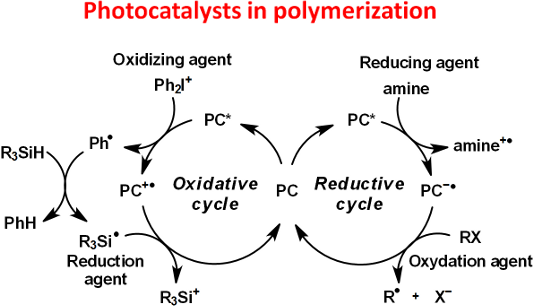
- of the ligand is essential for good properties. 2.1.3 The latest generation of metal-based catalysts: Emergence of the TADF complexes: Metal complexes are still at the origin of numerous researches as photoredox catalysts, these researches being notably motivated by their remarkable long-lived
- excited state lifetimes that make these structures highly reactive structures. Since 2012 and thanks to the pioneering works of Adachi et al. in this field [69][70][71], a new class of metal-based complexes has been developed for photoredox application: TADF (abbreviation for Thermally Activated Delayed
- localization of the electrons on the triplet state, which upconvert to the singlet state thermally (i.e., at room temperature) and can promote a radiative decay from the singlet excited state. This property gives to TADF complex lifetime of their excited state comparable to the lifetime of the excited state of



Recent advances in materials for organic light emitting diodes
Beilstein J. Org. Chem. 2018, 14, 1944–1945, doi:10.3762/bjoc.14.168
- in design, from fluorescent compounds to phosphorescent organometallic complexes to organic thermally activated delayed fluorescence (TADF) molecules, the latter driving tremendous recent excitement within the field of organic semiconductor research. This thematic issue of the Beilstein Journal of
- Organic Chemistry covers novel phosphorescent and TADF materials design and their inclusion as emitters in OLEDs. Some highlights in this issue include the work of Thanh-Tuân Bui et al., who provide a welcome perspective on blue TADF materials for OLEDs in the form of a review article [2]. Cristina
- molecular design approach for orange-emitting TADF molecules employing a fluorenone acceptor [5]. In the full research paper by Feng-Ming Xie et al., they disclose two bipolar, high-energy phenothiazine-5,5-dioxide-based host materials conceived to be used for deep blue OLED devices [6]. The articles in
D–A–D-type orange-light emitting thermally activated delayed fluorescence (TADF) materials based on a fluorenone unit: simulation, photoluminescence and electroluminescence studies
Beilstein J. Org. Chem. 2018, 14, 672–681, doi:10.3762/bjoc.14.55
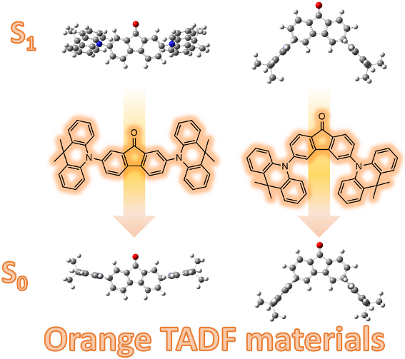
- . China 10.3762/bjoc.14.55 Abstract The design of orange-light emitting, thermally activated, delayed fluorescence (TADF) materials is necessary and important for the development and application of organic light-emitting diodes (OLEDs). Herein, two donor–acceptor–donor (D–A–D)-type orange TADF materials
- exciton utilization of TADF materials. Importantly, OLEDs based on 2 exhibited a maximum external quantum efficiency of 8.9%, which is higher than the theoretical efficiency of the OLEDs based on conventional fluorescent materials. Keywords: fluorenone acceptor; orange light emission; organic light
- increase the cost of the final OLEDs. Alternatively, a thermally activated delayed fluorescence (TADF) material is a kind of noble-metal-free fluorescent material able to transform triplet excitons into singlet excitons through reverse intersystem crossing (RISC) to achieve 100% IQEmax in theory [4]. On the


Recent advances on organic blue thermally activated delayed fluorescence (TADF) emitters for organic light-emitting diodes (OLEDs)
Beilstein J. Org. Chem. 2018, 14, 282–308, doi:10.3762/bjoc.14.18
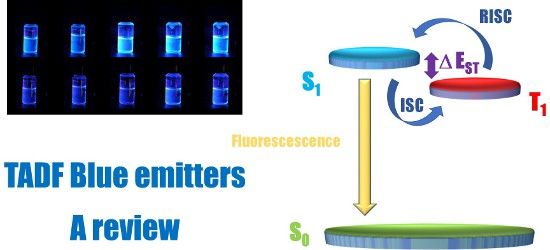
- activity of the scientific community in this field. Recently, a great deal of interest has been devoted to the elaboration of emitters exhibiting a thermally activated delayed fluorescence (TADF). By a specific molecular design consisting into a minimal overlap between the highest occupied molecular
- popularized by Chihaya Adachi since 2012. In this review, we proposed to focus on the recent advances in the molecular design of blue TADF emitters for OLEDs during the last few years. Keywords: blue; electroluminescence; emitter; OLED; TADF; Introduction Since the pioneering works of Tang and VanSlyke in
- delayed fluorescence (TADF) emitters. As specificity, these materials can thermally repopulate the singlet state from the triplet state by reverse intersystem crossing (RISC), leading to an increase of the luminescence intensity. From the OLEDs viewpoint, TADF emitters behave by harvesting both singlet




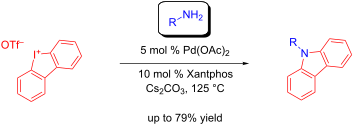
Palladium-catalyzed synthesis of N-arylated carbazoles using anilines and cyclic diaryliodonium salts
Beilstein J. Org. Chem. 2013, 9, 1202–1209, doi:10.3762/bjoc.9.136
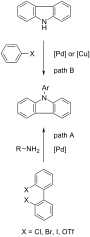
- , or as host or luminescent-materials in electronic devices (OLEDs) (Figure 1) [2][3][4][5][6][7]. Representative examples are the host molecules mCP, CBP and CBZ1-F2, the hole transporter BCz2 [8] or the recently described thermally activated delayed fluorescence (TADF) emitter 4CzIPN [9]. Therefore




Other Beilstein-Institut Open Science Activities



