


Search results
Search for "Ugi reactions" in Full Text gives 29 result(s) in Beilstein Journal of Organic Chemistry.
Synthesis of (−)-julocrotine and a diversity oriented Ugi-approach to analogues and probes
Beilstein J. Org. Chem. 2011, 7, 1504–1507, doi:10.3762/bjoc.7.175
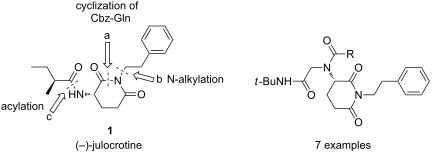
- analogues possess a protease-resistant peptoid scaffold and this might lead to an enhanced activity [19][20]. In this endeavor, all Ugi reactions were initiated by pre-imine formation of 5 and reaction with formaldehyde as the oxo-component, after which the multicomponent reaction was completed by the



Ugi post-condensation copper-triggered oxidative cascade towards pyrazoles
Beilstein J. Org. Chem. 2011, 7, 1310–1314, doi:10.3762/bjoc.7.153

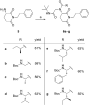
- possible Ugi pathways to introduce an alkene moiety that is prone to undergo an intramolecular [3 + 2] cycloaddition with a hydrazone, we selected the Ugi coupling between α-hydrazonocarboxylic acids and allylamine as the most straightforward path. There are several reports on the use of hydrazones in Ugi
- reactions [14][15][16][17][18][19][20][21][22][23], however, to the best of our knowledge, there is no report involving α-hydrazonocarboxylic acids. Hydrazone 1a was prepared through condensation of pyruvic acid with phenylhydrazine. Adding 1a to aqueous formaldehyde, allylamine and tert-butylisocyanide in


A straightforward approach towards combined α-amino and α-hydroxy acids based on Passerini reactions
Beilstein J. Org. Chem. 2011, 7, 1299–1303, doi:10.3762/bjoc.7.151

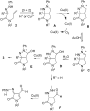
- chelated enolates and subsequent oxidation/Passerini reaction. This protocol works with both, aldehyde and ketone intermediates, as long as the ketones are activated by electron-withdrawing groups. In principle Ugi reactions are also possible, allowing the generation of diamino acid derivatives. Keywords
- : amino acids; chelated enolates; epoxides; Passerini reactions; Ugi reactions; Introduction Multicomponent reactions (MCR) are a very popular and powerful tool in modern organic synthesis [1][2][3][4]. Besides a wide range of heterocycle syntheses [5] and catalytic cross coupling reactions [6], the
- our chelated enolate (Scheme 1) [29]. In this case an amino acid 4 with an allyl alcohol side chain was formed which could be oxidized to the α,β-unsaturated aldehyde 5. Although these types of aldehydes are critical candidates in Passerini and Ugi reactions [30], we were interested to see if we could


Long-range diastereoselectivity in Ugi reactions of 2-substituted dihydrobenzoxazepines
Beilstein J. Org. Chem. 2011, 7, 976–979, doi:10.3762/bjoc.7.109
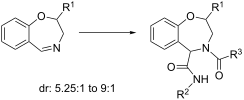
- good yields, nine different tetrahydro[f][1.4]benzoxazepines 6, equipped with three diversity points. As shown in Table 1, all the tested Ugi reactions proceeded with remarkably high diastereoselectivity, if one considers that the R1 substituent is quite far away from the imine carbon. This long range
- conformation of imine 5a, as minimized using CSC Chem3D (MOPAC-PM3). a) TBAD [(t-BuO2C−N=)2], PPh3, THF, −15 °C → rt, 49% (3a), 62% (3b); b) LiAlH4, Et2O–THF, 0 °C, 90% (4a), 88% (4b); c) HCl, CH2Cl2–H2O, rt; d) R2NC, R3CO2H, MeOH, rt. Possible explanation of diastereoselectivity in Ugi reactions of imines 5
- . Results of Ugi reactions of imines 5a,b. Supporting Information Supporting Information File 133: Complete experimental procedures. Supporting Information File 134: NMR characterization of products 6 and NMR spectra. Acknowledgements We wish to thank Benedetta Pollarolo for her collaboration to this work


Other Beilstein-Institut Open Science Activities



