


Search results
Search for "cathodic reduction" in Full Text gives 29 result(s) in Beilstein Journal of Organic Chemistry.
Electrochemical oxidation of cholesterol
Beilstein J. Org. Chem. 2015, 11, 392–402, doi:10.3762/bjoc.11.45
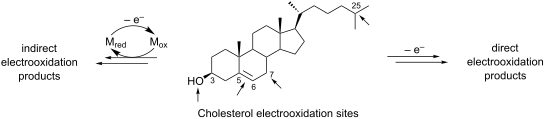
- biology [18][19][20][21]. In analogy of the oxidation of cholesterol in the human body the Takayama group [22] has employed the process of dioxygen activation by Tl(II), which was electrochemically generated by the cathodic reduction of the Tl(III) hematoporphyrin (HMP) complex. The system produced
- source since no additives were employed. The observed results may be explained by assuming a cathodic reduction of dichloromethane to chloride ions, followed by their diffusion to the anodic compartment, and electrooxidation to chlorine which reacted with cholesterol. An efficient electrochemical
- by the possibility of cathodic dichloromethane reduction yielding chloride ions, which can migrate to the anodic compartment. To prevent the cathodic reduction of dichloromethane a small amount of glacial acetic acid was added to the cathodic compartment, but its leakage to the anodic part of the


Stereoselective cathodic synthesis of 8-substituted (1R,3R,4S)-menthylamines
Beilstein J. Org. Chem. 2015, 11, 294–301, doi:10.3762/bjoc.11.34
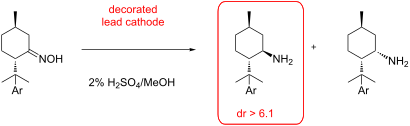
- additional substituent in position 8 is described. Due to 1,3-diaxial interactions a pronounced diastereoselectivity for the menthylamines is found. Keywords: cathodic reduction; chiral amines; electrosynthesis; menthylamines; oximes; Introduction Optically active amines serve as powerful and versatile


Cathodic reductive coupling of methyl cinnamate on boron-doped diamond electrodes and synthesis of new neolignan-type products
Beilstein J. Org. Chem. 2015, 11, 200–203, doi:10.3762/bjoc.11.21
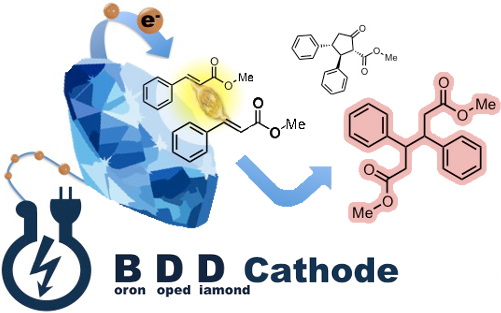
- -type products were synthesized from the hydrodimer. Keywords: boron-doped diamond (BDD) electrode; cathodic reduction; electrochemistry; electrosynthesis; neolignan; Introduction Numerous lignans and neolignans were found as secondary plant metabolites, and many of them are known to exhibit
- in preparative-scale cathodic reduction of organic compounds [7]. During our investigations of phenolic oxidation reactions using BDD electrodes, we observed the generation of solvent-derived methoxy radicals that conducted an oxidation process of the phenol substrate to the corresponding coupling
- product [8]. In our second investigation on the use of the BDD electrode in organic synthesis, the electrochemical reduction of methyl cinnamate (1a) was investigated to assess the applicability of BDD electrodes under cathodic reduction conditions, and to obtain new neolignan-type bioactive substances


Electrocarboxylation: towards sustainable and efficient synthesis of valuable carboxylic acids
Beilstein J. Org. Chem. 2014, 10, 2484–2500, doi:10.3762/bjoc.10.260
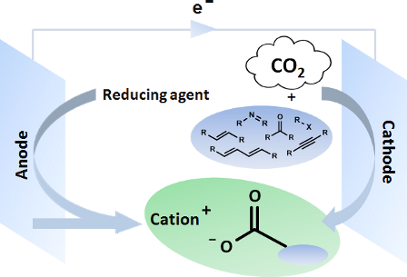
- . However, product formation through cathodic reduction of acetonitrile is ruled out properly, since no cyanoacetic acid was formed when using a cation-exchange membrane. Since most of the product is present in the anolyte, current yields are rather low (24%). Moreover, the electrolyte anion and the
- appeared to be very promising for this purpose, fulfilling both the role of electrolyte and reducing agent. Tetraethylammonium cations have high reduction stability, while still possessing good ion pairing properties. The degree of delocalization of the positive charge is large enough to prevent cathodic
- reduction and small enough to allow a quick and stable interaction with the cathodically formed carboxylate anions. Furthermore, oxalate and formate are easily oxidized at a Pt anode, gradually releasing the tetraethylammonium cations. The combination of both salts in acetonitrile gives near quantitative


Other Beilstein-Institut Open Science Activities



