


Search results
Search for "dicarboxylic acids" in Full Text gives 27 result(s) in Beilstein Journal of Organic Chemistry.
Quinoline based receptor in fluorometric discrimination of carboxylic acids
Beilstein J. Org. Chem. 2008, 4, No. 52, doi:10.3762/bjoc.4.52
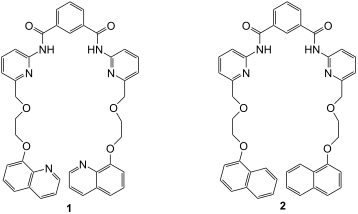
- dicarboxylic acids from aliphatic dicarboxylic acids and even long chain aliphatic dicarboxylic acids from short chain aliphatic dicarboxylic acids. The receptor 1 is found to be selective for citric acid with a strong excimer emission in CHCl3. On the contrary, the receptor 2 exhibited less binding constant
- - and dicarboxylic acids by a large number of receptors of different architectures is known [11][12][13][14]. We have also reported a series of synthetic receptors for carboxylic acids of various types [15][16][17][18]. In continuation, we report here a new quinoline based sensor 1 (Figure 1) which is
- more -OH groups in the backbone, exhibits a value of 1.55 × 10⁵ M−1 which is slightly less than tartaric and citric acids. The non-hydroxy dicarboxylic acids such as succinic, glutaric, terephthalic acids bind weakly compared to the hydroxy acids. Besides the dilution method we also followed a


Crystal engineering of analogous and homologous organic compounds: hydrogen bonding patterns in trimethoprim hydrogen phthalate and trimethoprim hydrogen adipate
Beilstein J. Org. Chem. 2006, 2, No. 8, doi:10.1186/1860-5397-2-8
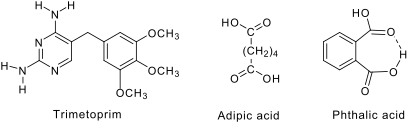
- ] other types of hydrogen-bonded networks are present. The hydrogen-bonding networks in the crystal structures of TMP/pyrimethamine salts of various dicarboxylic acids have been investigated in our laboratory [13][21]. Recently we have also reported a novel isomorphism [21]. The crystal structures of



Other Beilstein-Institut Open Science Activities



