


Search results
Search for "metal carbene" in Full Text gives 27 result(s) in Beilstein Journal of Organic Chemistry.
Sequential Au(I)-catalyzed reaction of water with o-acetylenyl-substituted phenyldiazoacetates
Beilstein J. Org. Chem. 2011, 7, 631–637, doi:10.3762/bjoc.7.74
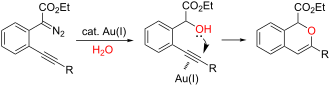
- steps. Keywords: alkyne; carbene O–H insertion; cyclization; diazo compounds; gold catalysis; 1H-isochromene; Introduction Transition metal carbene complexes are versatile intermediates and can undergo diverse transformations, including X–H (X = C, O, S, N, etc.) insertions, cyclopropanations, ylide
- formation, and 1,2-migrations [1][2][3][4][5]. Among the various methods to generate metal carbene complexes, transition metal-catalyzed decomposition of diazo compounds is the most straightforward and is highly reliable. Various transition metals have been found to decompose diazo compounds and then


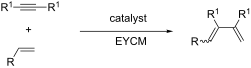
Ene–yne cross-metathesis with ruthenium carbene catalysts
Beilstein J. Org. Chem. 2011, 7, 156–166, doi:10.3762/bjoc.7.22
- [3] demonstrated that alkyne polymerization could be initiated directly from terminal alkynes without previous preparation of a metal carbene but via the formation of a reactive vinylidene tungsten species. Later on, the efficiency of ruthenium vinylidene precursors was also shown in olefin
- later Mori [22][23] utilized chromium alkoxycarbene to develop the first cyclizations via catalytic intramolecular enyne metathesis transformation. These initial works gave reason to postulate the interaction of metal carbene with alkyne to form a metallacyclobutene that rearranges to give a metal
- triple bonds with a metal carbene. General scheme for EYCM and side reactions. Catalytic cycle with initial interaction of a metal methylidene with the triple bond. Catalytic cycle with initial interaction of a metal alkylidene with the triple bond. Formation of 2,3-disubstituted dienes via cross


Other Beilstein-Institut Open Science Activities



