


Search results
Search for "photopolymerization" in Full Text gives 26 result(s) in Beilstein Journal of Organic Chemistry.
N-alkyl-N-(phosphonoethyl) substituted (meth)acrylamides – new adhesive monomers for self-etching self-priming one part dental adhesive
Beilstein J. Org. Chem. 2009, 5, No. 72, doi:10.3762/bjoc.5.72
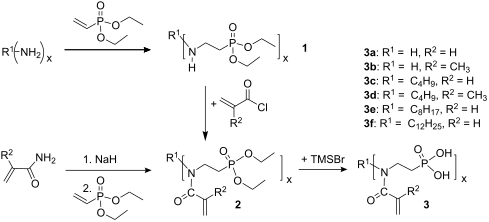
- /141.2 ppm (3d), 121.7/140.2 ppm (3h). Absorptions of the P-OH moiety were found at 1078, 3390 and 3411 cm−1 (3c, 3d). DSC investigation of 3 The polymerization behavior of N-alkyl-N-(phosphonoethyl)acrylamides and methacrylamides 3 was investigated by photopolymerization using a DSC7/DPA7 unit. The
- photochemically or thermally with AIBN as initiator. The methacrylamides 3 exhibit a relatively strong delay of photopolymerization. The thermal initiated polymerization with AIBN leads to relatively low polymerization enthalpies ranging from −8.57 (3b) to −25.1 (3h) kJ·mol−1 per double bond only, which are
- photopolymerization. Surprisingly, phosphonic acid 3c shows the highest adhesion to both enamel and dentin. Probably, 3c fulfils better than the other monomers some of the essential conditions for high adhesion to both tooth substrates such as the presence of hydrophilic/hydrophobic moieties of the adhesive molecule


Other Beilstein-Institut Open Science Activities



