


Search results
Search for "surface plasmon resonance" in Full Text gives 27 result(s) in Beilstein Journal of Organic Chemistry.
Synthesis and solvodynamic diameter measurements of closely related mannodendrimers for the study of multivalent carbohydrate–protein interactions
Beilstein J. Org. Chem. 2014, 10, 1524–1535, doi:10.3762/bjoc.10.157
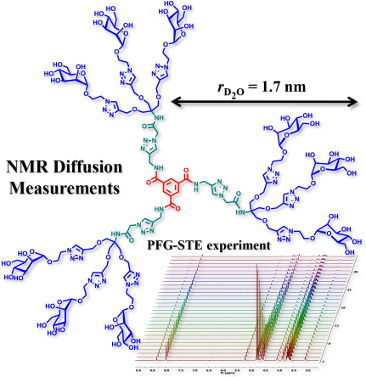
- precipitation of the complexes [30][31]. Alternatively, the application of surface plasmon resonance (SPR) also creates artificial situations not sufficiently related to the natural cellular events, thus requiring complex mathematical algorithms [32]. Most solid-phase immunoassays (ELLA, ELISA) also fall under


Molecular recognition of surface-immobilized carbohydrates by a synthetic lectin
Beilstein J. Org. Chem. 2014, 10, 1354–1364, doi:10.3762/bjoc.10.138
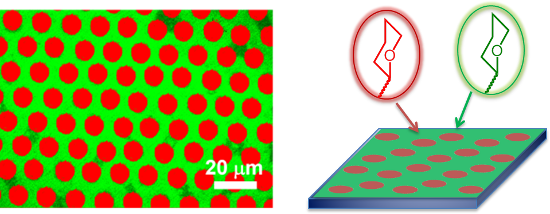
- . Read out is performed with an array scanner using fluorescence microscopy or surface plasmon resonance. In recent years, microcontact printing (μCP) [21][22][23][24] has gained importance as a replication method for biological microarrays such as protein [25][26] and DNA microarrays [27][28][29][30
- plasmon resonance (SPR) spectroscopy a commercially available polycarboxylate hydrogel sensor surface was employed, which is known to be particularly advantageous for low molecular weight compounds due to the signal amplification caused by multiple binding events in the hydrogel on the sensor. The
- functionalized with Man ink, and vice versa. As expected, it was observed that FITC-HisHis binds to Gal, and not to Man (Figure 5). In our preceding work, we had observed that the parallel isomer of HisHis binds to β-galactosides [40]. In order to confirm the interaction between HisHis and NANA with surface


Other Beilstein-Institut Open Science Activities



