


Search results
Search for "high yield" in Full Text gives 618 result(s) in Beilstein Journal of Organic Chemistry. Showing first 200.
Efficient synthesis of fluorinated triphenylenes with enhanced arene–perfluoroarene interactions in columnar mesophases
Beilstein J. Org. Chem. 2024, 20, 3263–3273, doi:10.3762/bjoc.20.270
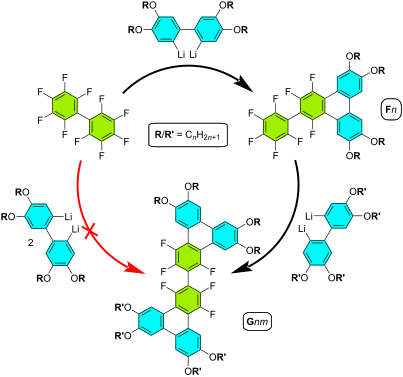
- prepared in high yield via FeCl3-oxidative coupling of 1,2-dialkoxy-4-bromobenzene (Scholl reaction). The new triphenylene derivatives, F3–F12, were prepared in moderate to high yields (51–73%). In addition, three bitriphenylene derivatives were synthesized in a subsequent annulation step from Fn




Controlled oligomerization of [1.1.1]propellane through radical polarity matching: selective synthesis of SF5- and CF3SF4-containing [2]staffanes
Beilstein J. Org. Chem. 2024, 20, 3134–3143, doi:10.3762/bjoc.20.259
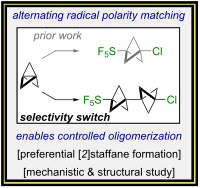
- a single oligomer across a panoply of different transformations typically range from <1% to ≈30% when n > 1 is desired [35]. To the best of our knowledge, the assembly of functionalized [n]staffanes from 1 in high yield/selectivity and in one step via controlled radical oligomerization remains a


Cyclodextrin-based rotaxanes for polymer materials: challenge on simultaneous realization of inexpensive production and defined structures
Beilstein J. Org. Chem. 2024, 20, 3026–3049, doi:10.3762/bjoc.20.252
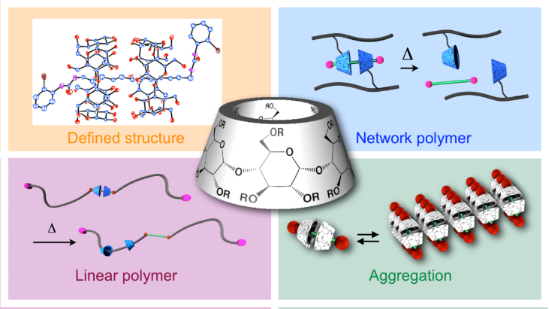
- in a high yield. In this reaction, the size of the end-capping agent is the key, as an extremely large reagent does not react well with the amino axle-end groups, whereas an extremely small reagent cannot function as an end-cap. This reaction exhibits the following multiple advantages compared with
- structure analysis, and is purified by simple precipitation without requiring chromatography; (3) various end-capping agents are available, and well-optimized conditions can ensure a high yield (e.g., 2-methoxyphenyl isocyanate obtains an 85% yield after 3 h of reaction [49]). Owing to such a high-yield
- considerably studied. However, in a small-molecule system, high-yield synthesis is still not so conventional except with the urea end-capping method. In the next section, the structural regulation system is explored and discussed in terms of its applicability to polymer systems. Structural control of the (poly






Recent advances in transition-metal-free arylation reactions involving hypervalent iodine salts
Beilstein J. Org. Chem. 2024, 20, 2891–2920, doi:10.3762/bjoc.20.243

- substituent also participated with the high yield of corresponding product. Further, the reaction with iodonium salts with electron-donating substituents in the aryl ring required an extension of the reaction duration to 24 hours. Furthermore, the scope of substrates was investigated, with a focus on the




Synthesis of pyrrole-fused dibenzoxazepine/dibenzothiazepine/triazolobenzodiazepine derivatives via isocyanide-based multicomponent reactions
Beilstein J. Org. Chem. 2024, 20, 2870–2882, doi:10.3762/bjoc.20.241
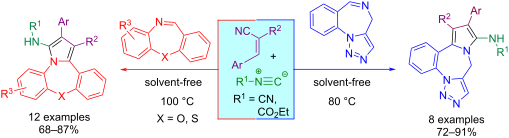
- olefins and isocyanides (Scheme 4). As expected, under almost the same conditions as described in Scheme 3 (only at 80 °C), a new type of heterocyclic compounds, pyrrole-fused triazolobenzodiazepines, was obtained in high yield. As summarized in Scheme 4, a variety of gem-diactivated olefins with electron


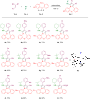


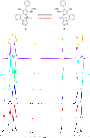


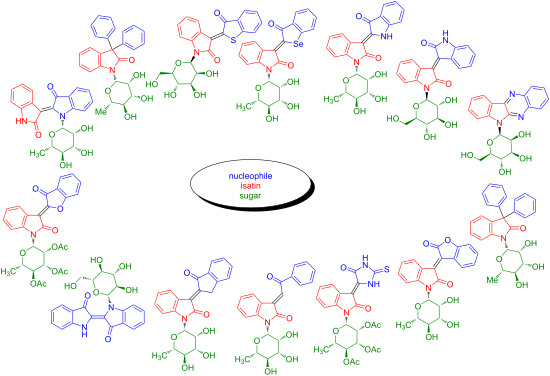
N-Glycosides of indigo, indirubin, and isoindigo: blue, red, and yellow sugars and their cancerostatic activity
Beilstein J. Org. Chem. 2024, 20, 2840–2869, doi:10.3762/bjoc.20.240
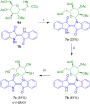
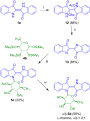
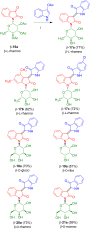
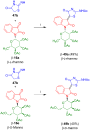
- product can be explained by rearrangement of the rhamnosyl group from the oxygen to the nitrogen atom. Oxidative debenzylation of 5a afforded 5b in high yield. Unfortunately, all attempts to remove the pivaloyl protective groups failed. On the other hand, employment of tri-O-acetyl-α-ʟ-rhamnosyl










5th International Symposium on Synthesis and Catalysis (ISySyCat2023)
Beilstein J. Org. Chem. 2024, 20, 2704–2707, doi:10.3762/bjoc.20.227
- novel lipophilic cinchona squaramide organocatalyst. This organocatalyst was evaluated in a benchmark Michael addition of acetylacetone to trans-β-nitrostyrene, yielding the Michael adduct with high yield and enantioselectivity. The hydrophobic chain of the catalyst allowed the organocatalyst to be
- easily recovered by precipitation using polar solvents. This catalyst proved to be excellent for the preparation of (S)-baclofen on a gram scale, furnishing the main chiral intermediate in high yield and enantioselectivity. Furthermore, the catalyst was recycled over five cycles while maintaining its

Synthesis of fluoroalkenes and fluoroenynes via cross-coupling reactions using novel multihalogenated vinyl ethers
Beilstein J. Org. Chem. 2024, 20, 2691–2703, doi:10.3762/bjoc.20.226

- 2a in good yields (Table 1, entries 9–11). Cross-coupling with palladium bis(trifluoroacetate), which is more reactive than palladium diacetate, gave the corresponding product in high yield of 96% (Table 1, entry 12). Without the addition of triphenylphosphine, the reaction proceeded in only 12
- % yields (Table 3, entries 6–8). The reaction between 1a and 4j, which contains an electron-withdrawing nitro group, afforded 2j in 88% yield (Table 3, entry 9). Although p-hydroxyphenylboronic acid (4k) gave 2k in only 9% yield, m-aminophenylboronic acid (4l) provided 2l in high yield (Table 3, entries 10


Machine learning-guided strategies for reaction conditions design and optimization
Beilstein J. Org. Chem. 2024, 20, 2476–2492, doi:10.3762/bjoc.20.212

- to high-yield results from approximately 100,000 experimental conditions using fewer than 100 experiments. Moving from individual synthetic steps to CASP, Nambiar et al. [201] investigated the impact of integrating a global reaction conditions prediction model with local reaction optimization on


Hypervalent iodine-mediated cyclization of bishomoallylamides to prolinols
Beilstein J. Org. Chem. 2024, 20, 2455–2460, doi:10.3762/bjoc.20.209
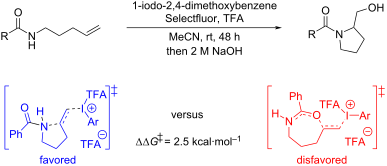
- was the five-membered prolinol 7a rather than the initially assigned isomeric seven-membered tetrahydrooxazepine 6 [16]. Subsequently, we set out to understand the O- versus N-chemoselectivity by DFT modelling, and to develop an effective synthetic protocol for the preparation of prolinols 7 in high
- yield (Scheme 1B). Notably, we are unaware of any reported method to achieve this specific transformation in the literature. Although, Tellitu and co-workers have reported a related preparation of indoline derivatives mediated by bis(trifluoroacetoxy)iodobenzene (PIFA) [17]. Results and Discussion In


Facile preparation of fluorine-containing 2,3-epoxypropanoates and their epoxy ring-opening reactions with various nucleophiles
Beilstein J. Org. Chem. 2024, 20, 2421–2433, doi:10.3762/bjoc.20.206
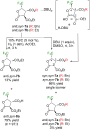
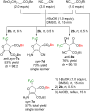
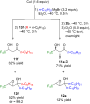
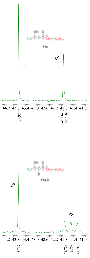
- the production of the possible olefinic product n-C8H17CH=CH2. Moreover, when the reaction mixture was quenched with D2O, incorporation of deuterium was observed to give 11a-D in a high yield which allowed us to conclude the possible presence of the C-copper species just before quenching. Our result





Efficient one-step synthesis of diarylacetic acids by electrochemical direct carboxylation of diarylmethanol compounds in DMSO
Beilstein J. Org. Chem. 2024, 20, 2392–2400, doi:10.3762/bjoc.20.203
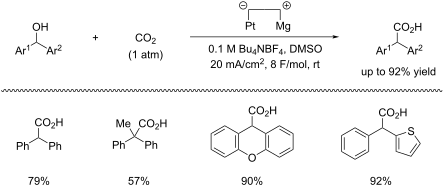
- position [19]. Notably, when diphenylmethanol (1a) was used as substrate for electrochemical carboxylation in DMSO, the carboxylation efficiently proceeded to give diphenylacetic acid (2a) in high yield. In this paper, we focus on electrochemical carboxylation of diarylmethanol compounds 1 in DMSO and


Asymmetric organocatalytic synthesis of chiral homoallylic amines
Beilstein J. Org. Chem. 2024, 20, 2349–2377, doi:10.3762/bjoc.20.201
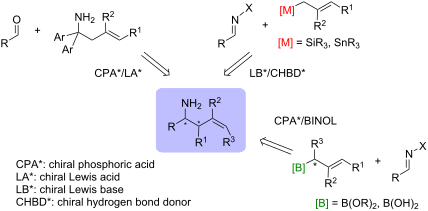
- (DHQ)2PHAL catalyst 138 has been identified as the most efficient that afforded high yield and enantioselectivity with a 10 mol % loading. The diastereoselectivity was 20:1 or better in most cases and was found to be independent of the reaction conditions. The optimised protocol involved stirring 1






Selective hydrolysis of α-oxo ketene N,S-acetals in water: switchable aqueous synthesis of β-keto thioesters and β-keto amides
Beilstein J. Org. Chem. 2024, 20, 2225–2233, doi:10.3762/bjoc.20.190

- °C, the reaction efficiency significantly decreased (Table 1, entry 13). Alike 2a, the keto isomer of 3a was the dominant isomer, with a keto/enol ratio of 3:1. Then, we tested the effects of different bases on the reaction and found that the strong bases NaOH and KOH gave 3a in high yield (Table 1



Diastereoselective synthesis of highly substituted cyclohexanones and tetrahydrochromene-4-ones via conjugate addition of curcumins to arylidenemalonates
Beilstein J. Org. Chem. 2024, 20, 2016–2023, doi:10.3762/bjoc.20.177
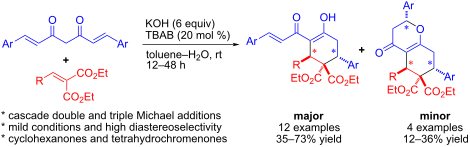
- base (KOH) and a phase-transfer catalyst (PTC) in a biphasic medium (toluene–H2O) at room temperature, leading to highly functionalized cyclohexanones and tetrahydrochromenones as major and minor products, respectively, in moderate to high yield and excellent diastereoselectivity. Results and


Harnessing the versatility of hydrazones through electrosynthetic oxidative transformations
Beilstein J. Org. Chem. 2024, 20, 1988–2004, doi:10.3762/bjoc.20.175
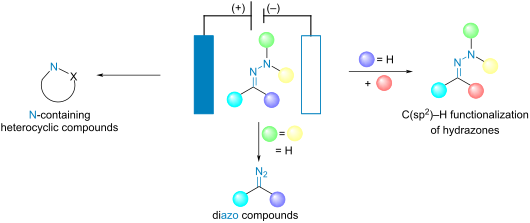
- -tetraethylammonium perchlorate solution under constant potential in a divided cell equipped with platinum gauze anode and nickel cathode. Such a transformation constituted a straightforward route to the corresponding fused s-triazolo perchlorates 46 in moderate to high yield. Coulometric analysis established that
- aldehyde-derived N,N-dialkylhydrazones 123 under constant current with two carbon electrodes. Aromatic and aliphatic sodium sulfinates 124 were employed as sources of sulfinate radicals under electrolyte-free reaction conditions. The targeted product was obtained in high yield regardless of the electronic









Development of a flow photochemical process for a π-Lewis acidic metal-catalyzed cyclization/radical addition sequence: in situ-generated 2-benzopyrylium as photoredox catalyst and reactive intermediate
Beilstein J. Org. Chem. 2024, 20, 1973–1980, doi:10.3762/bjoc.20.173
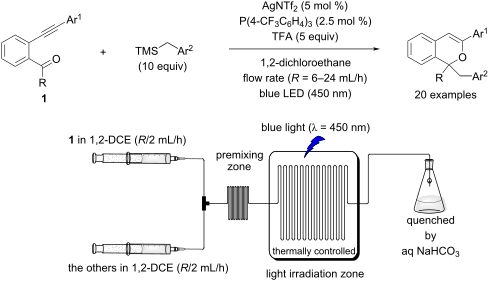
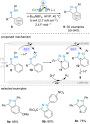
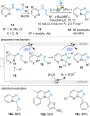
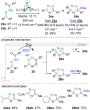
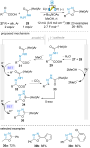
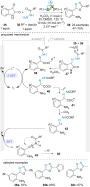
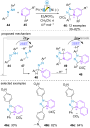
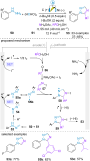
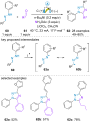
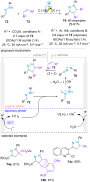
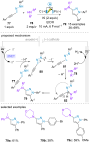
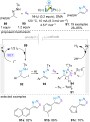
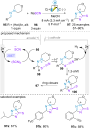
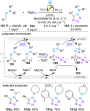
- , the reaction of substrate 1c having a methyl group as a weak electron-donating group at the para-position afforded product 3c in high yield (Table 2, entry 3: 76%). In addition, the reaction of 1d having a bromo group resulted in a moderate yield, but with a significant improvement compared with the
- batch reaction (Table 2, entry 4: 57% vs 10%). The reaction of 1e substituted with a strong electron-withdrawing trifluoromethyl group afforded the product 3e in high yield (Table 2, entry 5: 77%), again confirming the high efficiency of the flow reaction system (batch: 54%). Next, the effects of the
- of the ortho-substituent (Table 2, entry 10 vs entries 3 and 7). When a fluoro group was introduced to the tethering phenyl backbone, a high yield was obtained regardless of whether it was introduced at the 6- or 7-position (Table 2, entries 11 and 12). Next, the effects of a carbonyl substituent


1,2-Difluoroethylene (HFO-1132): synthesis and chemistry
Beilstein J. Org. Chem. 2024, 20, 1955–1966, doi:10.3762/bjoc.20.171

- -difluoroethylene and the disappearance of vinyl protons resonances in the 1H NMR spectra [78]. Addition to the C=C bond Halogen addition: 1,2-Difluoroethylene was reported to react with chlorine [46][79] and bromine [51] under irradiation, yielding 1,2-difluoro-1,2-dihaloethanes in moderate to high yield (Scheme 9
- (trifluoromethyl)amine easily reacted with (Z)-1,2-difluoroethylene to form the addition product in high yield (Scheme 11) [89]. However, the stereochemistry of this reaction has not been reported. A similar reaction of (Z)-1,2-difluoroethylene with N-chloroimidobis(sulfonyl fluoride) (Scheme 12) [90] was shown to
- be stereounspecific, although the addition product was reported to form in high yield. In the same publication [90], it was mentioned that (FSO2)2NH did not form an addition product in the reaction with (Z)-1,2-difluoroethylene, although the reaction of (FSO2)2NH with other olefins, including


Negishi-coupling-enabled synthesis of α-heteroaryl-α-amino acid building blocks for DNA-encoded chemical library applications
Beilstein J. Org. Chem. 2024, 20, 1922–1932, doi:10.3762/bjoc.20.168
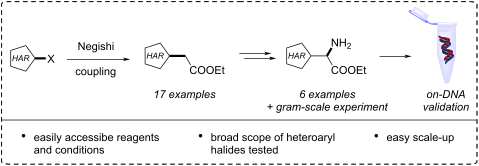
- acetate 2i in high yield. A similar result was obtained for the furanyl derivative 2j. Pyrazoles were the only substrate class which clearly benefited from light irradiation (2k–o), displaying not just a shorter reaction time but also higher yields. Even unprotected pyrazoles (2k, 2m, 2n) performed well


Solvent-dependent chemoselective synthesis of different isoquinolinones mediated by the hypervalent iodine(III) reagent PISA
Beilstein J. Org. Chem. 2024, 20, 1914–1921, doi:10.3762/bjoc.20.167
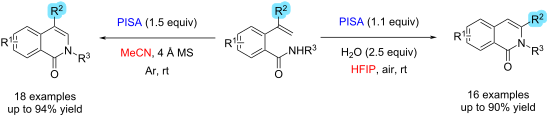
- , respectively, the substrates could be successfully converted to the products 3b–d and 2f in 52–87% yield with this method. In addition, a good or high yield of 3-methylisoquinolinones 3e–k, with different substituents on the phenyl ring, was also obtained. It is worth noting that when an electron-withdrawing




Electrochemical radical cation aza-Wacker cyclizations
Beilstein J. Org. Chem. 2024, 20, 1900–1905, doi:10.3762/bjoc.20.165
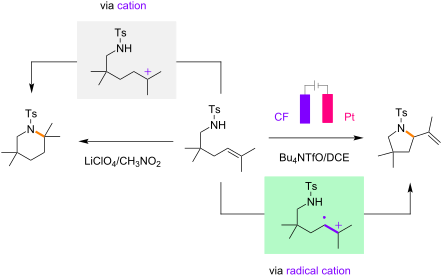
- ), with platinum (Pt) as a cathode. To our delight, a constant-current condition at 1 mA was productive, and the desired five-membered pyrrolidine 2 was obtained in high yield (Table 1, entry 2). During the screening of conditions, the addition of acetonitrile (CH3CN) was found to be effective, probably




Access to 2-oxoazetidine-3-carboxylic acid derivatives via thermal microwave-assisted Wolff rearrangement of 3-diazotetramic acids in the presence of nucleophiles
Beilstein J. Org. Chem. 2024, 20, 1894–1899, doi:10.3762/bjoc.20.164

- derivative 3a could be obtained in high yield (83%) after simple chromatographic separation of the reaction mixture (Scheme 2). When the synthesis was carried out using conventional heating in 1,2-dichlorobenzene (200 °C, 1 h), product 3a was obtained in slightly lower yield (75%), so further experiments


The Groebke–Blackburn–Bienaymé reaction in its maturity: innovation and improvements since its 21st birthday (2019–2023)
Beilstein J. Org. Chem. 2024, 20, 1839–1879, doi:10.3762/bjoc.20.162
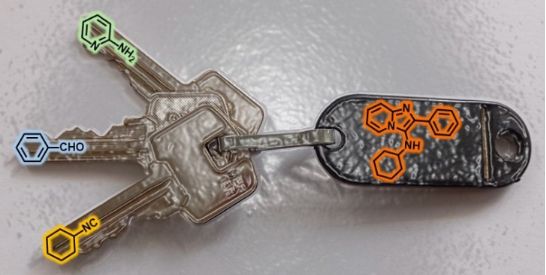
- derivatization, allowed the obtainment of 18 in high yield under relatively mild conditions, and was extended to the synthesis of 23 analogues, all in high yields (>86%). The catalyst could be recovered from the reaction medium by precipitation and reused up to five times without loss in activity. In 2020, Tyagi






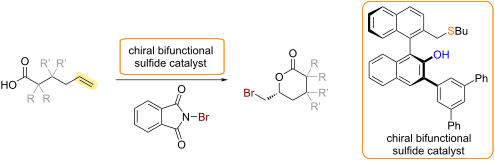
Chiral bifunctional sulfide-catalyzed enantioselective bromolactonizations of α- and β-substituted 5-hexenoic acids
Beilstein J. Org. Chem. 2024, 20, 1794–1799, doi:10.3762/bjoc.20.158
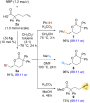
- substrate was also examined to give a dihydroisocoumarin product 3o in high yield with moderate enantioselectivity. The absolute stereochemistry of the bromolactonization product 3o was confirmed by comparison with reported data [24]. The transformations of the optically active bromolactonization product 3a


Oxidative fluorination with Selectfluor: A convenient procedure for preparing hypervalent iodine(V) fluorides
Beilstein J. Org. Chem. 2024, 20, 1785–1793, doi:10.3762/bjoc.20.157
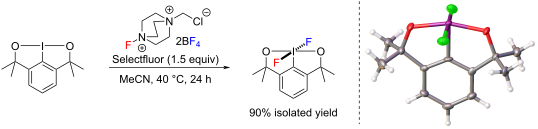
- efficient separation from the excess Selectfluor and its byproduct. Reducing the amount of Selectfluor to 2.5 equivalents and the reaction time to 24 hours (Table 2, entry 2) resulted in a similar high yield of difluoroiodane 6. The reaction also proceeded well at either room temperature for 24 hours (Table





