


Search results
Search for "hydroamination" in Full Text gives 55 result(s) in Beilstein Journal of Organic Chemistry.
Synthetic applications of gold-catalyzed ring expansions
Beilstein J. Org. Chem. 2011, 7, 767–780, doi:10.3762/bjoc.7.87
- and trapping of the carbocation by the sulfonamide. Subsequent intramolecular hydroamination gave the pyrrolidine products. 1.3 Oxiranes As an oxophilic Lewis acid, gold can activate epoxides towards the attack of nucleophiles. A good example is the AuCl3 catalyzed ring opening of aryl alkyl epoxide


Sequential Au(I)-catalyzed reaction of water with o-acetylenyl-substituted phenyldiazoacetates
Beilstein J. Org. Chem. 2011, 7, 631–637, doi:10.3762/bjoc.7.74
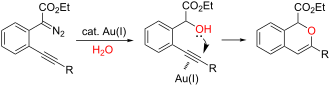
- chemical processes in the fine chemical industry. In this context, we have previously reported the copper(I)-catalyzed reaction of amines with o-acetylenyl-substituted phenyldiazoacetates, which leads to a Cu(I)-catalyzed tandem N–H insertion/hydroamination of an alkyne [29]. Subsequently, we have tried to


Synthesis of chiral mono(N-heterocyclic carbene) palladium and gold complexes with a 1,1'-biphenyl scaffold and their applications in catalysis
Beilstein J. Org. Chem. 2011, 7, 555–564, doi:10.3762/bjoc.7.64
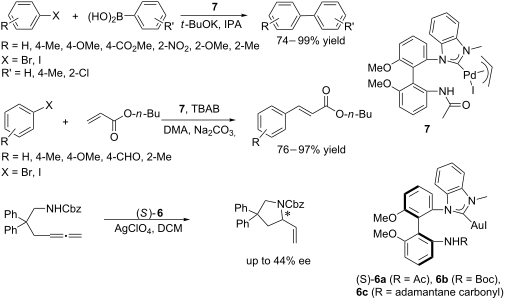
- showed good catalytic activities in the asymmetric intramolecular hydroamination reaction to give the corresponding product in moderate ee. Keywords: chiral mono(N-heterocyclic carbene) complex; Heck–Mizoroki reaction; hydroamination; Suzuki–Miyaura reaction; Introduction N-heterocyclic carbene (NHC
- activities in the reaction of arylbromides or iodobenzene with n-butyl acrylate to afford the coupling products 10 in up to 97% yield. The results have been summarized in Table 2. Intramolecular hydroamination reaction catalyzed by NHC–Au(I) complex (S)-6a Since the first example of NHC–Au complex was
- NHC–Au(I) complex (S)-6a was consequently investigated as the catalyst in the asymmetric intramolecular hydroamination of allenes. This reaction has been achieved with high enantioselectivity by a chiral phosphine–Au(I) complex [87][88][89][90][91][92][93]. Treatment of allene 11 with (S)-6a and




A review of new developments in the Friedel–Crafts alkylation – From green chemistry to asymmetric catalysis
Beilstein J. Org. Chem. 2010, 6, No. 6, doi:10.3762/bjoc.6.6
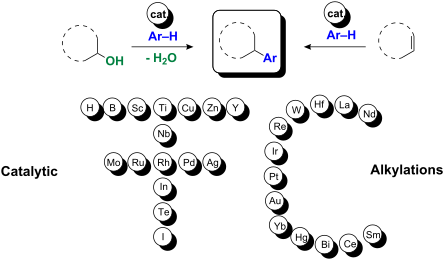
- hydroamination reactions [66]. Nevertheless, Beller et al. developed a valuable method to overcome these limitations. In 1999 they described the transition metal catalyzed hydroarylation of anilines 46 with styrenes using a cationic Rh-complex [67]. Depending on the aniline derivative, a combination of 2.5 mol
- well [68]. Ackermann et al. attempted to develop a Ti(IV)-catalyzed hydroamination of anilines with olefins, and surprisingly discovered that a mixture of hydroamination and ortho-hydroarylation products was formed. Upon further heating of the secondary amine 48 in the presence of TiCl4 the ortho


The enantiospecific synthesis of (+)-monomorine I using a 5-endo- trig cyclisation strategy
Beilstein J. Org. Chem. 2007, 3, No. 39, doi:10.1186/1860-5397-3-39
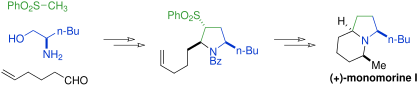
- transformations, would be converted into the 2,5-syn disubstituted pyrrolidine core 8 via alkene 7. With all the required carbon atoms in place, the final steps would involve deprotection, intramolecular hydroamination of the alkene and desulfonylation. Initial studies directed towards this goal exploited the
- -Hydride® to give the free amines 23 and 15c, which were subjected to mercury-mediated hydroamination (Scheme 6 and Scheme 7). [20] Cyclisation of 23 proceeded in good yield to give a 9:4 mixture of two indolizidines, epimeric at the C-5 methyl group 24-anti and 24-syn (Scheme 6). Cyclisation of the
- required for the preparation of (+)-monomorine I Mercury-mediated hydroamination Proposed transition state for mercury-mediate hydroamination Model study for the reductive amination-based cyclisation The synthesis of (+)-monomorine I Deprotection of N-benzoylpyrrolidines Supporting Information Supporting




Other Beilstein-Institut Open Science Activities



