


Search results
Search for "intercalation" in Full Text gives 53 result(s) in Beilstein Journal of Organic Chemistry.
Laterally substituted symmetric and nonsymmetric salicylideneimine-based bent-core mesogens
Beilstein J. Org. Chem. 2012, 8, 129–154, doi:10.3762/bjoc.8.15
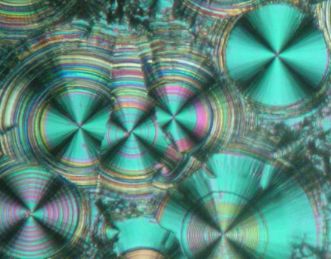
- (Figure 2). The layer thicknesses amount to d = 4.0 nm (OH 1a) and d = 4.2 (OH 1b). Based on a calculated molecular length of L ~ 5.4 nm, the molecular long axes are tilted with respect to the layer normal by about 42°, excluding an intercalation of the terminal chains. EHC cells consisting of two thin




Synthesis of (−)-julocrotine and a diversity oriented Ugi-approach to analogues and probes
Beilstein J. Org. Chem. 2011, 7, 1504–1507, doi:10.3762/bjoc.7.175
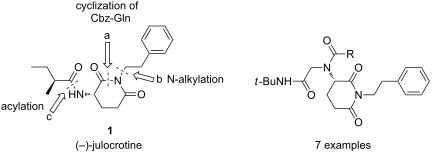
- -4CR was utilized for the synthesis of a molecular probe prototype of 1, which can be used for intercalation studies (Scheme 3). For this propose, the natural product scaffold should be attached through a spacer to a reporter tag, which is normally a luminescent group or a dye. The advanced



Synthetic incorporation of Nile Blue into DNA using 2′-deoxyriboside substitutes: Representative comparison of (R)- and (S)-aminopropanediol as an acyclic linker
Beilstein J. Org. Chem. 2010, 6, No. 13, doi:10.3762/bjoc.6.13
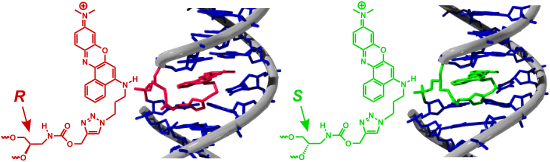
- this chromophore to DNA. We interpret the similarity of the absorption properties together with the results from the thermal dehybridization studies, as discussed above, as a result of the intercalation of the Nile Blue dye in duplex DNA. To further explore the optical properties we recorded steady
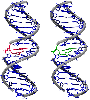
- chains and the triazolyl group represents the most critical issue for intercalation. From both molecular models it became obvious that this tether is long and flexible enough allowing the Nile Blue chromophore to intercalate in a nearly perfectly stacked position between the adjacent base pairs. This




Other Beilstein-Institut Open Science Activities



