


Search results
Search for "ATP" in Full Text gives 85 result(s) in Beilstein Journal of Organic Chemistry.
Synthesis and evaluation of cell-permeable biotinylated PU-H71 derivatives as tumor Hsp90 probes
Beilstein J. Org. Chem. 2013, 9, 544–556, doi:10.3762/bjoc.9.60
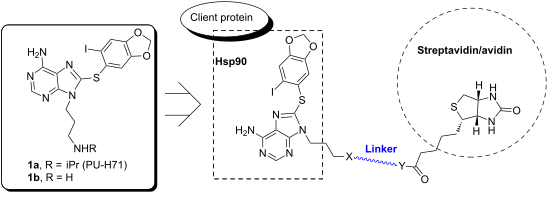
- clinical trials, has been the ATP-competitive inhibitors that bind to the N-terminal nucleotide binding pocket [4][5]. Hsp90 belongs to the family of GHKL (G = DNA gyrase subunit B; H = Hsp90; K = histidine kinases; L = MutL) ATPases, which is distinguished by a unique bent shape of its nucleotide binding
- pocket [6]. This distinctive shape has enabled for the design of highly selective ATP-competitive inhibitors of Hsp90. Through the efforts of multiple drug-discovery groups, many classes of inhibitors have been identified [3][5][7][8]. While much is known about the general types of structures that


A chemist and biologist talk to each other about caged neurotransmitters
Beilstein J. Org. Chem. 2013, 9, 64–73, doi:10.3762/bjoc.9.8
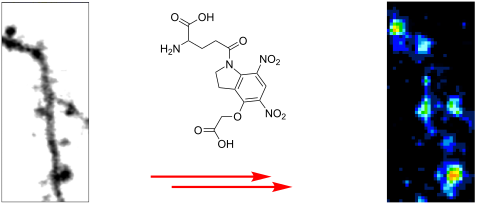
- active molecules to be synthesized with photochemically protecting groups at their active sites were nucleotides [1][2]. Two reports appeared in 1977 and 1978 describing the synthesis of ortho-nitrobenzyl derivatives of cyclic-AMP [1] and ATP [2]. The photolabile cAMP derivative was one member of a
- series of phosphate esters made as membrane permeable pronucleotides. Thus, this optical probe arose out of the context of the already developed prodrugs that used thermal chemistry for release of their latent cargo. In contrast, the photolabile ATP molecule was synthesized in a physiology department for
- rapid photoactivation of a particular enzyme, the Na,K-ATPase. It was the latter group that dubbed such photochemical probes “caged compounds”. This simple term has been adopted by biologists since that time [3][4][5][6][7][8][9], perhaps because the photolabile ATP compound was the one that was used in


Hydrophobic analogues of rhodamine B and rhodamine 101: potent fluorescent probes of mitochondria in living C. elegans
Beilstein J. Org. Chem. 2012, 8, 2156–2165, doi:10.3762/bjoc.8.243
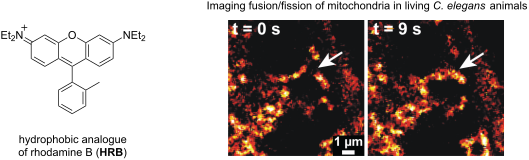
- mitochondrial inner membranes (typically −120 to −180 mV, depending on cell type) [6][7][8][9]. This membrane potential is critical for ATP synthesis, and is generated by pumping of protons across the mitochondrial inner membrane by the respiratory chain. Many delocalized lipophilic cations preferentially




Chemical modification allows phallotoxins and amatoxins to be used as tools in cell biology
Beilstein J. Org. Chem. 2012, 8, 2072–2084, doi:10.3762/bjoc.8.233
- actin Actin was prepared from rabbit muscle as described previously [36]. The binding assay was used with the following modifications: Freshly prepared G-actin solution was diluted in Tris-ATP buffer (2 mM of Tris; 0.2 mM ATP; 0.1 mM CaCl2; 0.02% NaN3; pH 7.8) to an extinction of 0.28 at 290 nm (null
- room temperature the solution was filled up to ten volumes with Tris-ATP buffer and gently homogenized. Hydrophilic toxin derivatives were dissolved in potassium Tris-buffer (100 mM KCl, 1 mM Tris, pH 7.4). The concentration was determined spectrophotometrically at 300 nm (ε (300 nm) = 10100 M−1 cm−1




Synthesis of 5-oxyquinoline derivatives for reversal of multidrug resistance
Beilstein J. Org. Chem. 2012, 8, 1700–1704, doi:10.3762/bjoc.8.193
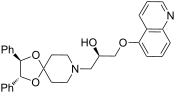
- 10.3762/bjoc.8.193 Abstract The inhibition of ABC (ATP binding cassette) transporters is considered a powerful tool to reverse multidrug resistance. Zosuquidar featuring a difluorocyclopropyl-annulated dibenzosuberyl moiety has been found to be an inhibitor of the P-glycoprotein, one of the best-studied
- “multidrug resistance”. Various transporters of the ATP-binding cassette family, so called ABC transporters, have been shown to be responsible for multidrug resistance [1]. Among these multidrug-resistance ABC transporters, the P-glycoprotein has been investigated most intensively [2]. As P-glycoprotein is

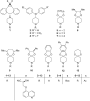


Thermodynamic and kinetic stabilization of divanadate in the monovanadate/divanadate equilibrium using a Zn-cyclene derivative: Towards a simple ATP synthase model
Beilstein J. Org. Chem. 2012, 8, 81–89, doi:10.3762/bjoc.8.8
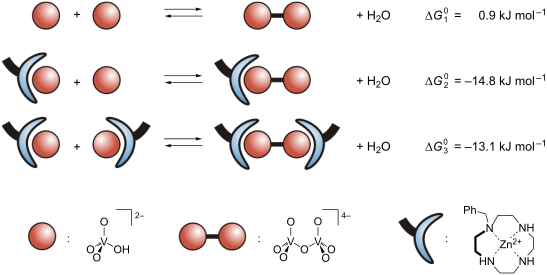
- Hanno Sell Anika Gehl Frank D. Sonnichsen Rainer Herges Otto-Diels Institut für Organische Chemie, Christian-Albrechts-Universität zu Kiel, Otto-Hahn-Platz 4, 24418 Kiel, Germany 10.3762/bjoc.8.8 Abstract For the condensation of anions such as phosphate and ADP to form ATP and water, nature
- ; Introduction Driving endergonic reactions with external energy sources is one of the challenging and so far unsolved problems in supramolecular chemistry. The best known example in nature is probably the condensation of phosphate and ADP to ATP, driven by a proton gradient across a membrane [1]. There are a
- number of preconditions that have to be met for such an energy driven condensation of inorganic anions. At least three steps (four stages) are required (Figure 1): a) Moving both complexated anions together, b) bond formation (condensation), and c) product release/reactant binding. In the ATP synthase




Natural product biosyntheses in cyanobacteria: A treasure trove of unique enzymes
Beilstein J. Org. Chem. 2011, 7, 1622–1635, doi:10.3762/bjoc.7.191
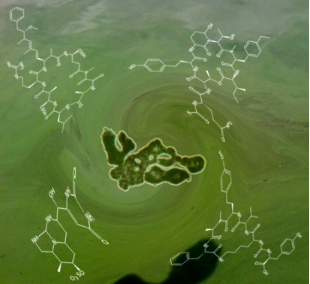
- studied, PatD is a single ATP-dependent enzyme not requiring an additional oxidase enzyme [60]. The PatG protease encoded by the cluster was shown to macrocyclize diverse substrates by a mechanism closely resembling the thioesterase-catalyzed chemistry of most NRPS systems [61]. Several related pathways
- Microcystis and Planktothrix [64][65]. Post-translational modification of microviridins is achieved by the activity of two closely related ATP grasp ligases, MdnB and MdnC (MvdC and D in Planktothrix). The enzymes introduce two ω-ester linkages between threonine and aspartate and serine and glutamate (MdnC
- MAA shinorine in Anabaena variabilis ATCC 29413: A dehydroquinase synthase homologue (DHQS), an O-methyl-transferase (O-MT), an ATP grasp ligase and an NRPS-like enzyme. Cloning of the entire gene cluster in E. coli led to the production of shinorine. The production of the intermediate 4-deoxygadusol


Coupled chemo(enzymatic) reactions in continuous flow
Beilstein J. Org. Chem. 2011, 7, 1449–1467, doi:10.3762/bjoc.7.169
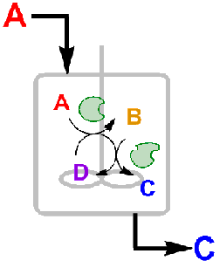
- of ATP and glucose 1-phosphate. When the reaction mixture containing starting materials and cofactors was circulated for 48 hours through the reactor, 50% of UMP was transformed to UDP-Gal. Although in their work the authors did not establish the continuous production of UDP-Gal, in principle such a


Bioorthogonal metabolic glycoengineering of human larynx carcinoma (HEp-2) cells targeting sialic acid
Beilstein J. Org. Chem. 2010, 6, No. 24, doi:10.3762/bjoc.6.24
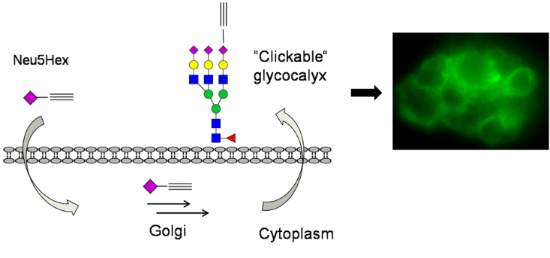
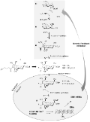
- kinase; ATP: adenosine triphosphate; PEP: phosphoenolpyruvate; CTP: cytidine triphosphate; PPi: pyrophosphate; DNA: deoxyribonucleic acid; mRNA: messenger ribonucleic acid. Proposed metabolic pathway of Neu5Hex 3 based on known mechanisms of Neu5Gc 2 uptake [5]. TGN: trans-Golgi network, CMP: cytidine




Recent progress on the total synthesis of acetogenins from Annonaceae
Beilstein J. Org. Chem. 2008, 4, No. 48, doi:10.3762/bjoc.4.48
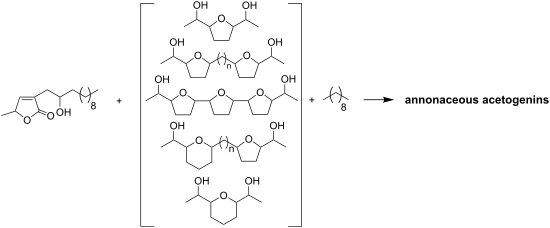
- ]. Inhibition by these mechanisms results in adenosine triphosphate (ATP) deprivation, which leads to apoptosis of the highly energy demanding tumor cells [11]. The acetogenins are now considered as the most potent (effective in nanomolar concentrations) known inhibitors of the mitochondrial complex I [9][12


Other Beilstein-Institut Open Science Activities



