Search results
Search for "DMF" in Full Text gives 1101 result(s) in Beilstein Journal of Organic Chemistry. Showing first 200.
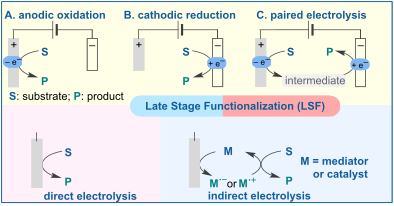
A review of recent advances in electrochemical and photoelectrochemical late-stage functionalization classified by anodic oxidation, cathodic reduction, and paired electrolysis
Beilstein J. Org. Chem. 2024, 20, 2500–2566, doi:10.3762/bjoc.20.214
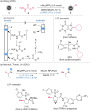
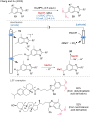
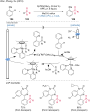
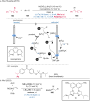
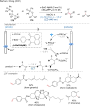
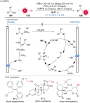
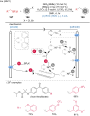
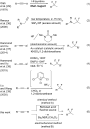
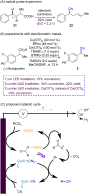
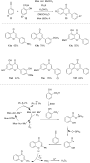
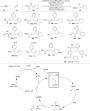
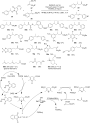
- oxyformylation with brominations/chlorinations/trifluoromethylations using DMF and NaBr/NaCl/NaSO2CF3 as readily available reagents. The reported yields for this regio- and chemoselective transformation are high. For each reaction type, one LSF example was demonstrated using an estrone derivative
- . Mechanistically, this transformation can be understood as follows: first, a Br/Cl/CF3 radical is formed via anodic oxidation, which subsequently attacks the olefin. The newly formed benzyl radical is oxidized to a carbocation, which undergoes nucleophilic attack by DMF. Hydrolysis of the imine delivers the final






















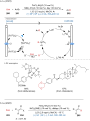


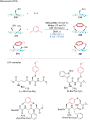


Photoredox-catalyzed intramolecular nucleophilic amidation of alkenes with β-lactams
Beilstein J. Org. Chem. 2024, 20, 2461–2468, doi:10.3762/bjoc.20.210
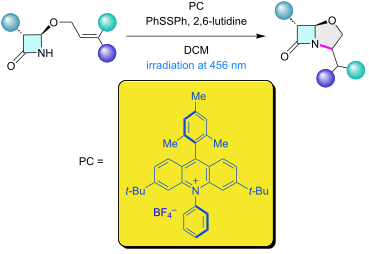
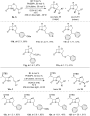
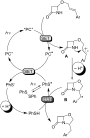
- (Table 1, entry 10). The reaction was successfully conducted in various solvents, such as DCM, DCE, and MeCN (Table 1, entries 1, 7, and 8). However, DMF failed to yield the desired product (Table 1, entry 6). Shortening the reaction time to 14 hours resulted in minimal product formation (Table 1, entry




Efficient one-step synthesis of diarylacetic acids by electrochemical direct carboxylation of diarylmethanol compounds in DMSO
Beilstein J. Org. Chem. 2024, 20, 2392–2400, doi:10.3762/bjoc.20.203
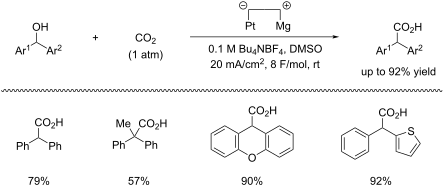
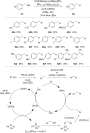
- constant-current electrolysis in DMF using an undivided cell equipped with a Pt cathode and a Mg anode in the presence of carbon dioxide. On the other hand, carboxylation scarcely took place in DMF when other benzyl alcohols were used as substrates. Lundberg and co-workers recently reported similar results
- showing that electrochemical carboxylation of benzyl alcohols in the presence of Bu4NBH4 in DMF using graphite electrodes gave the corresponding carboxylic acids only in poor yield [18]. We recently found that DMSO is a more suitable solvent for electrochemical carboxylation of benzyl alcohols. Even
- ), electrodes (Table 1, entries 2, 6, and 7), and electricity (Table 1, entries 2 and 8–10) were investigated. A current density between 10 and 30 mA/cm2 had little effect on the yield of 2a (Table 1, entries 1–3). Carboxylation of 1a also took place in DMF instead of DMSO as solvent. However, the efficiency


gem-Difluorination of carbon–carbon triple bonds using Brønsted acid/Bu4NBF4 or electrogenerated acid
Beilstein J. Org. Chem. 2024, 20, 2261–2269, doi:10.3762/bjoc.20.194
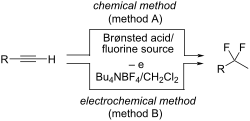
- , entry 6), but TfOH gave the product 2a in 72% yield (Table 1, entry 7). As for the solvent, CH3CN slightly afforded 2a, although N,N-dimethylformamide (DMF) and dimethyl sulfoxide (DMSO) were not suitable for the reactions (Table 1, entries 8–10). A fluorine source, such as Bu4NF or BF3·Et2O, instead of



Metal-free double azide addition to strained alkynes of an octadehydrodibenzo[12]annulene derivative with electron-withdrawing substituents
Beilstein J. Org. Chem. 2024, 20, 2234–2241, doi:10.3762/bjoc.20.191
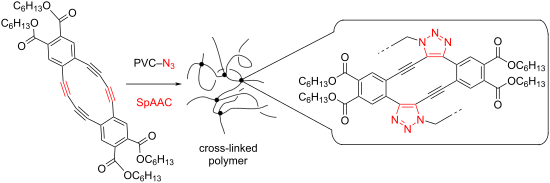
- partially azidated poly(vinyl chloride) (PVA-N3) was prepared by stirring poly(vinyl chloride) and NaN3 in DMF at room temperature overnight. Measurements NMR spectra were recorded using a JEOL mode Al300 (300 MHz) at room temperature. Deuterated chloroform was used as the solvent unless otherwise stated




Multicomponent syntheses of pyrazoles via (3 + 2)-cyclocondensation and (3 + 2)-cycloaddition key steps
Beilstein J. Org. Chem. 2024, 20, 2024–2077, doi:10.3762/bjoc.20.178

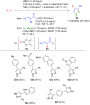
- the corresponding pyrazolone derivatives, thereby providing access to both bis(pyrazolyl) and bis(pyrazolonyl)methanes. Enaminones 81 can be generated as intermediates by condensation of 1,3-dicarbonyl compounds and DMF-dimethylacetal (DMFDMA, 79). The reaction is catalyzed by the solvent 2,2,2




Allostreptopyrroles A–E, β-alkylpyrrole derivatives from an actinomycete Allostreptomyces sp. RD068384
Beilstein J. Org. Chem. 2024, 20, 1981–1987, doi:10.3762/bjoc.20.174
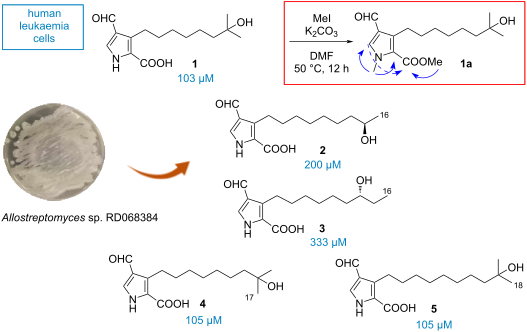
- , 332.1832; found, 332.1838. Methylation of 1 Allostreptopyrrole A (1, 2.0 mg, 0.007 mmol) and K2CO3 (4.4 mg, 0.032 mmol) were stirred in dry DMF (0.5 mL) at 50 °C for 10 min. Methyl iodide (19 μL, 0.32 mmol) was added and the mixture was stirred at this temperature for 12 h [29]. Reaction completion was


1,2-Difluoroethylene (HFO-1132): synthesis and chemistry
Beilstein J. Org. Chem. 2024, 20, 1955–1966, doi:10.3762/bjoc.20.171

- ) [101][102]. Our group attempted to use (E/Z)-1,2-difluoroethylene in a Heck reaction [78]. The experiments were performed using 4-iodotoluene or methyl 4-iodobenzoate in DMF, Pd(OAc)2 as a catalyst, and Et3N as a base (Scheme 25). The reactions were carried out in a stainless steel autoclave at 120 °C


Regioselective alkylation of a versatile indazole: Electrophile scope and mechanistic insights from density functional theory calculations
Beilstein J. Org. Chem. 2024, 20, 1940–1954, doi:10.3762/bjoc.20.170
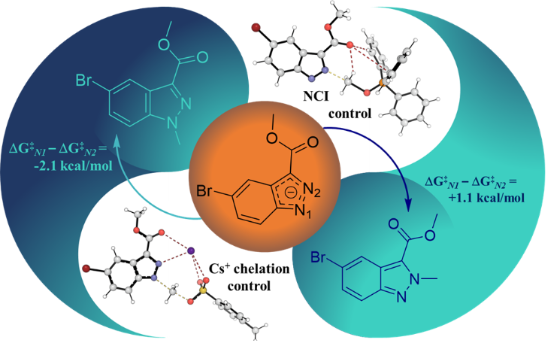
- -substituted indazole analogs in 44% and 40% yields, respectively, by treating compound 6 with methyl iodide and potassium carbonate in dimethylformamide (DMF) at room temperature for 17 h [40]. Other works have shown poor selectivity when 6 and other isomers similar to 6 were reacted with isopropyl iodide and
- Scheme 1 compound 6 was treated with isopropyl iodide (7) in DMF in the presence of sodium hydride to provide products 8 and 9 in 38% and 46% yields, respectively. The structures of both compounds were unambiguously assigned using X-ray crystallography and 1H and nuclear Overhauser effect (NOE) NMR
- S1 in Supporting Information File 1. Stoichiometric manipulation of 12 to 6 in DMF at 90 °C provided the N1-substituted product P1 in 52–60% yields. The yields of P1 formation were largely unaffected in DMF with temperatures ranging from room temperature to 110 °C. Varying the equivalents of Cs2CO3


A new platform for the synthesis of diketopyrrolopyrrole derivatives via nucleophilic aromatic substitution reactions
Beilstein J. Org. Chem. 2024, 20, 1933–1939, doi:10.3762/bjoc.20.169
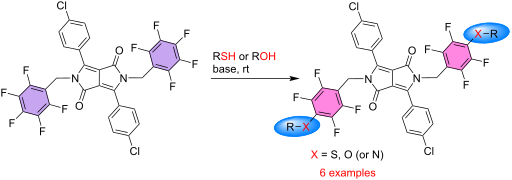
- conducted under remarkably mild conditions. Results and Discussion The initial step of our method involved the N-alkylation of DPP 1 with pentafluorobenzyl bromide (Scheme 1). Although a similar reaction had been previously reported for other DPP derivatives, the experimental conditions used (DMF, K2CO3
- performed in dry DMF at room temperature, in the presence of a base (K2CO3 or Cs2CO3). Room temperature was chosen due to the observed rapid degradation of the starting material at elevated temperatures. The work described herein allowed us to assess the potential of DPP 2 as a novel platform for obtaining
- excellent nucleophiles and generally react under mild conditions, resulting in the substitution of the 4-F atom of the pentafluorophenyl groups. In this case, reactions with thiols were performed in dry DMF and K2CO3 was used as the base. Three different thiols were tested: pyridine-4-thiol, pyridine-2


Novel oxidative routes to N-arylpyridoindazolium salts
Beilstein J. Org. Chem. 2024, 20, 1906–1913, doi:10.3762/bjoc.20.166
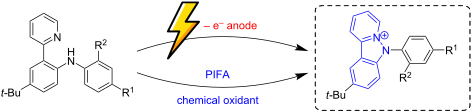
- diaryldihydrophenazine was increased (10%). Thus, protonation completely suppressed the intramolecular cyclization route. Heterocyclic salts S1–S3 were obtained as amorphous solids, soluble in polar solvents (acetonitrile, DMF, acetone) and chlorinated hydrocarbons (CHCl3, CH2Cl2). The structure of new N
- in line with the green chemistry requirements [24]. To test the assumption, the preparative oxidation of amine A1 was performed in the potentiostatic mode at 1.6 V (vs Ag/AgCl, KCl(sat.)) in a two-compartment cell in DMF; sodium tosylate was used as a supporting electrolyte. After a charge
- conditions of the potentiostatic electrolysis were the following: a two-compartment cell, a glassy carbon (GC) anode, DMF, the potential increased from 1.0 V to 1.4 V vs Ag/AgCl, KCl(sat.)), 2 F per mol of amine electricity passed, sodium tosylate (0.1 M) as a supporting electrolyte, and 2 equiv of 2.6


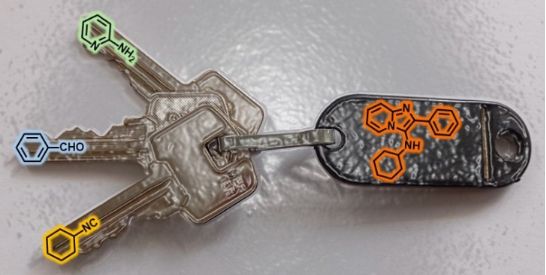
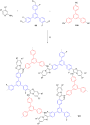
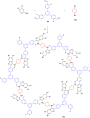
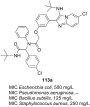
The Groebke–Blackburn–Bienaymé reaction in its maturity: innovation and improvements since its 21st birthday (2019–2023)
Beilstein J. Org. Chem. 2024, 20, 1839–1879, doi:10.3762/bjoc.20.162






A facile three-component route to powerful 5-aryldeazaalloxazine photocatalysts
Beilstein J. Org. Chem. 2024, 20, 1831–1838, doi:10.3762/bjoc.20.161
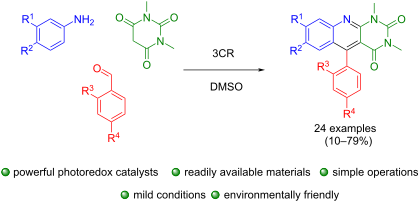
- was significantly enhanced when refluxing in DMF with a catalytic amount of AlCl3 compared to the reaction in clear DMF (Table 1, entries 7–9). Other Lewis acids were not as effective, except for a combination of DMSO/TMSOTf (Table 1, entry 4). The application of AcOH/PPA for the synthesis of 5
- heating conditions (CH). Syntheses were performed in DMSO, DMSO/AlCl3, DMF/AlCl3 and AcOH/H2SO4 at 110 °C (Table 1, entries 5, 6, 9, and 12). Under these conditions, the reaction time was significantly reduced to 1 hour from the usual 15 hours, however, the yields stayed in the range of 30%, and the
- derivatives 2i–k, we changed the solvent to DMF/AlCl3, which increased the yields to 41–45%. However, the 7-methoxy derivative 2l with o-methyl substituent in the aldehyde moiety precipitated in DMSO after two days of reaction time. Interestingly, we observed only traces of another possible regioisomer 2m




Syntheses and medicinal chemistry of spiro heterocyclic steroids
Beilstein J. Org. Chem. 2024, 20, 1713–1745, doi:10.3762/bjoc.20.152


Chemo-enzymatic total synthesis: current approaches toward the integration of chemical and enzymatic transformations
Beilstein J. Org. Chem. 2024, 20, 1693–1712, doi:10.3762/bjoc.20.151
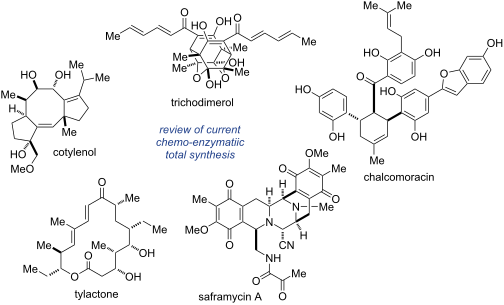
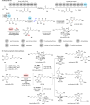
- experimental results, Gulder and co-workers devised a strategy to control the dimerization modes by adjusting the polarity of the organic co-solvent to establish the divergent synthesis of dimeric scaffolds. Indeed, with 20% DMF in the SorbC-catalyzed enzymatic oxidative dearomatization, the Michael addition




Benzylic C(sp3)–H fluorination
Beilstein J. Org. Chem. 2024, 20, 1527–1547, doi:10.3762/bjoc.20.137

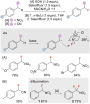
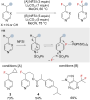
- . Secondary and tertiary substrates worked well under the reaction conditions, whereas primary positions afforded low yields (14). No additive was required to achieve the desired selectivity, but in some cases the addition of small amounts of iron salt [FeCl4][FeCl2(dmf)3] improved yields. In 2022, Pieber and








Electrophotochemical metal-catalyzed synthesis of alkylnitriles from simple aliphatic carboxylic acids
Beilstein J. Org. Chem. 2024, 20, 1497–1503, doi:10.3762/bjoc.20.133
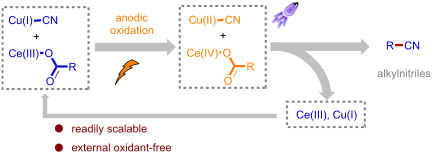
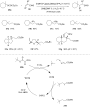
- -known to be highly susceptible to electroplating on the cathode and thus require the use of ligands to avoid detrimental cathode deposition during electrolysis (Table 1, entry 3). In addition, we discovered that the additional use of DMF as co-solvent is beneficial to the reaction efficiency–reactions
- using acetonitrile as the solvent frequently led to the observation of Cu deposition at cathode (Table 1, entry 4). We reasoned that DMF could coordinate to the copper center, acting as a ligand to prevent copper from cathode reduction. Constant current electrolysis is also applicable to the reaction
- yields are of isolated products. Unless otherwise noted, reaction conditions were as follows: 0.2 mmol acids, 0.4 mmol TMSCN, CeCl3 (10 mol %), Cu(OTf)2/BPhen (5/6 mol %), 0.05 mmol BTMG, 0.2 mmol TBABF4, 0.5 mmol TFE, 3.5 mL of CH3CN, 0.5 mL of DMF, carbon felt as the anode, Pt as the cathode, under N2


Photoswitchable glycoligands targeting Pseudomonas aeruginosa LecA
Beilstein J. Org. Chem. 2024, 20, 1486–1496, doi:10.3762/bjoc.20.132
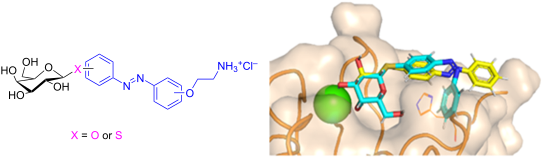
- binding of one isomer only. Experimental General experimental details. Commercially available solvents and reagents were used without further purification. Reactions carried out under anhydrous conditions are performed under argon in glassware previously dried in an oven. DMF and THF were previously dried
- (1.0 equiv) in anhydrous DMF (≈3.5 mL per mmol) was added K2CO3 (2.0–4 equiv) and BocNHCH2CH2Br (1.5–4 equiv), then stirred overnight at 60 °C. After the reaction was completed (TLC monitoring), the mixture was evaporated to dryness under reduced pressure. The residue was dissolved in EtOAc
- crystalline complexes. The protein is represented by orange ribbon, His53 by lines, and calcium by green sphere. Synthesis of photoswitchable LecA inhibitors. Reagents and conditions: (i) DMC, Et3N, H2O, −10 °C to rt, 8 h, 50% for 7, 40% for 10; (ii) BrCH2CH2NHBoc, K2CO3, DMF, 60 °C, 15 h, 91% for 8, 80% for


Selectfluor and alcohol-mediated synthesis of bicyclic oxyfluorination compounds by Wagner–Meerwein rearrangement
Beilstein J. Org. Chem. 2024, 20, 1462–1467, doi:10.3762/bjoc.20.129
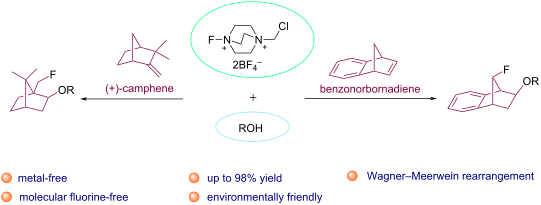
- that there was a 12% conversion with CH3CN and a 10% conversion with nitromethane, while no conversion occurred with the other solvents including, CH2Cl2, EtOAc, 1,4-dioxane and DMF (Table 1, entries 1–6). To see the effect of reactant ratios on yields, when reactants were gradually increased at room


Synthesis of 4-functionalized pyrazoles via oxidative thio- or selenocyanation mediated by PhICl2 and NH4SCN/KSeCN
Beilstein J. Org. Chem. 2024, 20, 1453–1461, doi:10.3762/bjoc.20.128
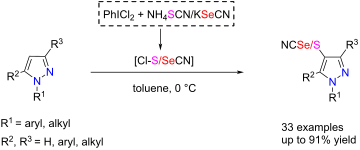
- , solvent screening showed that toluene was the most appropriate solvent, while the reaction led to a much lower yield when DMF, MeOH, MeCN, or DCM were used as solvents (Table 1, entries 13–17). On the basis of the above experimental results, the optimized conditions for the thiocyanation of the model


Generation of alkyl and acyl radicals by visible-light photoredox catalysis: direct activation of C–O bonds in organic transformations
Beilstein J. Org. Chem. 2024, 20, 1348–1375, doi:10.3762/bjoc.20.119
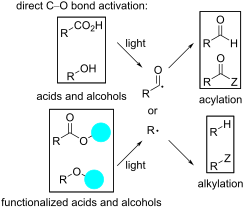
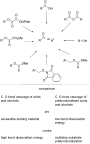
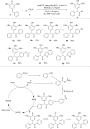
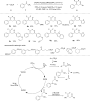
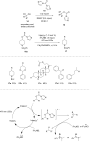
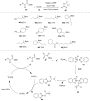
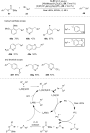
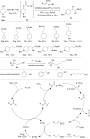
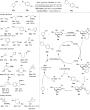
- in DMF solvent and requires ca. 18 h to finish upon irradiation with blue LEDs. The catecholboronic esters produced at first are transesterified into pinacol borane by addition of pinacol and triethylamine. The reaction proved to be useful for a wide variety of substrates, such as borneol, menthol
- DMF with the help of photoexcited Ir(ppy)3. The suggested mechanism begins with the formation of photoexcited *[Ir(III)], which promotes SET to oxalate and generates an oxalate radical anion and [Ir(IV)]. The fragmentation of the oxalate radical anion produces an alkyl radical. The radical
- subsequently undergoes addition to B2cat2 (19) to produce the boryl radical 41. Here, the choice of solvent is also important. The interaction between DMF and the boryl radical 41 assists B–B bond scission to furnish the target borylated products and an intermediate 43, which is oxidized by [Ir(IV








Synthesis of 1,2,3-triazoles containing an allomaltol moiety from substituted pyrano[2,3-d]isoxazolones via base-promoted Boulton–Katritzky rearrangement
Beilstein J. Org. Chem. 2024, 20, 1334–1340, doi:10.3762/bjoc.20.117
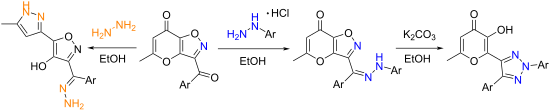
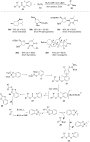
- in the presence of K2CO3 in DMF allowed us to prepare 3-methoxypyran-4-one derivative 7 (Scheme 9). Conclusion In summary, we investigated the reaction of substituted pyrano[2,3-d]isoxazolones with diverse hydrazines. We have demonstrated that initially the studied process leads to appropriate


Domino reactions of chromones with activated carbonyl compounds
Beilstein J. Org. Chem. 2024, 20, 1256–1269, doi:10.3762/bjoc.20.108
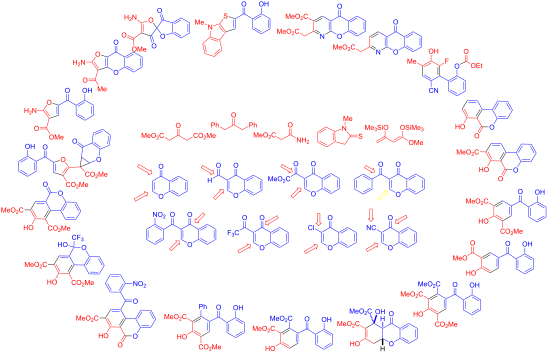
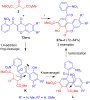
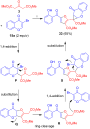
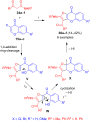
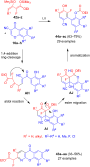
- (10%). Synthesis of 33. Conditions: i, DBU (1.3 equiv), THF, 20 °C, 12 h. Synthesis of 35a–x. Conditions: i, DBU (1.3 equiv), 1,4-dioxane, 20 °C, 12 h. Synthesis of 36a–f. Conditions: i, 1) DBU (1.3 equiv), 1,4-dioxane, 20 °C, 12 h; 2) I2 (2 equiv), DBU (3 equiv), MeCN or DMF. Synthesis of 37a,b
- . Conditions: i, 1) DBU (1.3 equiv), 1,4-dioxane, 20 °C, 12 h; 2) I2 (2 equiv), DBU (3 equiv), MeCN or DMF. Then aqueous work-up at the air. Synthesis of 39a–i. Conditions: i, method A: DBU (1.3 equiv), 1,4-dioxane, 20 °C; method B: K2CO3 (4 equiv), DMF, 20 °C. Synthesis of 40. Conditions: i, piperidine, MeOH









The Ugi4CR as effective tool to access promising anticancer isatin-based α-acetamide carboxamide oxindole hybrids
Beilstein J. Org. Chem. 2024, 20, 1213–1220, doi:10.3762/bjoc.20.104
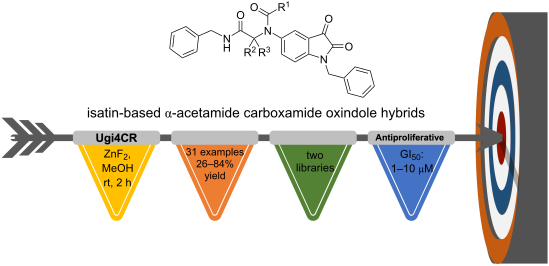
- into the scaffold. Benzyl azide (6), obtained using a previously reported procedure [27], was used in the CuAAC reaction. The α-acetamide carboxamide 1,2,3-triazole oxindole hybrid 7 was easily obtained in 61% yield using Cu(OAc)2 as catalyst, ascorbic acid, DMF as solvent, and microwave reaction




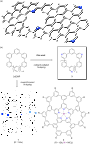
Introduction of peripheral nitrogen atoms to cyclo-meta-phenylenes
Beilstein J. Org. Chem. 2024, 20, 1207–1212, doi:10.3762/bjoc.20.103
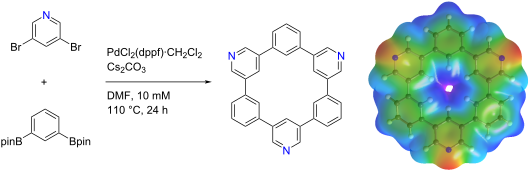
- Cs2CO3 (48.9 g, 150 mmol) in 3.0 L of DMF was stirred at 110 °C for 24 h. After the addition of H2O (2.5 L) and CHCl3 (3.0 L), the precipitate was removed by filtration. The organic layer was separated, dried over Na2SO4, and concentrated in vacuo. To eliminate the soluble by-products, the crude material