


Search results
Search for "HFIP" in Full Text gives 76 result(s) in Beilstein Journal of Organic Chemistry.
Chromo- and fluorophoric water-soluble polymers and silica particles by nucleophilic substitution reaction of poly(vinyl amine)
Beilstein J. Org. Chem. 2010, 6, No. 79, doi:10.3762/bjoc.6.79
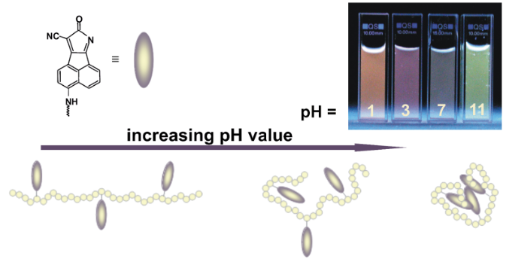
- both compounds, the shortest UV–vis absorption maxima were observed at λmax(1-M) = 568 nm and λmax(1-P) = 513 nm in HFIP. 1-M shows the longest wavelength UV–vis absorption band at λmax = 580 nm in DMSO, whereas 1-P has the strongest bathochromic shift in ethanol at λmax = 538 nm. These band shifts
- the longest-wavelength emission maximum in DMSO at λmax = 595 nm and 1-P in ethanol at λmax = 586 nm. The longest hypsochromic shifts of the fluorescence emission maximum were observed at λmax(1-M) = 577 nm in HFIP and λmax(1-P) = 561 nm in DMMA. These band shifts correspond to a small solvatochromic
- range of Δ(1-M) = 524 cm−1 and Δ(1-P) = 760 cm−1, respectively. Furthermore, for 1-M only a small Stokes shift (9–15 nm) is observed, whereas 1-P shows a larger one (26–63 nm), which reaches a maximum in strong HBD solvents (HFIP). Again, the solvent-dependent fluorescence emission maxima can be




Other Beilstein-Institut Open Science Activities



