Search results
Search for "aldehyde" in Full Text gives 862 result(s) in Beilstein Journal of Organic Chemistry. Showing first 200.
Enantioselective regiospecific addition of propargyltrichlorosilane to aldehydes catalyzed by biisoquinoline N,N’-dioxide
Beilstein J. Org. Chem. 2024, 20, 3069–3076, doi:10.3762/bjoc.20.255
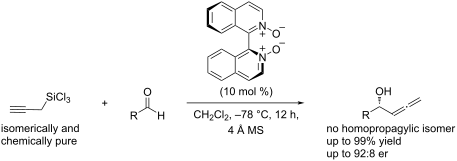
- toward electrophiles [14][15][16][17][18][19]. Consequently, all reported asymmetric catalytic aldehyde allenylation methods are currently limited to metal/metalloid reagents bearing R2 substituents [21][22][23][24][25][26][27][28][29][30][31][32][33][34], except for the methods with
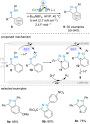
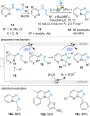
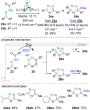
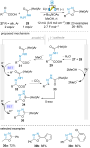
- the allenylation reaction of benzaldehyde (1a) as model aldehyde with catalyst 3 (Scheme 4). Catalyst 3 was the only catalyst previously studied by Nakajima for propargyltrichlorosilane [36]. Ever since Nakajima reported the beneficial effect of N,N-diisopropylethylamine on the reaction rate of the
- aldehyde allylation reaction with allyltrichlorosilane [47], it has been routinely employed in analogous chlorosilane reactions [48][49][50][51][52][53][54][55]. However, a mechanistic basis of its role on the observed rate acceleration remains elusive while it certainly functions as a scavenger of HCl


Advances in radical peroxidation with hydroperoxides
Beilstein J. Org. Chem. 2024, 20, 2959–3006, doi:10.3762/bjoc.20.249
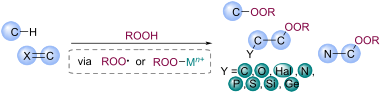
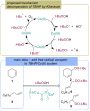
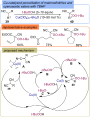
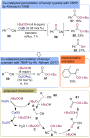
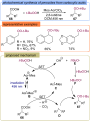
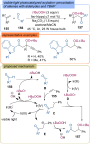
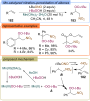
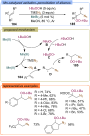
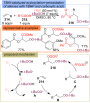
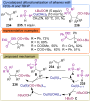
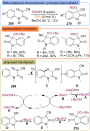
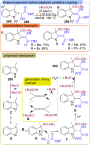
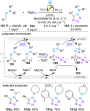
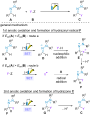
- . The oxidation of benzyl alcohol 62 with TBHP results in aldehyde C, HAT from which by tert-butoxy radical A leads to the C-centered radical D. Subsequent recombination of radicals D and B provides the target product 63. An enantioselective peroxidation method of alkylaromatics with TBHP using chiral
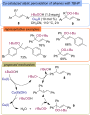
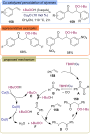
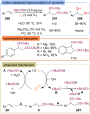
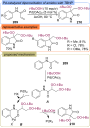
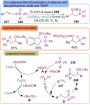
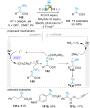
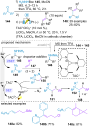
- ]. The set of tert-butoxy A and tert-butylperoxy B radicals are formed from TBHP during the Cu(I)/Cu(II) redox cycle. The Cu(II)/TBHP system also provides oxidation of benzyl alcohol 80 to the corresponding aldehyde C. The reaction of isocyanate 81 with aldehyde C generates oxazoline D, HAT from D by the
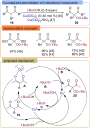
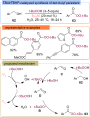
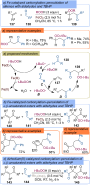
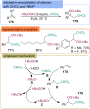
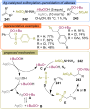
- Fe-catalyzed decarbonylative alkylation–peroxidation of alkenes 130 with aliphatic aldehydes 131 and TBHP to provide chain elongated peroxides 132 was developed (Scheme 44a) [103]. Aliphatic aldehyde 131 were used as the sources of 1°, 2°, 3° alkyl moieties via decarbonylation strategy. The proposed































Synthesis of fluorinated acid-functionalized, electron-rich nickel porphyrins
Beilstein J. Org. Chem. 2024, 20, 2954–2958, doi:10.3762/bjoc.20.248
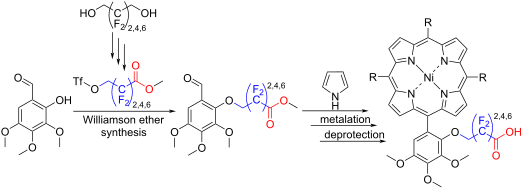
- -synthetic modification of this porphyrin proved to be difficult. Therefore, we have integrated the acid group into the aldehyde component of the Rothemund reaction to prepare the target porphyrin. In initial tests, we have established that trifluoroacetic acid can be replaced by perfluorinated alkyl
- ) as the aldehyde component due to its commercial availability. A OH group was introduced to serve as the nucleophile in the Williamson ether synthesis with the triflates 16, 17, and 18 (Scheme 2). Towards this end, 3,4,5-trimethoxybenzaldehyde (19) was iodinated using N-iodosuccinimide (NIS) to give
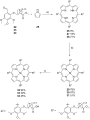
- Williamson ether synthesis to yield 22 (78%), 23 (44%), and 24 (44%). Compounds 22, 23, and 24 were used as aldehyde components in the Rothemund-type synthesis of metal-free porphyrins 26 (9%), 27 (18%), and 28 (21%) (see Scheme 3). Metalation was achieved with nickel acetylacetonate to obtain the ester


C–H Trifluoromethylthiolation of aldehyde hydrazones
Beilstein J. Org. Chem. 2024, 20, 2883–2890, doi:10.3762/bjoc.20.242
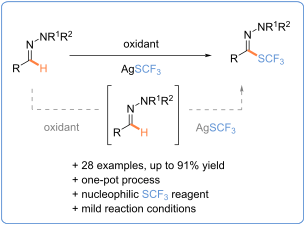
- /Education Center for Excellence in Molecular Sciences Institute of Chemistry, Chinese Academy of Sciences, Beijing 100190, China 10.3762/bjoc.20.242 Abstract The selective C–H trifluoromethylthiolation of aldehyde hydrazones afforded interesting fluorinated building blocks, which could be used as a
- trifluoromethylthiolated molecules, which could be used as synthetic handles for synthesizing more complex molecules, is still appealing. In this context, we turned our attention to the trifluoromethylthiolated hydrazones, an interesting building block. Indeed, aldehyde hydrazones have been well studied and used in
- various transformations [54][55][56][57][58][59][60][61][62][63][64]. In consequence, a large number of transition-metal-catalyzed or radical-mediated processes for C–H functionalization of aldehyde hydrazones has flourished over the years. An ideal scenario for a direct and sustainable synthetic route


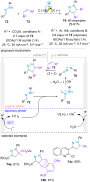
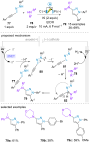
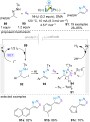
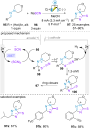
Synthesis of pyrrole-fused dibenzoxazepine/dibenzothiazepine/triazolobenzodiazepine derivatives via isocyanide-based multicomponent reactions
Beilstein J. Org. Chem. 2024, 20, 2870–2882, doi:10.3762/bjoc.20.241
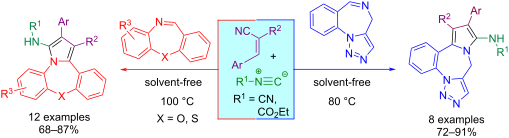
- with 1,10-phenanthroline as cyclic imine under solvent-free conditions for the synthesis of pyrrole-fused phenanthroline. This reaction proceeds via in situ formation of zwitterion I through reaction of the aldehyde and malononitrile followed by 1,3-dipolar cycloaddition (Scheme 1a) [41]. Chen and co






Multicomponent synthesis of α-branched amines using organozinc reagents generated from alkyl bromides
Beilstein J. Org. Chem. 2024, 20, 2834–2839, doi:10.3762/bjoc.20.239
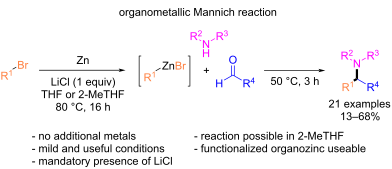
- 16 h at 80 °C (Table 1, entry 2). However, its suitability in the multicomponent coupling with an amine and an aldehyde still had to be demonstrated as there was no precedent for such a Mannich multicomponent coupling involving nonstabilized organozinc halides using THF or 2-MeTHF as solvent. To our
- species 2 were collected using a syringe and allowed to react with an amine 3 and an aldehyde 4 under moderate heating (Scheme 2). The multicomponent couplings proceeded smoothly, with an acceptable yield of the α-branched amine being obtained after 3 h at 50 °C. A range of secondary amines as well as


Access to optically active tetrafluoroethylenated amines based on [1,3]-proton shift reaction
Beilstein J. Org. Chem. 2024, 20, 2776–2783, doi:10.3762/bjoc.20.233
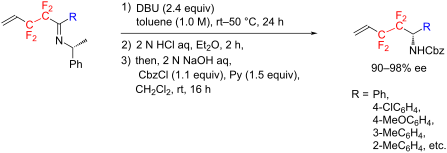
- ]. As a diastereoselective synthesis, reductive coupling reactions of commercially available 4-bromo-3,3,4,4-tetrafluoro-1-butene and glyceraldehyde 10a, its imine derivative 11, or Garner's aldehyde 10b have been reported [23][24]. Although the diastereoselectivities were low in some cases, the



Synthesis of spiroindolenines through a one-pot multistep process mediated by visible light
Beilstein J. Org. Chem. 2024, 20, 2722–2731, doi:10.3762/bjoc.20.230
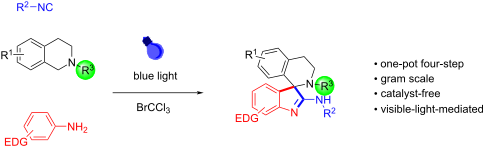
- product 6 was not observed. Instead, among the several side-products formed, we were able to isolate α-aminoamidine 7, as the result of a 3C Ugi-type reaction between an aldehyde obtained from an oxidation–hydrolysis process of compound 5, tert-butyl isocyanide and 2 equivalents of aniline, and the





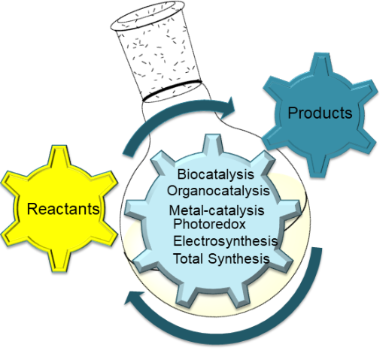
5th International Symposium on Synthesis and Catalysis (ISySyCat2023)
Beilstein J. Org. Chem. 2024, 20, 2704–2707, doi:10.3762/bjoc.20.227
- a new family of isatin-based α-acetamide carboxamide oxindole hybrids using the versatile Ugi four-component reaction [18]. Sixteen hybrids were prepared by reacting 5-amino-1-benzyl-3,3-dimethoxyindolin-2-one, benzyl isocyanide, carboxylic acids, and aldehyde/ketone derivatives, catalyzed by ZnF2

Computational design for enantioselective CO2 capture: asymmetric frustrated Lewis pairs in epoxide transformations
Beilstein J. Org. Chem. 2024, 20, 2668–2681, doi:10.3762/bjoc.20.224
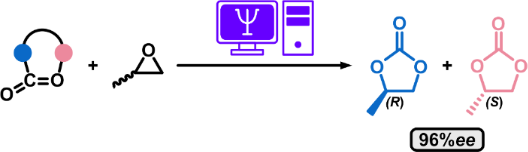
- mechanism is followed by 40% of the catalysed reactions studied. Mechanism 2 (Figure 5B) contains an additional step. In this mechanism, the epoxide is first isomerised through TS14, resulting in the formation of the aldehyde (Min4). It can be observed that the opening of the epoxide is catalysed by the
- presence of the CO2 adduct. In the gas phase and isolated, the isomerisation of the epoxide exhibits a barrier of 52.6 kcal·mol−1. In the case of F2_NB_H_H, the barrier is reduced to 37.0 kcal·mol−1. CO2 later reacts with the aldehyde, forming the insertion product already observed in mechanism 1 (Min2


The scent gland composition of the Mangshan pit viper, Protobothrops mangshanensis
Beilstein J. Org. Chem. 2024, 20, 2644–2654, doi:10.3762/bjoc.20.222
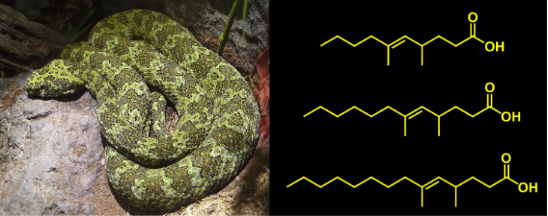
- the resulting solution was stirred for 1 h at that temperature. Aldehyde 3 (105 mg, 0.7 mmol) was added at −10 °C and stirred for a further 18 h. The reaction mixture was diluted with pentane and filtered. After the removal of the solvent, the crude product was purified by column chromatography using


Synthesis and cytotoxicity studies of novel N-arylbenzo[h]quinazolin-2-amines
Beilstein J. Org. Chem. 2024, 20, 2592–2598, doi:10.3762/bjoc.20.218
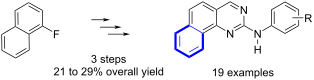
- afforded the known aldehyde 2 in 65% yield [13]. Then, reaction with guanidinium carbonate in DMA at high temperature [12], gave the desired intermediate 2-aminobenzo[h]quinazoline (3). In a final step, classical Buchwald–Hartwig coupling [14][15][16][17] with bromobenzene under the conditions described


HFIP as a versatile solvent in resorcin[n]arene synthesis
Beilstein J. Org. Chem. 2024, 20, 2469–2475, doi:10.3762/bjoc.20.211
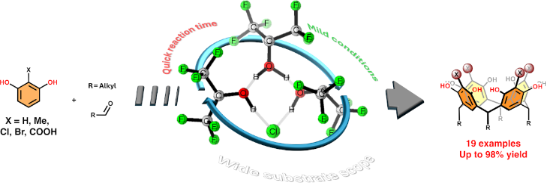
- tolerated. This method leads to a variety of 2-substituted resorcin[n]arenes in a single synthetic step with isolated yields up to 98%. Keywords: cavitand; cyclization; HFIP; hydroxyalkylation; resorcinarenes; Introduction The acid-catalyzed aldehyde-resorcinol condensation has been studied for more than
- a century [1][2][3]. Decades of research culminated in the landmark paper by Niederl and Vogel [4], whose quantitative elementary analysis and molecular weight determinations led them to conclude that the most likely product of the aldehyde-resorcinol condensation was a four-fold species resulting
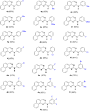
- presence of various aldehydes featuring different alkyl chains, all of which exhibited high isolated yields (Scheme 2, compounds 1a–e). Interestingly, literature reports commonly show lower yields as the aldehyde alkyl chain increases in length where commonly refluxing temperatures are required [9][74][76


Asymmetric organocatalytic synthesis of chiral homoallylic amines
Beilstein J. Org. Chem. 2024, 20, 2349–2377, doi:10.3762/bjoc.20.201
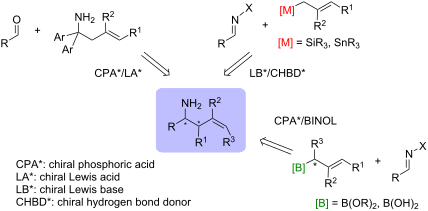
- (Scheme 6). The study explored a broad range of p-methoxyphenyl (PMP)imines derived from aryl, heteroaryl and alkyl aldehydes (including ethyl glyoxylate), demonstrating yields of 57–98% and high enantioselectivity of 90–98%. Screening of aldehyde and amine components indicated that the method is
- slightly more efficient with electron-poor substrates. On the other hand, high enantioselectivity was maintained over the aldehyde scope regardless of steric size and position of the substituents. A few years later, Wulff and co-workers [42] further elaborated the aza-Cope rearrangement methodology by
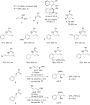
- crystal XRD of the corresponding hydrochloride salt. Microwave-induced one-pot asymmetric allylation of in situ-formed arylimines, catalysed by (R)-3,3’-diphenyl-BINOL. Aldehyde and amine scope [26]. aThe reaction was conventionally heated at 50 °C for 24 hours instead of microwave irradiation. b1.0 equiv




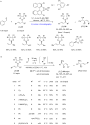


Deuterated reagents in multicomponent reactions to afford deuterium-labeled products
Beilstein J. Org. Chem. 2024, 20, 2270–2279, doi:10.3762/bjoc.20.195
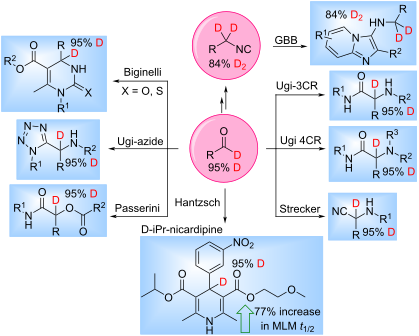
- aldehyde [10]. Latterly, Yamamoto utilized a 90% deuterated [D2]-isocyanide in a copper catalyzed [3 + 2] cycloaddition to afford a 60% deuterated [D2]-pyrrole [11]. The utility of the Leuckart–Wallach reaction towards the generation of isocyanides was first explored by Dömling [12], yet the use of such
- deuteration of formamide product while increasing formamide equivalents increases the yield at the cost of deuterated %. Excess reaction time increases side product formation and thermal degradation of the aldehyde starting material. To combat this, microwave irradiation was employed which dramatically
- Scheme 2 but is open to debate. Thus, formamide adds to the [D1]-aldehyde A to form hemiaminal B which eliminates D2O to give imine D. Deprotonation of formamide D forms the resonance and zwitterrion-stabilized isocyanate E [22]. We then hypothesize that zwitterion E rearranges with loss of CO2 to form


Synthesis and reactivity of the di(9-anthryl)methyl radical
Beilstein J. Org. Chem. 2024, 20, 2254–2260, doi:10.3762/bjoc.20.193
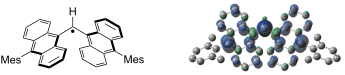
- dimerization in solution, the radical still remains even at 190 K due to the bulky nature of the two anthryl groups. Interestingly, upon exposure to air, the purple color of the radical solution quickly fades to orange, resulting in decomposition to give 9-anthryl aldehyde and anthroxyl radical derivatives
- radical. The unpaired electron is primarily located at the central sp2 carbon, a highly reactive site. The DAntM radical readily reacts with oxygen, leading to 1,2-dioxetane intermediate and decomposition to give anthryl aldehyde and a stable anthroxyl radical. Results and Discussion The synthetic route
- formation of a 1,2-dioxetane (DOT) intermediate and decomposition to aldehyde 1 and anthroxyl radical 5 via C–C and O–O bond cleavage. This reactivity is attributed to the predominant localization of an unpaired electron at the central sp2 carbon of the DAntM radical. These findings provide variable


Electrochemical allylations in a deep eutectic solvent
Beilstein J. Org. Chem. 2024, 20, 2217–2224, doi:10.3762/bjoc.20.189
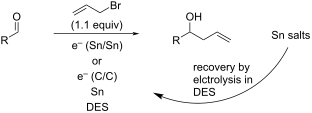
- constant current of 20 mA. With this promising start, several other aldehydes and two ketones were explored under the same reaction conditions (Table 2). A range of aromatic aldehydes worked well as well as one aliphatic aldehyde (Table 2, entry 13) and one alkenyl aldehyde (Table 2, entry 10), although
- , entries 5–7) did not result in carbonyl addition. The benzyl bromide was recovered intact, while for the other two, they are both sufficiently volatile that they would have been lost during the work-up. For all three, the aldehyde was recovered unreacted. While the use of DES as solvent and electrolyte
- the allylation product. Only in the case of the cyclohexanecarboxaldehyde (Table 6, entry 3) was the yield lower and in this case this lower yield was the result of incomplete conversion of the aldehyde. For as successful as the TBAB/EG conditions were, TBAB is not inexpensive. Choline chloride is

O,S,Se-containing Biginelli products based on cyclic β-ketosulfone and their postfunctionalization
Beilstein J. Org. Chem. 2024, 20, 2143–2151, doi:10.3762/bjoc.20.184
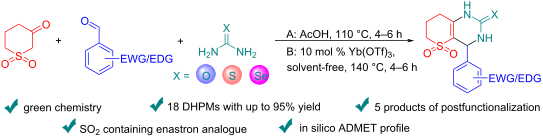
- ) are the key methodology to access valuable heterocycles for medicinal chemistry projects. The classical Biginelli reaction (1893) is an acid-catalyzed, three-component reaction between an aldehyde, β-ketoester, and urea that produces 3,4-dihydropyrimidin-2(1H)-ones, also known as DHPMs (Scheme 1A
- -alkyl/aryl-substituted analogues, and aldehyde component switch to heteroaromatic (2-pyridinaldehyde) and aliphatic (iPrCHO, cinnamaldehyde). Unfortunately, we failed in both replacements and were unable to obtain any reasonable products. The list of unsuccessful reagents is shown in Figure S7 (see



Multicomponent syntheses of pyrazoles via (3 + 2)-cyclocondensation and (3 + 2)-cycloaddition key steps
Beilstein J. Org. Chem. 2024, 20, 2024–2077, doi:10.3762/bjoc.20.178

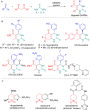
- hydrolactite catalysts (C-Mg-Al HAT-3) [90]. With β-ketoesters, the method can be extended to a four-component synthesis. Initially, β-ketoesters react with hydrazine to form pyrazolones, while a Knoevenagel reaction between malononitrile and aldehyde simultaneously generates a Michael system. Both




Harnessing the versatility of hydrazones through electrosynthetic oxidative transformations
Beilstein J. Org. Chem. 2024, 20, 1988–2004, doi:10.3762/bjoc.20.175
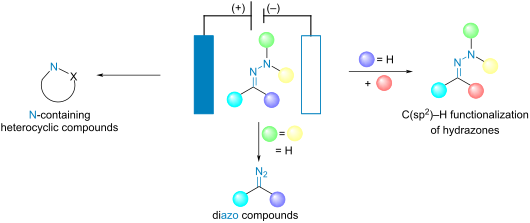
- readily available hydrazones under mild, safe and oxidant-free reaction conditions. This review presents a comprehensive overview of oxidative electrosynthetic transformations of hydrazones. It includes the construction of azacycles, the C(sp2)−H functionalization of aldehyde-derived hydrazones and the
- asymmetric preparation of chiral amines through the addition of nucleophilic partners [21][22] while the azaenamine character of some aldehyde-derived hydrazones has been demonstrated in the coupling with suitable electrophiles such as Michael acceptors [23][24]. Last but not least, the C=N bond of
- the electrochemical oxidative transformations of hydrazones. It is organized in four main parts: (i) synthesis of azacycles, (ii) synthesis of functionalized hydrazones through C(sp2)–H functionalization of aldehyde-derived hydrazones, (iii) access to diazo compounds, and (iv) synthesis of



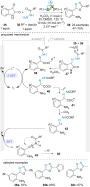
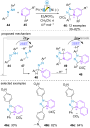
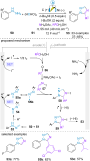
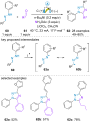






Development of a flow photochemical process for a π-Lewis acidic metal-catalyzed cyclization/radical addition sequence: in situ-generated 2-benzopyrylium as photoredox catalyst and reactive intermediate
Beilstein J. Org. Chem. 2024, 20, 1973–1980, doi:10.3762/bjoc.20.173
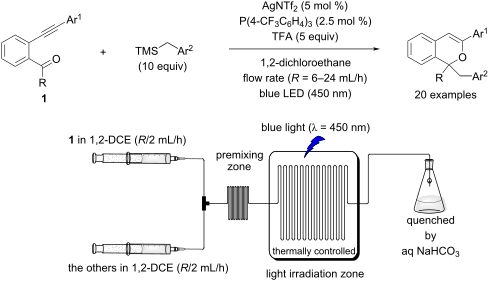
- time was extended from 2.5 min to 10 min), it did not exceed the yield of the batch reaction. In contrast, aldehyde 1n having a simple phenyl group gave product 3n in good yield (Table 3, entry 3: 72%). Because the yield of this flow reaction was better than that of the batch reaction (65%), the
- , respectively, in high yields (Table 3, entries 4 and 5). The aldehyde 1q bearing a strong electron-withdrawing trifluoromethyl group at the para-position gave product 3q in moderate yield (Table 3, entry 6: 63%), with the recovery of substrate 1q (18%). The reaction of ortho-methyl-substituted aldehyde 1r


The Groebke–Blackburn–Bienaymé reaction in its maturity: innovation and improvements since its 21st birthday (2019–2023)
Beilstein J. Org. Chem. 2024, 20, 1839–1879, doi:10.3762/bjoc.20.162
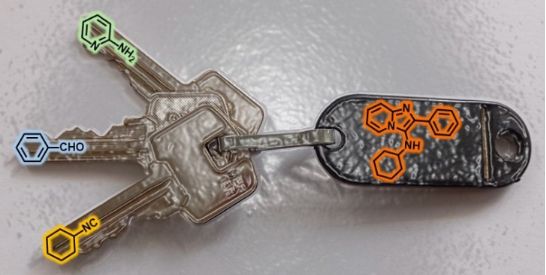
- significantly more active than 9, owing to higher rigidity and the correct position of the ortho H atoms in close proximity to the σ-holes on the I atom. The authors demonstrated that hydrogen bonding between H in ortho position of 8 and both O atom of aldehyde and N atom of imine significantly increased the
- the tolerability of a wide range of aldehydes, starting from one of the most used, benzaldehyde, passing through heteroaromatic and aliphatic structures with different substituents. In this context, some examples where the aldehyde functionality is incorporated into sugar derivatives, natural
- , the use of 5-HMF (23) [36], a renewable carbon source derived from biomass, responds to these requirements. This aldehyde displays additional functionalities useful for further modifications of the GBB adducts, but some optimization was necessary due to its intolerance to high temperatures and






A facile three-component route to powerful 5-aryldeazaalloxazine photocatalysts
Beilstein J. Org. Chem. 2024, 20, 1831–1838, doi:10.3762/bjoc.20.161
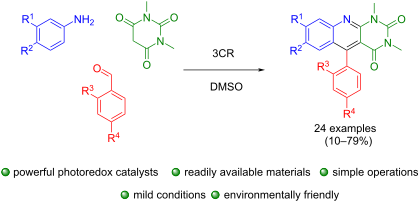
- have been successfully synthesised through a one-pot, three-component reaction involving N,N-dimethylbarbituric acid, an aromatic aldehyde and aniline. By utilizing readily available reagents, this approach opens up the opportunity for the efficient formation of a variety of 5-aryldeazaalloxazines
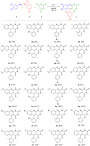
- derivatives 2i–k, we changed the solvent to DMF/AlCl3, which increased the yields to 41–45%. However, the 7-methoxy derivative 2l with o-methyl substituent in the aldehyde moiety precipitated in DMSO after two days of reaction time. Interestingly, we observed only traces of another possible regioisomer 2m
- the described conditions. The halogen groups on the anilines slightly decreased their reactivity, leading to the formation of products 2q–w with lower yields. However, the 8-chlorine derivative 2u with a o-tolyl aldehyde moiety was prepared with a yield of 37%. Aromatic aldehydes bearing bromine and




Ugi bisamides based on pyrrolyl-β-chlorovinylaldehyde and their unusual transformations
Beilstein J. Org. Chem. 2024, 20, 1773–1784, doi:10.3762/bjoc.20.156
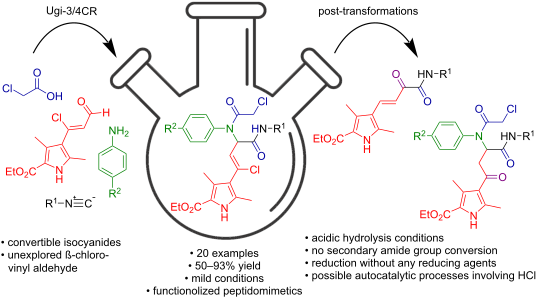
- . [15][18]. Further, the application of reagents with additional functional groups in the Ugi reaction makes it possible to further increase the complexity of the product structures, also due to possible post-transformation reactions. For example, if an unsaturated bond is present in the aldehyde
- presence of several alternative reaction centers in the structure of our substances, we sometimes encountered unexpected and intriguing results. Results and Discussion Synthesis of Ugi bisamides Four-component and three-component Ugi reactions The combination of pyrrole-containing α,β-unsaturated aldehyde




Chemo-enzymatic total synthesis: current approaches toward the integration of chemical and enzymatic transformations
Beilstein J. Org. Chem. 2024, 20, 1693–1712, doi:10.3762/bjoc.20.151
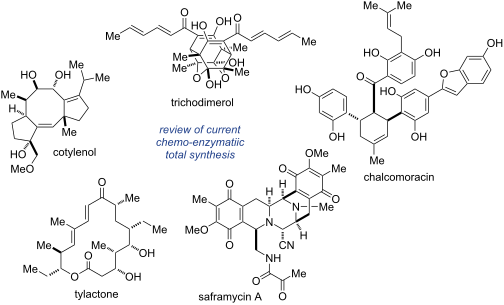
- biosynthetic intermediate 8 to its analogs 21, enabling the chemo-enzymatic total synthesis of 1. The chemical synthesis commenced with the preparation of two fragments and their subsequent coupling to assemble the core 5/8/5 tricyclic scaffold (Scheme 3A). The left-half fragment, aldehyde 14, was synthesized
- and subsequent oxidation yielded aldehyde 18, a precursor for the intramolecular ring closure of the eight-membered ring. Upon treatment of 18 with BF3·Et2O, diastereoselective Prins cyclization of 18 proceeded to generate secondary alcohol 19. Subsequent one-pot treatment with (n-Bu)4NF·HF resulted
- -terminus of SorbB catalyzes conversion of thioester 31 using NADPH to liberate aldehyde 32, and subsequent Knoevenagel condensation-type cyclization leads to sorbicillin (33). The FAD-dependent monooxygenase SorbC, utilized in the chemo-enzymatic total synthesis of 2, catalyzes the oxidative