


Search results
Search for "amino alcohol" in Full Text gives 80 result(s) in Beilstein Journal of Organic Chemistry.
A divergent asymmetric approach to aza-spiropyran derivative and (1S,8aR)-1-hydroxyindolizidine
Beilstein J. Org. Chem. 2007, 3, No. 41, doi:10.1186/1860-5397-3-41
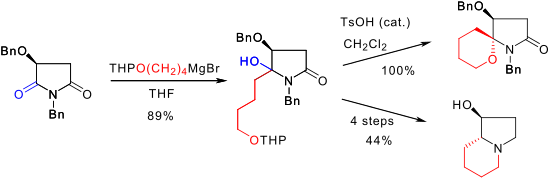
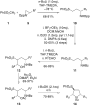
- procedure, namely, N-debenzylation/O-mesylation/Boc-cleavage/cyclization, and O-debenzylation. Alternatively, amino alcohol 8 was mesylated and the resultant mesylate 12 was subjected to hydrogenolytic conditions, which gave (1S,8aR)-1-hydroxyindolizidine (ent-3) in 60% overall yield from 8. Conclusion By
- -cleavage/cyclication, and O-debenzylation. In searching for a more concise method, amino alcohol 8 was mesylated (MsCl, NEt3, 0 °C) and the resultant labile mesylate 12 was subjected to catalytic hydrogenolysis (H2, l atm, 10% Pd/C, r.t.), which gave (1S,8aR)-1-hydroxyindolizidine (ent-3) in 60% overall
- . Stereoselective synthesis of (1S,8aR)-1-hydroxyindolizidine (ent-3). One-pot synthesis of ent-3 from amino alcohol 8. Supporting Information Supporting Information File 94: Experimental. Experimental procedures for the synthesis of all compounds described, and characterization data for the synthesized compounds



The enantiospecific synthesis of (+)-monomorine I using a 5-endo- trig cyclisation strategy
Beilstein J. Org. Chem. 2007, 3, No. 39, doi:10.1186/1860-5397-3-39
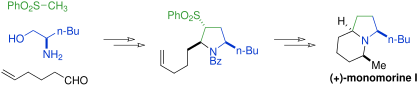
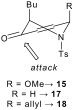
- synthesis of (+)-monomorine I, the initial target, pyrrolidine 22, was prepared. Commercially available D-norleucine was reduced to the amino alcohol 17. [19] This was then converted into the benzoyl-protected aminosulfone 20 via the diphenylphosphinylaziridine 18, which was ring-opened to give 19, followed




Pd-catalysed [3 + 3] annelations in the stereoselective synthesis of indolizidines
Beilstein J. Org. Chem. 2007, 3, No. 8, doi:10.1186/1860-5397-3-8
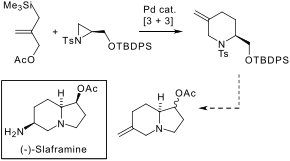
- modification of the route described by Righi and co-workers [11]. Accordingly, tosyl protection of (R)-serine 5 followed by esterification and TBDPS-protection provided 6 in good overall yield. Ester reduction was carried out conveniently on multigram scale using LiBH4 to give an amino alcohol that was


Synthesis and glycosidase inhibitory activity of new hexa- substituted C8-glycomimetics
Beilstein J. Org. Chem. 2005, 1, No. 12, doi:10.1186/1860-5397-1-12

- hands, we next turned to the obtention of C8-aminocyclitols. Thus, reduction of the azido group of 11 by dihydrogen in the presence of palladium black in ethyl acetate (Scheme 3) afforded the amino-alcohol 13 which could be submitted to acidic hydrolysis of the O-protective groups to give, after




Methods for the synthesis of polyhydroxylated piperidines by diastereoselective dihydroxylation: Exploitation in the two-directional synthesis of aza-C-linked disaccharide derivatives
Beilstein J. Org. Chem. 2005, 1, No. 2, doi:10.1186/1860-5397-1-2
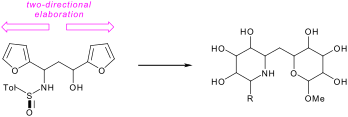
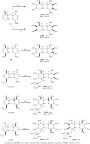
- configurations may be easily prepared. Our synthetic strategy is outlined in Scheme 1. We have previously shown that the configuration of 1,3-amino alcohol derivatives, such as 10, may be controlled by the addition of a lithium enolate to an N-sulfinyl imine (→ 9, for example) and diastereoselective reduction
- (Scheme 2).[24][25][26][27][28][29][30][31][32] Two-directional[33] oxidative ring expansion of 1,3-difuryl 1,3-amino alcohol derivatives 4 would yield a densely functionalised bis-enone which would be ripe for further functionalisation. The term "two-directional synthesis" is usually used to describe the
- materials were prepared from the 1,3-amino alcohol derivatives 1,3syn- and 1,3anti-10 (Scheme 6). Treatment of the difuryl 1,3-sulfinimido alcohols 1,3syn- and 1,3anti-10 with NBS in buffered THF-water precipitiated sulfonamide oxidation and two-directional ring expansion of both furan rings;[50] the crude





Other Beilstein-Institut Open Science Activities



