


Search results
Search for "fluorescence quenching" in Full Text gives 79 result(s) in Beilstein Journal of Organic Chemistry.
Synthetic incorporation of Nile Blue into DNA using 2′-deoxyriboside substitutes: Representative comparison of (R)- and (S)-aminopropanediol as an acyclic linker
Beilstein J. Org. Chem. 2010, 6, No. 13, doi:10.3762/bjoc.6.13
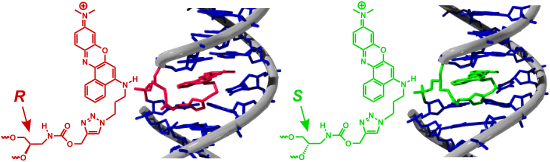
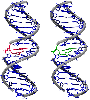
- between the phosphodiester bridges. Two sets of DNA duplexes were prepared. One set carried the chromophore in an A-T environment, the second set in a G-C environment. Both were characterized by optical spectroscopy. Sequence-dependent fluorescence quenching was applied as a sensitive tool to compare the
- ). Only minor, negligible differences were observed. Melting temperatures, UV–vis absorption spectra together with fluorescence quenching data indicate that Nile Blue stacks perfectly between the adjacent base pairs regardless of whether it has been attached via an S- or R-configured linker. This result
- photooxidizing guanines in the sequential neighborhood [17]. As a result, fluorescence quenching is observed in DNA and it is important to note that we decided to use this property as a sensitive tool to compare the electronic interactions of the phenoxazinium chromophore with the DNA base stack in order to


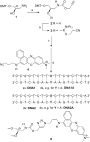


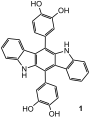
Synthesis of indolo[3,2-b]carbazole-based new colorimetric receptor for anions: A unique color change for fluoride ions
Beilstein J. Org. Chem. 2010, 6, No. 12, doi:10.3762/bjoc.6.12
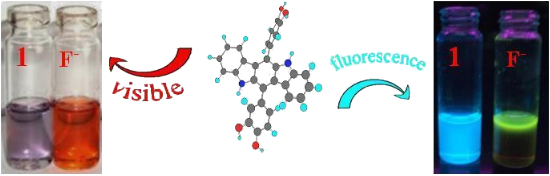
- orange) observed. Keywords: anion binding; colorimetry; fluorescence quenching; fluoride binding; indolocarbazole; Introduction The design and synthesis of chromogenic receptors for biologically important and environmentally harmful anion pollutants has attracted considerable attention in




Control of stilbene conformation and fluorescence in self-assembled capsules
Beilstein J. Org. Chem. 2009, 5, No. 79, doi:10.3762/bjoc.5.79
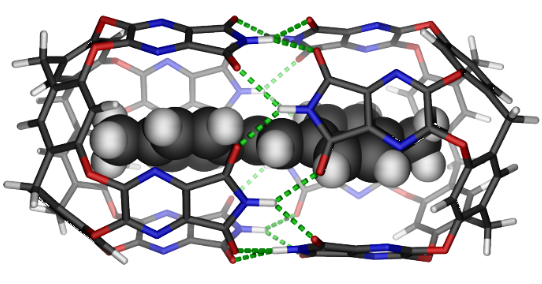
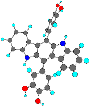
- in the snug, self-assembled complex 1.1 and exhibited fluorescence quenching due to the distortion of its ground-state geometry. When the complex is elongated by incorporating glycouril spacers, trans-stilbene is allowed to adapt a fully coplanar arrangement and fluorescence returns. Keywords


Quinoline based receptor in fluorometric discrimination of carboxylic acids
Beilstein J. Org. Chem. 2008, 4, No. 52, doi:10.3762/bjoc.4.52
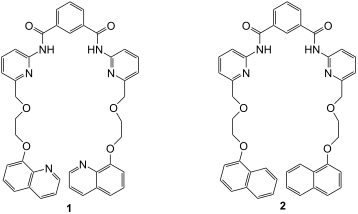
- receptor 1 and its 1:1 complexes with citric, D-(−)-tartaric, D-(−)-gluconic, succinic, glutaric, adipic, sebacic and terephthalic acids. On complexation, fluorescence quenching of the monomer emission occurs significantly with simultaneous generation of a new peak at longer wavelength, presumably due to


Other Beilstein-Institut Open Science Activities



