


Search results
Search for "oxindole" in Full Text gives 81 result(s) in Beilstein Journal of Organic Chemistry.
Expanding the chemical diversity of spirooxindoles via alkylative pyridine dearomatization
Beilstein J. Org. Chem. 2012, 8, 986–993, doi:10.3762/bjoc.8.111
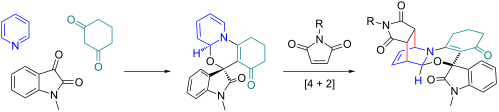
- development [9][10][11]. To our knowledge, most studies of these types of molecules focus on spirooxindoles bearing a pyrrolidine ring at the 3-position of the oxindole core, while few reports expand to formulate the syntheses of other spiro rings. As part of our ongoing reaction-screening objective [12][13
- exclusively in 74% yield (Table 1, entry 10). We predict that the formation of 6j by dehydration is due to the electron deficiency of the oxindole ring and subsequent stability gained from the ene–trione moiety. The structure of compound 6b was established by single-crystal X-ray analysis (Figure 1). Having




An intramolecular inverse electron demand Diels–Alder approach to annulated α-carbolines
Beilstein J. Org. Chem. 2012, 8, 829–840, doi:10.3762/bjoc.8.93
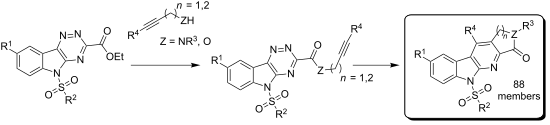
- existing indole framework. In general, applications of this construction sequence fall into two major camps, namely condensations routed through a 2-aminoindole synthon [49][50][51][52][53][54][55][56], and those targeting pyridine closures onto a 2-oxindole [57][58]. In addition, intramolecular Hartwig


Complete transfer of chirality in an intramolecular, thermal [2 + 2] cycloaddition of allene-ynes to form non-racemic spirooxindoles
Beilstein J. Org. Chem. 2011, 7, 601–605, doi:10.3762/bjoc.7.70
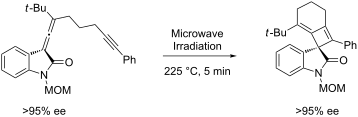
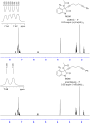
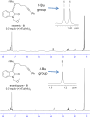
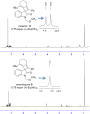
- complexes were resolved based upon the resonances at δ 3.98 and δ 3.87 ppm, which are peaks that correspond to the methyl in the MOM group on the oxindole nitrogen. For the enantiomerically enriched compound 9, only a single resonance is observed at δ 4.05 ppm in the presence of the chiral shift reagent




Total synthesis of (±)-coerulescine and (±)-horsfiline
Beilstein J. Org. Chem. 2010, 6, 876–879, doi:10.3762/bjoc.6.103

- rearrangement protocol was applied to obtain 3-allyl oxindole. This oxindole was then converted to (±)-coerulescine and (±)-horsfiline. Keywords: alkaloids; Claisen rearrangement; Jones oxidation; spiro-oxindole; Wittig olefination; Introduction The spiro[pyrrolidin-3,3′-oxindole] ring system is a widely
- . The majority of these alkaloids have interesting biological activities and pharmacological properties [9]. However, a crucial observation, reported by Danishefsky et al. [10], found that the unnatural analogous 3 and 4 (Figure 1) of the spiro[pyrrolidin-3,3′-oxindole] possessed significant activity
- protocols. Several synthetic approaches have been developed for the synthesis of the spiro[pyrrolidin-3,3'-oxindole] framework for horsfiline and coerulescine [11][12][13][14][15][16][17][18][19][20][21][22][23][24][25][26][27][28][29][30][31][32][33][34], both in racemic and enantiomeric forms. These


A thermally-induced, tandem [3,3]-sigmatropic rearrangement/[2 + 2] cycloaddition approach to carbocyclic spirooxindoles
Beilstein J. Org. Chem. 2010, 6, No. 33, doi:10.3762/bjoc.6.33
- Spirooxindoles are structural motifs containing a heterocycle or carbocycle at the C3 position of an oxindole. Particularly well known are the pyrrolidinyl-spirooxindoles 1 which have been classified as a privileged motif due to their presence in a large number of heterocyclic alkaloids (Figure 1) [1
- ]. Spirotryprostatin B (2) is just one example of many natural products from this class exhibiting interesting biological activity [2]. Compounds possessing a carbocycle at the C3 position of the oxindole, such as 3, are less common and spirooxindoles containing a four carbon spirocycle are rare. One notable natural
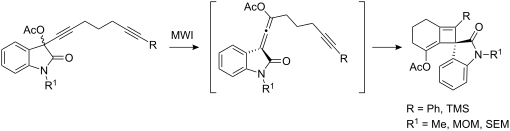
- allenyl acetate in intermediate 11 which in turn arises from the thermal [3,3]-sigmatropic rearrangement of 9a (Figure 3). We have briefly investigated the scope and limitations of this tandem cycloaddition reaction by varying the protecting group on the oxindole nitrogen, altering the substitution on the


Synthesis of dihydrophenanthridines by a sequence of Ugi-4CR and palladium- catalyzed intramolecular C-H functionalization
Beilstein J. Org. Chem. 2008, 4, No. 10, doi:10.3762/bjoc.4.10
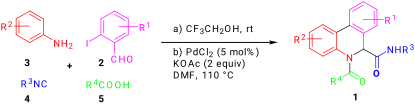
- reaction pathway leading to the formation of oxindole via an intramolecular N-arylation process was not observed under these conditions [25][26][27]. The preferential formation of compound 1a indicated that cyclization via palladium-catalyzed CH functionalization could be, under appropriate conditions, a


Other Beilstein-Institut Open Science Activities



