


Search results
Search for "polysaccharide" in Full Text gives 78 result(s) in Beilstein Journal of Organic Chemistry.
A bivalent glycopeptide to target two putative carbohydrate binding sites on FimH
Beilstein J. Org. Chem. 2010, 6, 801–809, doi:10.3762/bjoc.6.90
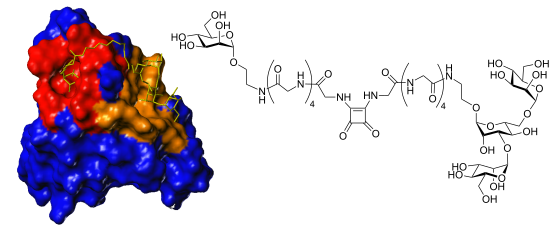
- ], employing type 1 fimbriated E. coli bacteria and mannan-coated microtiter plates. In this assay a mannosidic ligand competes with the polysaccharide mannan adsorbed on a polystyrene microtiter plate for FimH-mediated binding to the type 1 fimbriated bacteria. The inhibitory ligand is employed in serial


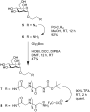
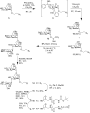

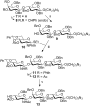
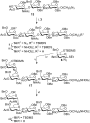
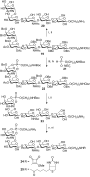
Synthesis of 6-PEtN-α-D-GalpNAc-(1–>6)-β-D-Galp-(1–>4)-β-D-GlcpNAc-(1–>3)-β-D-Galp-(1–>4)-β-D-Glcp, a Haemophilus influenzae lipopolysacharide structure, and biotin and protein conjugates thereof
Beilstein J. Org. Chem. 2010, 6, 704–708, doi:10.3762/bjoc.6.80
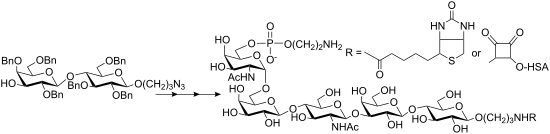
- College Dublin, Belfield, Dublin 4, Ireland, Phone: +353 17162318 10.3762/bjoc.6.80 Abstract Background: In bacteria with truncated lipopolysaccharide structures, i.e., lacking the O-antigen polysaccharide part, core structures are exposed to the immune system upon infection and thus their use as
- six serotypes, a–f, related to the structure of the capsular polysaccharide usually surrounding the bacterium [1]. Among these serotypes, type b is the cause of the most severe diseases, i.a. meningitis and pneumonia. However, there are now several commercial vaccines against this serotype that have


New amphiphilic glycopolymers by click functionalization of random copolymers – application to the colloidal stabilisation of polymer nanoparticles and their interaction with concanavalin A lectin
Beilstein J. Org. Chem. 2010, 6, No. 58, doi:10.3762/bjoc.6.58
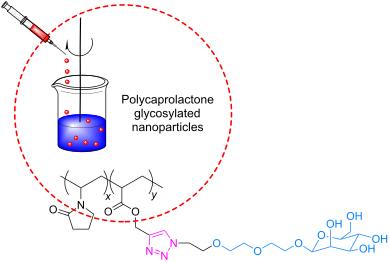
- addition to the hydrophilicity conferred by the carbohydrate moiety, specific targeting may be result from coating nanoparticles with oligo- or polysaccharide chains since the carbohydrate moieties play an essential role in molecular recognition processes. Although the carbohydrate ligands occur naturally


Other Beilstein-Institut Open Science Activities



