


Search results
Search for "triplet state" in Full Text gives 79 result(s) in Beilstein Journal of Organic Chemistry.
Effects of anion complexation on the photoreactivity of bisureido- and bisthioureido-substituted dibenzobarrelene derivatives
Beilstein J. Org. Chem. 2011, 7, 278–289, doi:10.3762/bjoc.7.37
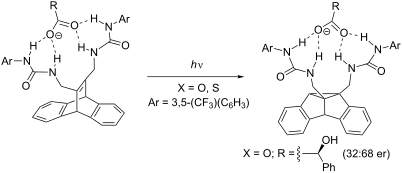
- benzophenone, a triplet-state di-π-methane rearrangement is induced. Thus, in the initial reaction step connection between one vinyl and one benzo carbon atom takes place, i.e., a so called vinyl–benzo bridging, that leads to the intermediate biradical BR1a [29]. Subsequent rearomatization with the formation
- nm) in the gas phase, and the latter compound is able to sensitize a triplet-state E/Z-isomerization of alkenes [48]. On the other hand, the thioureido-substituted dibenzobarrelene derivative 1i does not undergo a DPM rearrangement upon direct irradiation, despite the potentially sensitizing 3,5-bis
- association with anions. Specifically, the DPM rearrangement of the thioureido derivative 1i to give the dibenzosemibullvalene 2i can only be performed successfully when the self-quenching of the triplet state is suppressed by complex formation. At the same time it was shown in preliminary experiments that




Photoinduced homolytic C–H activation in N-(4-homoadamantyl)phthalimide
Beilstein J. Org. Chem. 2011, 7, 270–277, doi:10.3762/bjoc.7.36
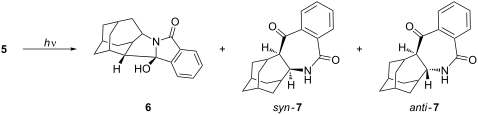
- (Scheme 1) [51]. The mechanism of the photoinduced domino reaction was investigated and it was found that it probably takes place from a higher excited triplet state or the singlet state [52]. Herein, we report the synthesis and photochemistry of a phthalimide derivative of homoadamantane 5. The research
- unreacted 5 was recovered. This finding is in accordance with acetone acting as a triplet sensitizer and the anticipated triplet state reactivity of the phthalimide in the H-abstraction reactions. Furthermore, the addition of H2O as a protic solvent also increased the reactivity of the phthalimide, based on
- notation of atoms see the Experimental), which precluded unambiguous assignment of the stereochemistry to the isomers 7. According to the above product study, a mechanism for the photochemical transformation of 5 can be proposed. On excitation (direct or sensitized) the triplet state of 5 is populated and


Synthesis of bis(3-{[2-(allyloxy)ethoxy]methyl}-2,4,6-trimethylbenzoyl)(phenyl)phosphine oxide – a tailor-made photoinitiator for dental adhesives
Beilstein J. Org. Chem. 2010, 6, No. 26, doi:10.3762/bjoc.6.26
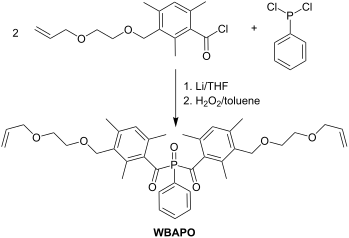
- between ~360 and 400 nm can be generally assigned to symmetry forbidden n-π* transitions, which are responsible for α-cleavage and formation of free radicals [17]. After excitation with light in the near UV–vis, the excited triplet state undergoes cleavage of the carbon-phosphorus bond, thereby producing


Reversible intramolecular photocycloaddition of a bis(9-anthrylbutadienyl)paracyclophane – an inverse photochromic system. (Photoactive cyclophanes 5)
Beilstein J. Org. Chem. 2009, 5, No. 20, doi:10.3762/bjoc.5.20
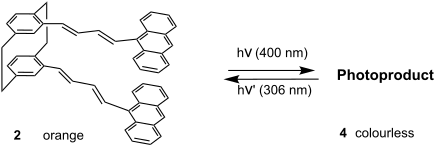
- observed to occur under geometrical constraints [11][12][24] through a triplet state process [25]. [4+2]-Cycloadditions can take place in a hot ground state [26]. This result is reminiscent of the [4+2]-photocycloaddition between two naphthalene substrates for the anti-[2.2](1,4)-naphthalenophane leading


Other Beilstein-Institut Open Science Activities



