


Search results
Search for "cellulose" in Full Text gives 105 result(s) in Beilstein Journal of Organic Chemistry.
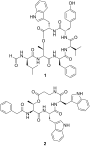
Synthesis of szentiamide, a depsipeptide from entomopathogenic Xenorhabdus szentirmaii with activity against Plasmodium falciparum
Beilstein J. Org. Chem. 2012, 8, 528–533, doi:10.3762/bjoc.8.60
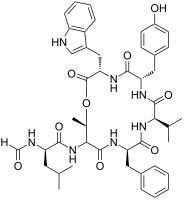
- an inoculum (turbidity equivalent to the optical density of 0.5 measured at 600 nm) of the different strains. Cellulose disks (100% cotton linter; Carl Roth, Karlsruhe, Germany) were loaded with 100 µg of the peptide. The dried disks were applied to the prepared agar plates and incubated for 24 h



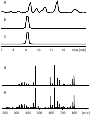
Conserved and species-specific oxylipin pathways in the wound-activated chemical defense of the noninvasive red alga Gracilaria chilensis and the invasive Gracilaria vermiculophylla
Beilstein J. Org. Chem. 2012, 8, 283–289, doi:10.3762/bjoc.8.30
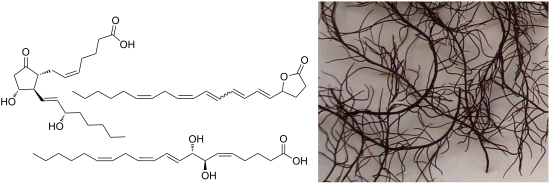
- mechanically simulated by grinding of algae (10 g) in a mortar and subsequent incubation for 5 min at rt before extraction with MeOH (2 mL). After filtration through cellulose, the extracts were mixed in a glass Petri dish with hot (60 °C) seawater (10 mL) containing 1.5% agar (Sigma Aldrich, Deisenhofen


Air-stable, recyclable, and time-efficient diphenylphosphinite cellulose-supported palladium nanoparticles as a catalyst for Suzuki–Miyaura reactions
Beilstein J. Org. Chem. 2011, 7, 378–385, doi:10.3762/bjoc.7.48

- Qingwei Du Yiqun Li Department of Chemistry, Jinan University, 510632 Guangzhou, China 10.3762/bjoc.7.48 Abstract A diphenylphosphinite cellulose palladium complex (Cell–OPPh2–Pd0) was found to be a highly efficient heterogeneous catalyst for the Suzuki–Miyaura reaction. The products were
- obtained in good to excellent yield under mild reaction conditions. Moreover, the catalyst could be easily recovered by simple filtration and reused for at least 6 cycles without losing its activity. Keywords: diphenylphosphinite cellulose; heterogeneous catalysis; nanopalladium; polymer-supported
- ligands [23][24][25] or palladium(0) nanoparticles on various solid supports [26][27][28][29][30][31] (polystyrene [26], silica [27], cellulose [28], corn starch [29], polymethyl methacrylate [30] and others [31]). In addition, cellulose as efficient support for Pd nanoparticles in other cross-coupling


Functionalized copolyimide membranes for the separation of gaseous and liquid mixtures
Beilstein J. Org. Chem. 2010, 6, 789–800, doi:10.3762/bjoc.6.86
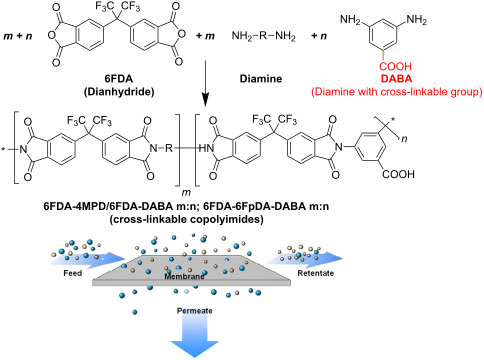
- separations are currently not possible because suitable membrane materials are not commercially available. It has been found that polymeric membranes, e.g., silicone rubber, polysulfone, cellulose acetate, PDMS, 1,2-polybutadiene and polyethylene are not suitable for this kind of separation because the
- . For economic reasons more and more membrane based processes in natural gas treatments are operated with polyimides as the membrane material instead of cellulose derivatives, since the intrinsic transport properties for the polyimides are much better. However, strong plasticization effects occur with
- between the single components in the feed mixture as previously discussed. However, the modified polymer structure shows good selectivity for CO2 over methane between 30 and 40, which indeed is attractive for commercial applications because it is much higher than the separation factors of the cellulose


Functionalized polymers: synthesis and properties
Beilstein J. Org. Chem. 2010, 6, No. 55, doi:10.3762/bjoc.6.55
- , naturally occurring polymers as cellulose or polyisoprene were simply modified, for example by esterification or cross-linking to obtain the desired properties. Hermann Staudinger, for instance, chemically modified starch to prove the existence of high molecular weight substances. Nowadays, the development
Other Beilstein-Institut Open Science Activities



