


Search results
Search for "cross-metathesis" in Full Text gives 108 result(s) in Beilstein Journal of Organic Chemistry.
Light-induced olefin metathesis
Beilstein J. Org. Chem. 2010, 6, 1106–1119, doi:10.3762/bjoc.6.127

- present developments in the use of light to expedite olefin ring-closing, ring-opening polymerisation and cross-metathesis reactions. Keywords: catalysis; light activation; olefin metathesis; photoactivation; photoinitiation; photoisomerisation; RCM; ROMP; ruthenium; tungsten; Introduction The metal


Gelation or molecular recognition; is the bis-(α,β-dihydroxy ester)s motif an omnigelator?
Beilstein J. Org. Chem. 2010, 6, 1079–1088, doi:10.3762/bjoc.6.123
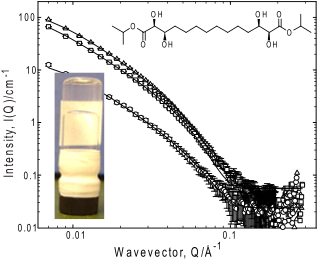
- thermal history of the sample, but not the gelation mechanism. Experimental Materials All solvents were of spectroscopic grade and used as received. Synthesis of gelators The omnigelator 4 was prepared as previously described [52] by sequential Grubbs double cross metathesis [53] between (Z)-cyclodecene
- using d7-isopropyl acrylate (5) in the initial cross metathesis step. The deuterated ester 5 was prepared from acryloyl chloride and d7-isopropanol (Et3N, CH2Cl2, 0→20 °C, 2 h); yields were essentially identical to the nondeuterated example, given that the deuterated acrylate 5 was carefully purified




Synthesis of fluorinated δ-lactams via cycloisomerization of gem-difluoropropargyl amides
Beilstein J. Org. Chem. 2010, 6, No. 48, doi:10.3762/bjoc.6.48
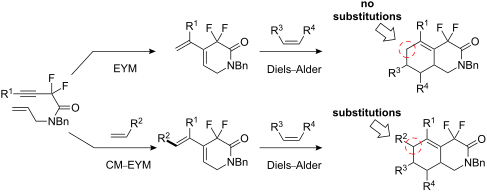
- reaction of fluorinated 1,7-enynes does not permit substitution at the 6-position of the resultant gem-difluoroisoquinolinone (eq 1, Scheme 2), we examined a potential cross metathesis–enyne metathesis tandem-type reaction (CM–EYM reaction). In theory, if the terminal vinyl group of diene 2 can be modified


Three step synthesis of single diastereoisomers of the vicinal trifluoro motif
Beilstein J. Org. Chem. 2009, 5, No. 61, doi:10.3762/bjoc.5.61
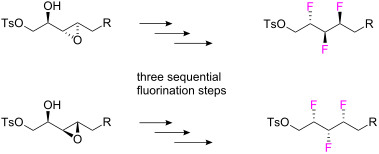
- following the procedure of Marinelli [14]. The tosyl ester 3 was then submitted to two cross-metathesis reactions using the Grubbs II catalyst and with an excess of either hexene or allyl benzene (5 equiv) to form allylic alcohols (S)-4 and (S)-5 respectively [15]. The excess of alkene favours the cross
- metathesis reaction and the products were obtained in good yields predominantly as the (E)-isomer. It was not possible to separate the minor (Z)-isomer at this stage, however isomer separation was more readily achieved after the subsequent epoxidation step. Thus (S)-4 and (S)-5 were subjected to epoxidation


Recent progress on the total synthesis of acetogenins from Annonaceae
Beilstein J. Org. Chem. 2008, 4, No. 48, doi:10.3762/bjoc.4.48
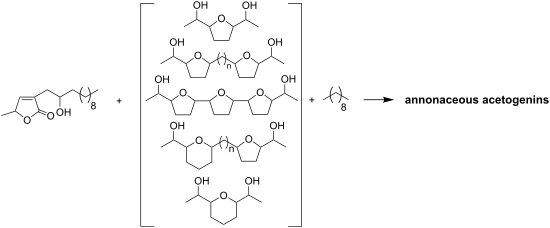
- -metathesis played a key role (Scheme 39) [99]. The bis-THF core unit 289 was constructed through a bidirectional outside-in hydroxy mesylate cascade cyclization route from 288. The bisbutenolide analogue 292 was prepared from diene 290 and the butenolide segment 291 through Grubbs cross-metathesis. Reaction
- allylsilane 285 mediated by SnCl4 afforded the bis-THF 286. Finally, the butenolide ring was installed using a procedure developed by Marshall’s group [96] to provide synthetic (+)-asimicin. In 2006, Marshall’s group reported the total synthesis of asimicin by a highly convergent route in which Grubbs cross


Total synthesis of the indolizidine alkaloid tashiromine
Beilstein J. Org. Chem. 2008, 4, No. 8, doi:10.1186/1860-5397-4-8
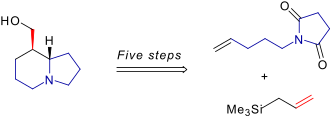
- centres on the stereoselective construction of the indolizidine core by capture of an electrophilic acyliminium species by a pendant allylsilane. The key cyclisation precursor is constructed using olefin cross-metathesis chemistry, which has the potential to facilitate both racemic and asymmetric
- approaches, depending upon the choice of the allylsilane metathesis partner. Results The use of the allyltrimethylsilane cross-metathesis approach enables the rapid construction of the key cyclisation precursor 3 (3 steps from commercial materials), which undergoes acid-induced cyclisation to give the
- and their cross-metathesis reactions studied as part of a putative asymmetric approach to tashiromine. In the event, α-hydroxysilane 12 underwent isomerisation under the reaction conditions to acylsilane 17, while silanes 14 and 15 were unreactive towards metathesis. Conclusion A concise


Combining two-directional synthesis and tandem reactions, part 11: second generation syntheses of (±)-hippodamine and (±)-epi-hippodamine
Beilstein J. Org. Chem. 2008, 4, No. 4, doi:10.1186/1860-5397-4-4
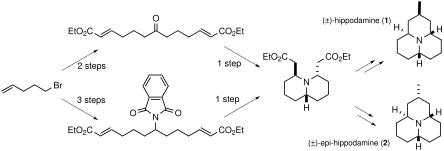
- -hippodamine are presented which are able to shorten the syntheses by up to two steps. Conclusions Key advances include a two-directional homologation by cross metathesis and a new tandem reductive amination / double intramolecular Michael addition which generates 6 new bonds, 2 stereogenic centres and two
- symmetrical dialkene similar to 4 using cross-metathesis with acrylonitrile was possible using the Hoveyda modification of Grubbs second generation catalyst [12] (Scheme 2). Thus, it seemed a logical extension of this thinking to see if we could carry out a direct double homologation of dialkene 4 with ethyl
- acrylate as the cross-metathesis coupling partner. In fact, due to the non-co-ordinating nature of ethyl acrylate (in comparison to acrylonitrile) and the inert phthalimide group, this reaction proved to be an outstanding success, delivering diester 6 in 88% yield over one step after a five day reaction in


Desymmetrization of 7-azabicycloalkenes by tandem olefin metathesis for the preparation of natural product scaffolds
Beilstein J. Org. Chem. 2007, 3, No. 48, doi:10.1186/1860-5397-3-48
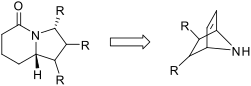
- , if the generated exocyclic double bond in the RORCM product is susceptible to olefin cross metathesis with the small amount of styrene that is derived from the precatalyst 1. These types of products are favored, if additional olefins are added as CM partners. With addition of 3 equivalents styrene
- and 12. A sequence of ring opening and cross metathesis is extremely efficient for desymmetrization of 7 and 12 as depicted in Scheme 4 for the synthesis of isoindole 19 and the disubstituted pyrrolidine 20. In these cases, catalyst loadings can be low and yields are excellent. Unfortunately the ROCM
- of 7-azabicycloalkenes appeared to be quite sensitive with respect to the olefin cross metathesis partner [67] and we have not been able to transfer this reaction to α-substituted olefins like 21 yet. A more successful attempt to introduce selectivity, was the enantioselective catalytic


Other Beilstein-Institut Open Science Activities



