


Search results
Search for "Mitsunobu" in Full Text gives 130 result(s) in Beilstein Journal of Organic Chemistry.
Pd-catalysed [3 + 3] annelations in the stereoselective synthesis of indolizidines
Beilstein J. Org. Chem. 2007, 3, No. 8, doi:10.1186/1860-5397-3-8
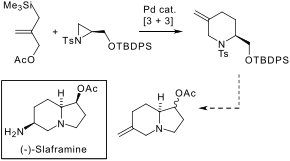
- smoothly transformed to aziridine 7 after Mitsunobu condensation. Having arrived at the key [3+3] annelation step, we decided to employ our standard conditions for the Pd-catalysed reaction. Indeed, we were pleased to find that the desired piperidine 8 could be furnished in high yield and that this


Reaction of benzoxasilocines with aromatic aldehydes: Synthesis of homopterocarpans
Beilstein J. Org. Chem. 2007, 3, No. 5, doi:10.1186/1860-5397-3-5
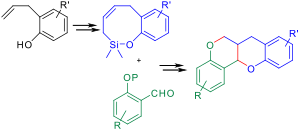
- with LiAlH4. Under these conditions the pivaloyl protecting group was removed, affording the dihydroxylated derivative 8. Application of the Mitsunobu conditions (DIAD, PPh3) to 9 promoted the cyclization to give the homopterocarpan 8. Therefore, following this five steps route, we have accessed the


Synthesis of coumarin or ferrocene labeled nucleosides via Staudinger ligation
Beilstein J. Org. Chem. 2006, 2, No. 23, doi:10.1186/1860-5397-2-23
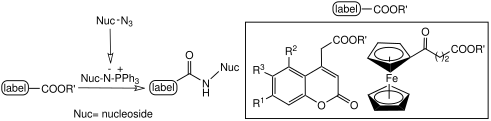
- synthesised from 5'-tosylated intermediates, [36] whilst 3'-azido-3'-deoxythymidine 6 was prepared via a Mitsunobu type reaction. [37] Staudinger reaction of azidonucleosides 3–6 with triphenylphosphine led to iminophosphorane intermediates 7–10, which reacted subsequently with active esters of coumarin-4


ADDP and PS-PPh3: an efficient Mitsunobu protocol for the preparation of pyridine ether PPAR agonists
Beilstein J. Org. Chem. 2006, 2, No. 21, doi:10.1186/1860-5397-2-21
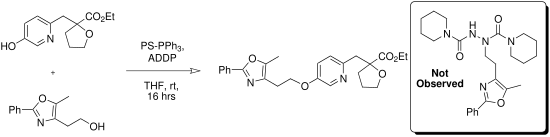
- Paul S. Humphries Quyen-Quyen T. Do David M. Wilhite Pfizer Global R&D, Department of Medicinal Chemistry, 10614 Science Center Drive, San Diego, CA 92121, USA 10.1186/1860-5397-2-21 Abstract A series of pyridine ether PPAR agonists were synthesized through an ADDP and PS-PPh3 modified Mitsunobu
- (Figure 1). Aromatic ethers are structural motifs found in many naturally occurring molecules and compounds of medicinal interest.[13] We envisaged the pyridyl ether moiety of 1 to be efficiently formed via Mitsunobu coupling of the requisite pyridinol and alkyl alcohols.[14][15][16][17] Our first attempt
- at the Mitsunobu reaction between pyridinol 2 and alcohol 3, utilizing a modification of the conditions originally reported by Mitsunobu,[18] afforded pyridyl ether 4 in 54% yield (Scheme 1). Interestingly, the reaction did not reach completion and pyridinol 2 was recovered, despite the fact that it


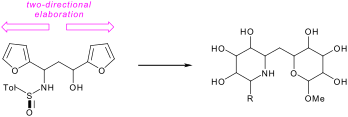
Methods for the synthesis of polyhydroxylated piperidines by diastereoselective dihydroxylation: Exploitation in the two-directional synthesis of aza-C-linked disaccharide derivatives
Beilstein J. Org. Chem. 2005, 1, No. 2, doi:10.1186/1860-5397-1-2
- and 18 were epimerised by Mitsunobu[43][44] inversion to yield the anti allylic alcohols 16 and 19. Diastereoselective dihydroxylation of a model system The diastereoselectivity of the dihydroxylation of the model compounds 15 and 17-19 was studied under both Upjohn[45] (cat. OsO4, NMO, acetone-water
- ] although the reducing agent still approaches the ketone from a pseudo-axial direction, the net stereochemical outcome is different (see Figure 6). The configuration of both alcohols in the bis-allylic alcohols trans-27 and cis-27 was cleanly inverted using a Mitsunobu reaction, and the resulting diesters





Other Beilstein-Institut Open Science Activities



