


Search results
Search for "UV irradiation" in Full Text gives 138 result(s) in Beilstein Journal of Organic Chemistry.
Enaminones in a multicomponent synthesis of 4-aryldihydropyridines for potential applications in photoinduced intramolecular electron-transfer systems
Beilstein J. Org. Chem. 2012, 8, 441–447, doi:10.3762/bjoc.8.50

- to the border of the visible region. In the presence of an appropriate electron-acceptor substituent in position 4, the absorbed UV irradiation can cause intramolecular electron transfer, thus converting light into charge separation over a distance of ca. 6 Å. This expectation is based on the recent




Natural product biosyntheses in cyanobacteria: A treasure trove of unique enzymes
Beilstein J. Org. Chem. 2011, 7, 1622–1635, doi:10.3762/bjoc.7.191
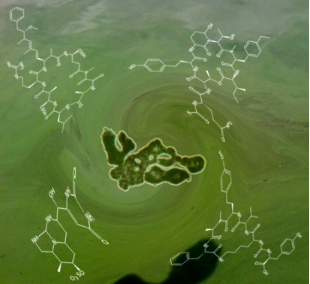
- /protection, and UV-absorption compounds. Cyanobacteria produce two types of sunscreen compounds, induced under UV irradiation: Scytonemin (19) and mycosporine-like amino acids 20 (Figure 11). Biosynthesis of the two groups of compounds has recently been elucidated, providing further examples for the


Fine-tuning alkyne cycloadditions: Insights into photochemistry responsible for the double-strand DNA cleavage via structural perturbations in diaryl alkyne conjugates
Beilstein J. Org. Chem. 2011, 7, 813–823, doi:10.3762/bjoc.7.93
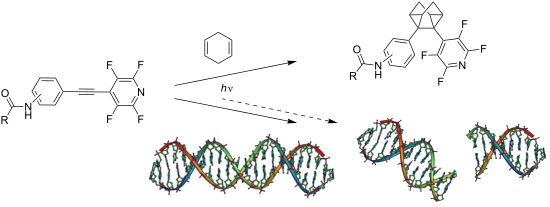
- 4 provided the homoquadricyclane product 12 in 42% yield after 2 h of UV irradiation in the presence of 100 equiv of 1,4-CHD. Under the same conditions, the p-substituted acetylene 3 reacts with 1,4-CHD sluggishly and gave <5% of product after 8.5 h of UV irradiation according to the 1H NMR spectrum
- 3. However, when the reaction was repeated in neat 1,4-CHD, the corresponding homoquadricyclane product 11 was isolated in 95% yield after only 1 h of UV irradiation. This result indicates that the photoaddition reaction of 3 can occur efficiently under more favorable conditions when there is a
- of <1 μM. On the other hand, conjugate 1 displayed strong phototoxicity toward the human melanoma A375 cell line in the nanomolar range (CC50 = 1.49 × 10⁻⁷ M) after 10 min of UV irradiation at 360 nm. Conjugates 6 and 7 also showed some phototoxicity. This result of cell proliferation inhibition by



Novel carbazole–pyridine copolymers by an economical method: synthesis, spectroscopic and thermochemical studies
Beilstein J. Org. Chem. 2011, 7, 638–647, doi:10.3762/bjoc.7.75
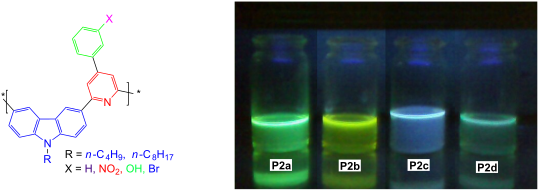
- . DSC graph for polymer P1a. UV–vis spectra of the polymers of (a) series P1 and (b) series P2. Photoluminescence spectra of polymers P1and P2 in CHCl3 solution. (a) Polymers of P2 series in visible light; (b) observed fluorescence (CHCl3 dilute solutions) under UV irradiation (254 nm). Synthesis of the




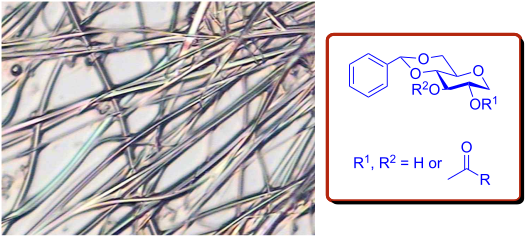
Synthesis and self-assembly of 1-deoxyglucose derivatives as low molecular weight organogelators
Beilstein J. Org. Chem. 2011, 7, 234–242, doi:10.3762/bjoc.7.31
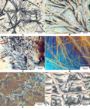
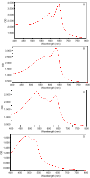
- was observed in (c). The UV–vis absorption spectra of the polymerized gel formed by compound 18A in ethanol (10 mg/mL): A, at room temperature after 3 min UV irradiation (λmax = 650 nm); B, at 50 °C ( λmax = 634 nm); C, at 60 °C incubation for 90 min (λmax = 534 nm, other peaks are 582, 636 nm); D




Exceptionally small supramolecular hydrogelators based on aromatic–aromatic interactions
Beilstein J. Org. Chem. 2011, 7, 167–172, doi:10.3762/bjoc.7.23
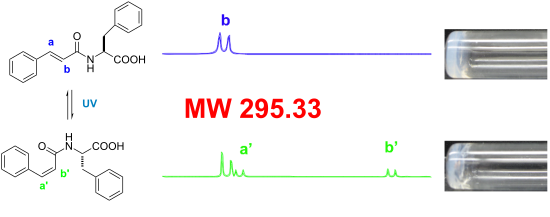
- properties. Notably, compound 6 can undergo cis/trans-isomerization upon UV irradiation. Keywords: aromatic–aromatic interaction; cinnamoyl; hydrogel; hydrogelator; supramolecular; Introduction Gels formed by three-dimensional, elastic networks to encapsulate a liquid [1], have many useful properties (e.g
- reason for phase separation, compound 6 was placed in a UV reactor for the same duration. As revealed by the 1H NMR (Figure 1F), a new set of peaks at 5.9 ppm and 6.6 ppm appears after UV irradiation, indicating that cis-6 forms upon the photo-excitation [36]. Since there was no new peak in the range of
- -isomer during UV irradiation. Thus, we infer that the formation of two layers in the gel IV after UV irradiation originates from geometric (cis/trans-) isomerism. Compound 6 also exhibits another interesting phenomenon. On acidification by 1N HCl solution, the solution of 6 (Figure 2A, 2.0 wt %) first




Miniemulsion polymerization as a versatile tool for the synthesis of functionalized polymers
Beilstein J. Org. Chem. 2010, 6, 1132–1148, doi:10.3762/bjoc.6.130
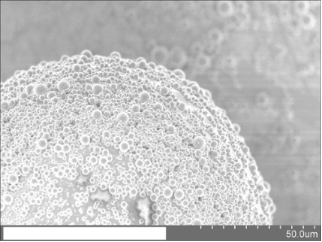
- that could be cleaved by UV-irradiation, temperature, or by pH change [122]. In order to study the release of encapsulated sulforhodamine dye from the capsules, polyurethane with and without cleavable functionalities were synthesized. Fluorescence spectroscopy of the supernatant obtained by the
- centrifugation of both polymer capsules submitted to different stimuli was recorded and the release of the dye was found to occur on different time-scales in the case of the cleavable shells, i.e., minutes for UV-irradiation, hours for a temperature increase, and days for a pH change. Polycondensation In aqueous





Light-induced olefin metathesis
Beilstein J. Org. Chem. 2010, 6, 1106–1119, doi:10.3762/bjoc.6.127

- trioxide (MoO3/SiO2) could be activated by UV irradiation under an alkane atmosphere in the metathesis of propene and 1-hexene. More recently, Sundararajan et al. [52][53][54], and Higashimura et al. [55] applied W(CO)6/CX4/hν methodologies for the polymerisation of alkyne derivatives, especially
- , the nitrile complexes displayed low activity even at room temperature. UV irradiation at 364 nm significantly enhanced the activity of all these complexes. The activity of the compounds, including comparisons with thermally active catalysts, are summarised in Table 1. Overall, the polymers obtained
- UV irradiation. The ruthenium complexes 12 showed much higher reactivity in the polymerisation of norbornene, albeit none of these complexes was completely thermally latent for this reaction. The remarkable tolerance of 12b to impurities and water, was highlighted by the fact that polymerisation can


Conjugated polymers containing diketopyrrolopyrrole units in the main chain
Beilstein J. Org. Chem. 2010, 6, 830–845, doi:10.3762/bjoc.6.92
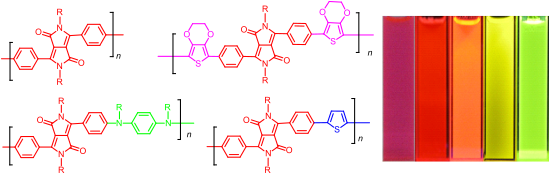
- 488 nm, the ε-value being a linear function of the DPP content. Upon UV irradiation the copolymers gradually decomposed. The rate of photodecomposition was found to increase with decreasing DPP phenylene comonomer ratio. Two different photoprocesses were recognized: a slow process originating from the


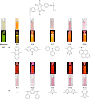
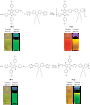


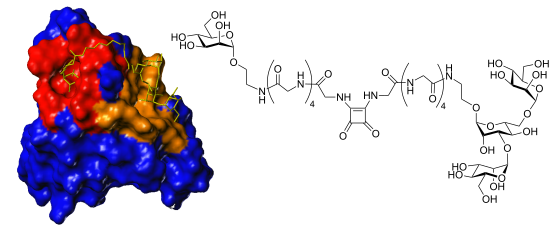
A bivalent glycopeptide to target two putative carbohydrate binding sites on FimH
Beilstein J. Org. Chem. 2010, 6, 801–809, doi:10.3762/bjoc.6.90
- reactions were carried out under an atmosphere of nitrogen or argon. Thin layer chromatography was performed on silica gel plates (GF 254, Merck). Detection was effected by UV irradiation and subsequent charring with 10% sulfuric acid in EtOH followed by heat treatment. Flash chromatography was performed on



Aromatic and heterocyclic perfluoroalkyl sulfides. Methods of preparation
Beilstein J. Org. Chem. 2010, 6, 880–921, doi:10.3762/bjoc.6.88
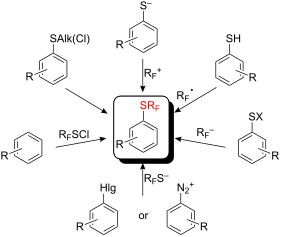
- -phenols, and diaryl disulfides with perfluoroalkyl iodides in liquid ammonia under UV irradiation Kornblum’s work on nucleophilic substitution in alkyl halides [134][135][136][137] and Bunnett’s reactions with non-activated aromatic substrates [138][139][140][141][142] (under UV irradiation) introduced
- polarity, and in spite of their tendency to undergo homolytic decomposition under UV irradiation, it is probable that they are also able to react with thiolate anions by a similar mechanism. Indeed, they react readily with aliphatic, aromatic and heterocyclic thiols [143][144][145][146], and with seleno
- - [147] and tellurophenols [148] under UV irradiation with formation of corresponding perfluoroalkyl sulfides, -selenides and -tellurides. The original method required liquid ammonia as the solvent and Pyrex glassware. Thiophenol and its derivatives containing both, electron-donating and electron


Anthracene functionalized terpyridines – synthesis and properties
Beilstein J. Org. Chem. 2010, 6, No. 54, doi:10.3762/bjoc.6.54
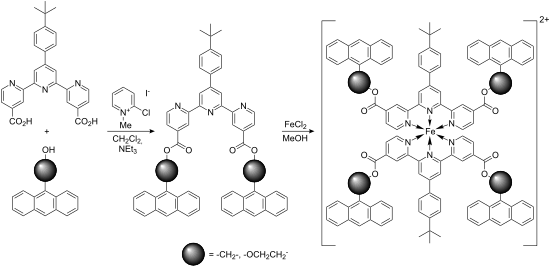
- ]-cycloaddition reaction. A degassed 5·10−5 × M solution of 5a in methylene chloride was irradiated with UV light (λ = 350 nm, Figure 1). The absorption spectrum of 5a (solid line) shows the expected absorption pattern for a compound containing anthryl residues. Upon UV irradiation the absorption decreases which
- establishing the identity of the photoproducts from 5a and 5b after UV irradiation. 1H NMR-spectra of the irradiation products (after evaporation of solvent) indicate that there is more than one reaction pathway, the number and overlapping of peaks (especially in the aromatic region) made assignments


A perfluorocyclopentene based diarylethene bearing two terpyridine moieties – synthesis, photochemical properties and influence of transition metal ions
Beilstein J. Org. Chem. 2010, 6, No. 53, doi:10.3762/bjoc.6.53
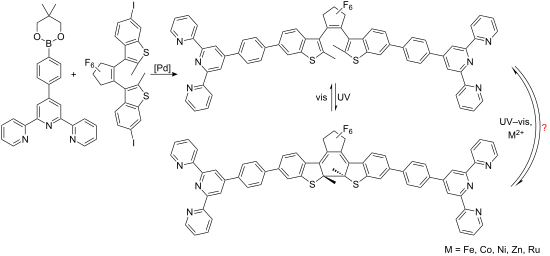
- ), we synthesized the binuclear complex 12, from ruthenium(III) chloride hydrate via the monoterpyridine complex 11 (Scheme 5). The UV–vis-spectra of the binuclear complex 12 in acetonitrile solution are shown in Figure 2 – before (solid), after UV-irradiation (dashed) and after irradiation with vis
- light (dotted). The absorption of the strong MLCT band at λ = 490 nm decreases upon UV-irradiation, while absorption in the visible region of the spectrum increases. This may be regarded as indication that the photochromic reaction of the ligand not only takes place in presence of ruthenium, but also
- absorption decreases upon UV-irradiation, no significant change of the absorption in the visible region occurred. This indicates inhibition of the photochromic reaction of the diarylethene by the MLCT transition, as previously reported for other iron(II) complexes of bisterpyridine thienylethenes [10]. In





